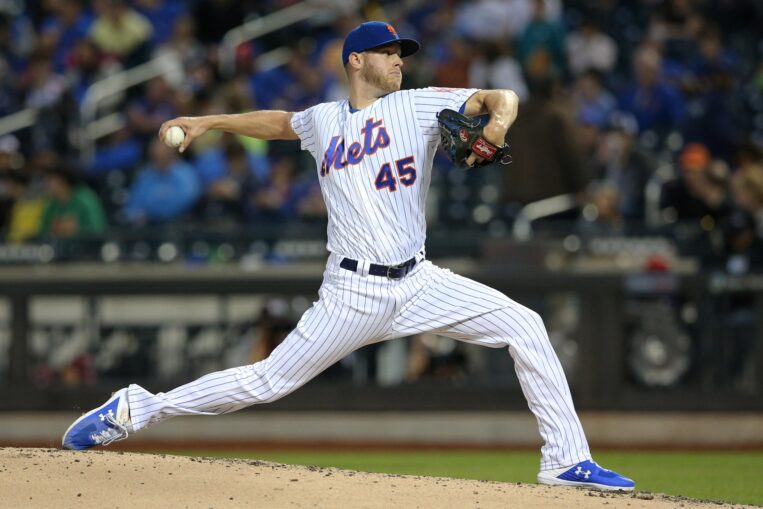
Zack Wheeler‘s resurgence in 2018 was remarkable. The New York Mets, as well as their rabid fan base, cautiously proceeded into the 2019 season with optimism that the 29-year-old right-hander could continue to develop as such.
After battling injuries, setbacks, and then more injuries — Wheeler missed all of the 2015 and 2016 seasons and part of 2017 before returning to the majors — the Smyrna, Georgia native shook off the rust and performed beautifully in 2018.
Over 29 starts (182.1 innings) last year, Wheeler pitched to a 3.31 earned-run average, 3.25 FIP, with 1.12 WHIP, 8.84 strikeouts and 2.71 walks per nine innings, respectively, 0.69 home runs allowed per nine innings, and 4.2 wins above replacement (FanGraphs).
In the second half of the season, Zack Wheeler was arguably the best pitcher in baseball — even rivaling eventual NL Cy Young Award winner and Mets rotation-mate, Jacob deGrom.
Over 11 starts (75 innings), the right-hander led qualified MLB starters with his 1.68 ERA, his 0.36 home runs per nine innings ranked second behind deGrom’s 0.29 mark in the second half, and his 21.1% hard-hit rate ranked second over that span, as well, trailing only Noah Syndergaard‘s 20.8% mark. To top it all off, Wheeler’s 24.8% full-season hard-hit rate was best in baseball.
For anyone with a rooting interest in Wheeler’s success since the Mets acquired the former first-round draft pick (2009; sixth overall) in the trade that sent Carlos Beltran to San Francisco in July 2011, his long-awaited blossoming last season was a terrific turn of events.
Those flashes of brilliance we saw from him over his first few seasons in the big leagues, followed by his bouts with injuries and the subsequent comeback attempts, were finally paying dividends.
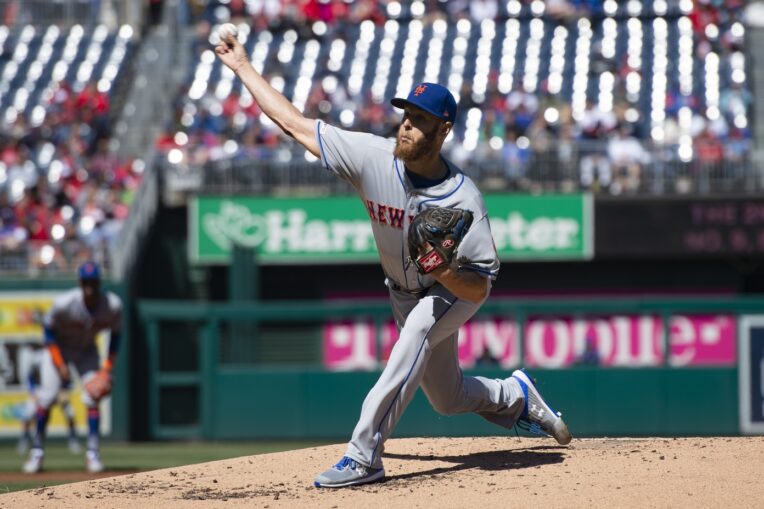
With his health and momentum on his side, Zack Wheeler entered the 2019 season with high hopes for himself — naturally.
After allowing 16 earned runs on 21 hits with 22 strikeouts and 14 walks over his first four starts (6.35 ERA; 22.2 innings), Wheeler’s kicked himself into gear, pitching to a 2.67 ERA over his last four outings (27 innings) with 36 strikeouts and five walks.
Denizens of Mets fans were ready to anoint Zack Wheeler next in the long line of Flushing mirages — bottle-rocket guys — to make their way through the organization over the years, and then, voila, the guy we saw last year miraculously reappeared. And right on time, too.
Coincidence or not, right around the time Wheeler straightened himself out, the Mets’ rotation as a group seemed to do the same. Over the last two weeks (heading into Wednesday’s games), the Metsies’ starters own a 2.64 ERA — third-best in baseball over that span.
And though his current 4.35 ERA doesn’t exactly scream ELITE, Zack Wheeler’s 2.70 FIP is good for fourth-best in baseball among qualified starters, his 27% hard-hit rate is fourth-least, his 0.54 home runs allowed per nine is ninth-least, and his 10.51 strikeouts per nine is tenth-highest in MLB.
That’s four top-ten marks in four extremely valuable statistical categories. And despite his unsavory, 111th-ranked ERA, Wheeler’s 1.6 wins above replacement ranks sixth in the majors among qualified starting pitchers.
Dodgers left-hander Hyun-Jin Ryu who, over his first eight starts of the 2019 season (52.1 innings), owns a 1.72 ERA with 9.29 strikeouts and a jaw-droppingly good 0.52 walks per nine innings, respectively, currently sits just behind Wheeler with 1.5 fWAR.

Clearly, Zack Wheeler’s doing a bunch of things right these days. That’s a win for this ballclub at the moment. With free agency looming for the 29-year-old after the season, one would imagine both player and organization will have a lot to digest as the year progresses.
If Wheeler continues to thrust himself into the upper-echelon of MLB pitching, Mets general manager Brodie Van Wagenen and his hand-picked front office will have to come to a general consensus as to whether they want to (recommend that the Wilpons) invest in him long-term.
There’s no arguing that he’s found a groove since making his way back to the majors, and his peripherals since returning support the hypothesis that Zack Wheeler’s success is for real and sustainable.
Whether this organization, who just rewarded Jacob deGrom with a five-year, $137.5 million extension — with similar situations (and, hopefully, outcomes) looming for Noah Syndergaard and Michael Conforto — sees fit to keep Wheeler in Queens for the foreseeable future is anyone’s guess at this point.
Having deGrom, Syndergaard, and Wheeler atop the Mets’ rotation through their respective primes is quite an enticing prospect, that’s for sure. For now, let’s just hope that Zack Wheeler can stay on this straight and narrow path as the season pushes on.