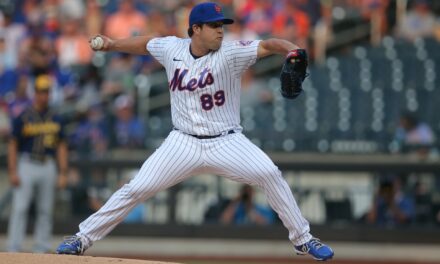
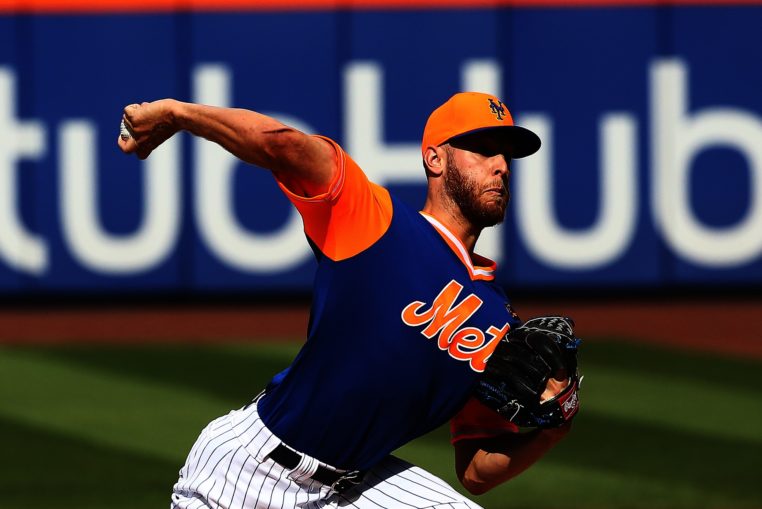
Zack Wheeler built off a remarkable comeback season with seven shutout innings as the Mets trounced the Washington Nationals by a final of 3-0 yesterday. He allowed six hits and three walks, lowering his ERA to 3.46. He hasn’t lost a game this season since June 22 – when his ERA stood at 4.85. There were definitely a few points, however, where Wheeler’shot streak hung suspended in the air.
Wheeler threw 109 pitches, though only 64 for strikes (58% – his lowest figure since June 12), with some innings coming particularly harder for him than others. The third inning, for example, required 23 pitches – only 10 of which came in as strikes. Through the third, just four of the 14 hitters Wheeler faced were given first-pitch strikes. The fastball dragged him behind hitters on numerous occasions, but Wheeler also had some difficulties spotting his splitters and sliders here and there.
Relative to his most recent start – a seven-inning, one-run, one-walk, 10-strikeout no-decision against the San Francisco Giants – Wheeler just didn’t seem to have it through the greater portion of yesterday’s start. If watching Jacob deGrom over the past three years has made any sort of a lasting impression, however, it’s that there’s a lot to enjoy in pitchers who stay competitive no matter how out-of-tune they may seem on the mound.
Wheeler’s first inning got dicey early after Adam Eaton led off with a drag bunt base hit and advanced on a sacrifice from Trea Turner two pitches later. With two outs and a 1-2 count on Anthony Rendon, Wheeler threaded a perfect 97 mph fastball along the inside part of the plate, but Rendon tapped it in between the mound and third base to sneak in with an infield hit. Having to pick the pieces back up, Wheeler worked ahead of Juan Soto and fanned him with a beautiful splitter, and followed up with a three-up, three-down, eight-pitch second. With a strikeout of Matt Wieters in the second, Wheeler picked up his 500th career punchout.
Even as the order turned and put a crimp in Wheeler’s stride, it’s hard to overlook the fact that he actually rose to the occasion and adapted. After walking Eaton on four pitches and allowing a single from Turner to put two quick men on the corners, Wheeler fell behind Bryce Harper 2-0 and then 3-1 before walking him on a weak curveball in with the count full. As the righty missed with a slider to fall behind Rendon 2-1, it started to become apparent that he was in a jam. Nonetheless, Wheeler painted the outside corner with another slider to even the count before inducing a weak lineout to shortstop and keep everyone at bay. One pitch to Soto later, the Mets were out of the inning, as Wheeler squeaked out a weak, unassisted forceout up the middle.
“I didn’t have my best stuff. Maybe in years past, it wouldn’t have gone so well,” Wheeler admitted in his postgame interview. “But I [felt] so good mechanically and in sync, being able to repeat that type of stuff, I can lock back in and go right after them.”
Just as he did in the second inning following a cumbersome first, Wheeler made quick work of the side in a spotless fourth, getting two weak groundouts to first base and one pop out to left field. The fifth inning brought Eaton and Turner to the plate, thus putting two more men on. This time, Harper would come up with a real chance to do damage. But Wheeler again elevated his game, getting ahead of the former MVP 0-2 before jamming him with a fastball upstairs to force a double play and squash another rally.
Four Nationals hitters came up to bat in the sixth, and each one either got into a hitter’s count or worked their way past five pitches. Juan Soto was the only one to make anything out of his turn, as he dribbled an infield hit in front of Amed Rosario to set Washington up to score first. Wheeler again kicked things into another gear, striking out Ryan Zimmerman on a great slider before Soto was caught stealing second to end the inning.
“I think it’s just him getting more and more comfortable with the pitcher he is,” managed Mickey Callaway said. “He’s more confident than he’s ever been. He’s obviously executing pitches [better] than he ever has. I think it’s a byproduct of him doing the right things.”
Callaway’s comments echoed his decision-making in the seventh, as Wheeler, then at 91 pitches and only up by one run, took the ball out for one more go-around. His fastball hit its trough at 93 mph, and Matt Wieters made him pay by singling up the middle to lead things off. Two weak outs later, Wheeler hit Eaton with a first-pitch fastball to bring Trea Turner back into the box for a third time.
Callaway didn’t even come out to get sent back to the dugout. Wheeler, simply put, the heat back on his fastball, made crafty use of his slider, jumped ahead 1-2, and induced a weak groundout to second base. Just like that, the righty had navigated one of his most daunting starts to date, and had done so without allowing a single run.
“I hope this is who he is. I think he can be this,” Callaway added in the same interview. “But from a feeling that the team has when he’s starting that day, absolutely we feel like deGrom’s on the mound or [Noah] Syndergaard’s on the mound. He’s in that category now.”
For somebody who was left off the active roster when Spring Training ended, Zack Wheeler has been nothing short of brilliant this season. He is now 7-0 with a 1.69 ERA and 0.98 WHIP in his last eight starts, including a 1.09 ERA and 4.25 K/BB ratio in the month of August.
With his fourth start of at least seven shutout innings, Wheeler now has as many this season as Jacob deGrom himself. If the season had started in June, the Mets would undoubtedly have two frontline Cy Young candidates in their rotation. Even with the first two months in the books, however, Zack Wheeler has been an absolute pleasure to watch this year not only in his ability to make pitches and get outs, but also in his newfound competitive approach on the mound.