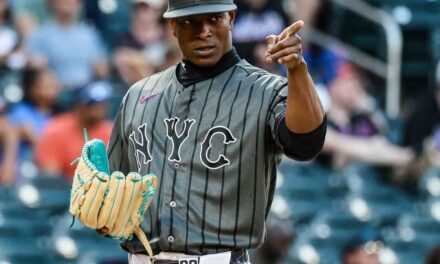

Matt Harvey is the New York Mets probable starter in the second game of their pivotal series against division rival Washington Nationals.
Over the past week, there has been much back and forth in the New York media between Matt Harvey, the Mets front office and Harvey’s agent Scott Boras regarding Harvey’s supposed innings pitched limit of 180 innings set by Dr. Andrews after Harvey’s Tommy John Surgery.
Through my experience as both a closer and starting pitcher during four years of collegiate baseball, there are three important aspects of in maintaining arm health:
- Proper rest and workout regime between outings
- Proper pitching mechanics
- Proper pitch count
Rest & Rebuild
Pitch counts are important but slightly overblown on a game to game basis. Starting pitchers should throw until their tired, usually landing in the 100 to 120 pitch range depending on the game. Once a pitcher becomes tired, there is greater probability their pitching mechanics will be weaker, translating to greater chance for injury. The main point is there should be less stress on the amount of pitches thrown per game and more attention to the time between starts.
Being a starting pitcher allows Harvey a solid four to five days rest and the ability to plan out a workout routine based on his scheduled starts. This helps keep his body in peak physical condition throughout the six month season.
The opposite situation is seen with Mets reliever Bobby Parnell, also in his first season back from Tommy John Surgery. With unpredictable usage and rest, Parnell struggles to gain a workout routine since his is almost always on call. This poor workout schedule leads to weaker bodies toward the end of the season, translating to heightened risk in poor mechanics and eventual injury or for Parnell, slower to minimal recovery from previous injury.
Additionally, its difficult harnessing command and regaining velocity due to the above coupled with less innings and pitches thrown. Throwing the baseball is the best way to regain command and arm strength.
Pitching Mechanics
Simply, Harvey’s uses his lower half well, helping alleviate stress from his arm. Harvey also exhibits good rhythm and balance throughout his motion, helping keep his arm in the correct throwing slot. This is the reason Harvey’s 98 mph fastball looks effortless.
Innings Versus Pitches Thrown
All innings are not created equal. Some take five pitches to complete. Some take forty pitches to complete.
Thus far in 2015, Jacob deGrom has 26 games started, compiling 169.0 innings and 2620 total pitches thrown. Harvey has 25 games started, compiling 166.1 innings and 2459 total pitches thrown. DeGrom has thrown 2.2 more innings than Harvey but thrown 161 more pitches than Harvey. Baltimore Orioles starter Wei-Yin Chen has thrown 2590 pitches in 165.2 innings pitched, 131 more pitches in 0.2 less innings than Harvey.
I’m not a doctor, nor do I pretend to be. I don’t have any scientific knowledge in the process of recovering from an arm injury and cannot suggest a proper pitching plan. My question is in the statistic used in measuring the pitching limit.
If Dr. Andrews suggests a hard, non-negotiable pitching limit of 180 innings, why would the inconsistent statistic of innings pitched be the statistical measure used for the limit? In 2015, statisticians and data collection programs such as PitchF/X record every pitch thrown. There is no other information available to help doctors decide a proper pitches thrown limit?
Dr. Andrews and his team of doctors need to research past pitchers PitchF/X before and after Tommy John surgery with the goal of figuring out a pitches thrown limit.
My Proposal
My advice to Dr. Andrews would be to take Harvey’s average number of pitches thrown per game, multiply it by the average number of seasonal starts at 33 and limit Harvey to a certain “safe” percentage of that average seasonal total of pitches thrown.
For example: Let’s say Dr. Andrew’s determines that Harvey in the first seasons coming back from Tommy John Surgery should only throw 90% of his total work load. Harvey is averaging 98.36 pitches per start this season, multiplied by 33 starts equal’s 3246 total projected pitches for 2015. 90% of this projected total equates to 2921.
Again, I don’t know what percentage of work load a pitcher should throw compared to his average work load. It is the job of Dr. Andrews to figure it out. But the percentage of work load should be based on total pitches thrown, not number of innings thrown.
Follow Chris Zaccherio on Twitter @ziography for more Mets insight going beyond statistics.