Here is the second of a six-part MMO Special Feature, our 2015 Mets Season Preview. I previewed the starting rotation yesterday and over the next two weeks, I’ll be previewing our Bullpen, Catching, Infield, Outfield and Bench. I hope you enjoy my research, analysis, and insights. Let’s continue with Part 2, our bullpen.
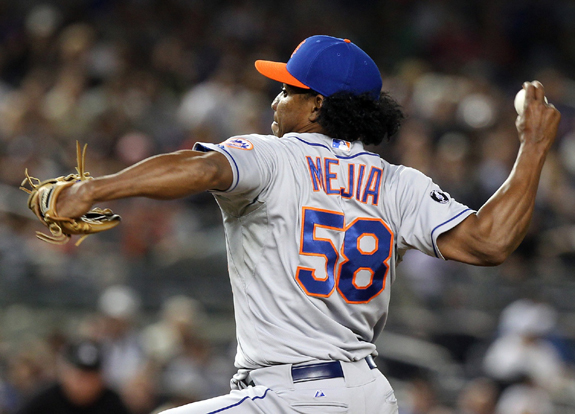
Jenrry Mejia
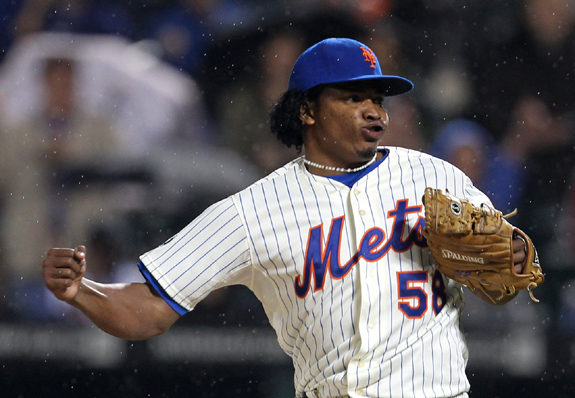 After making eleven starts at four levels in the Mets organization last year, Jenrry Mejia finally made the permanent transition to the bullpen, filling in for the injured Bobby Parnell. Mejia made seven starts at the beginning of the season before gradually converting to the closer role, where he saw major success.
The 24 year-old, in his second major stint with the big league club, earned himself the closer role that so many scouts had envisioned him filling. After converting to the bullpen, Mejia posted a 2.72 ERA in 56.1 innings, striking out 60 batters (9.56 K/9) and walking 21 (3.36 BB/9). His WHIP dropped from 1.58 to 1.42, which still isn’t great, but is much better than we saw when Mejia was with the Mets in 2010 as a 20 year-old.
If you look at Mejia now versus back in 2010 when Omar Minaya rushed him to the big leagues, he is just a completely different pitcher. In 2010, he was raw, not ready, and clearly outmatched by his big league opponents. Last year, he was, at times, just too nasty for anyone to hit. Steamer projects 22 saves and a 3.43 ERA for Mejia this season. Based on the sheer dominance he showed at times, and the growing comfort Mejia showed with the role throughout the season, he could certainly do better than that.
Jeurys Familia
 Of all the Mets pitchers who broke out last season, none was more dominant than Jeurys Familia. After allowing 13 runs in 23 innings between 2012 and 2013, Familia posted a 2.21 ERA in 77.1 innings.
While Mejia got all the attention for taking over the role as closer, Familia was significantly better, and proved he could be a solid closer in his own right. The hard-throwing righty proved himself especially useful both in the eighth inning as a setup man and as a fill-in closer when Mejia was unavailable. As tempting as it is to have a single relief ace, I like what Terry Collins did with Mejia and Familia last year, not afraid to use either one at the end of the game. Having two dominant pitchers comfortable in the closer role can be extremely helpful down the stretch or in the playoffs.
Familia stuck with his fastball and slider last year, his bread and butter. No longer does he have to keep the starting pitcher mentality that he had for years in the minor league system. And with the eighth-fastest fastball in the major leagues last year (96.2 miles per hour), he can get away with simplicity. He has seen his walk rate gradually drop throughout his minor league career and last year, it hit a reasonable (for a reliever) 3.72 BB/9. Considering how few hits he is allowing, that is more than reasonable.
With Famlia still at 25 years old and finally having some job security, I can absolutely see him having a dominant season once again, although perhaps not as dominant as much as last season. His opponents’ BABIP points towards a less successful 2015, but I don’t envision his ERA climbing far above 3.00, if it does at all.
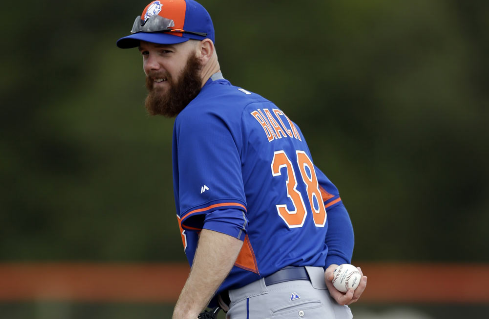
Vic Black
 Will the line of young, hard-throwing relievers ever end?
The Marlon Byrd and John Buck trade is looking better and better with each passing month as both Dilson Herrera and Vic Black establish themselves as valuable pieces. Black, of course, is further along than Herrera, having had a terrific season with the big league club last year. The righty had a 2.60 ERA in 34.2 innings with the Mets last season, and has a roster spot locked up going into this year.
Black started off last season in the minor leagues despite a decent end to the 2013 season because of major control issues he showed in spring training. As last year’s numbers showed, these issues are still present. Black finished the year with a 4.93 BB/9 rate. For the 26 year-old righty, this has to be a concern going into this year because that kind of walk rate is just not sustainable. Black’s xFIP was 4.16 last year. That’s more the direction Black’s ERA will go if he continues to walk batters at such a high rate.
Seeing as this isn’t a new problem for Black, I don’t see it suddenly getting better this year. Until he gets this fundamental issue worked out, Black likely won’t be able to replicate last year’s results.
Buddy Carlyle
 Buddy Carlyle is proof of the wonders a small sample size, limited exposure, and a low opponent BABIP can do for a pitcher.
At 36, Carlyle had by far the best season of his career, locking up a spot in the 2015 bullpen. His 1.45 ERA in 31 innings could not be touched by any other Met. Ironically, however, he is probably the relief pitcher I trust the least for the Mets this season (which can be taken as somewhat of a compliment for the bullpen I suppose). While Carlyle did pitch well in both Triple-A and the majors last season, he is also a 37 year-old career minor leaguer. With Black, Familia, and Mejia, there is a track record of being a promising prospect not too long ago. With Carlyle, there isn’t.
I also haven’t mentioned the fact that opponents had a .250 BABIP against Carlyle this season, which cannot be sustained. Frankly, he probably just had a lot of luck last season, which is certainly feasible in a small 31 inning sample. This isn’t to say he won’t be effective, only that he won’t be dominant. Steamer and ZiPS are split on him this season. Steamer has him pitching a grand total of one inning all season (which we can safely say will be wrong if Carlyle makes the team as expected) while ZiPS projects him to put up a 4.42 ERA in 55 innings. Given his track record, that is in the ballpark of what I would project.
Carlos Torres
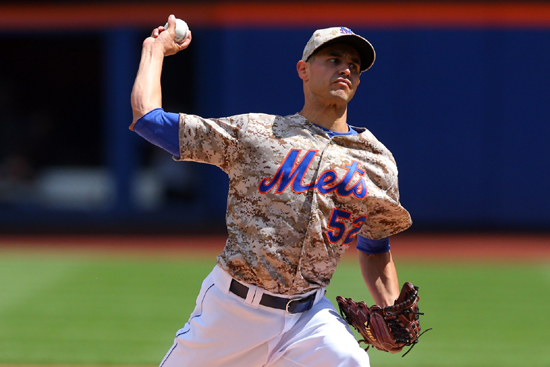 Carlos Torres has probably been the most versatile pitcher for the Mets over the last two seasons. During that time, he has made ten starts, 96 relief appearances, and tossed 183.1 innings. Oh, and he’s actually pitched well, too.
In 2013, Torres had a 3.44/4.30/3.50 ERA/FIP/xFIP line, pitching most of those innings as a starter. Last year, mostly in relief, he improved to 3.06/3.86/3.59. What is so great about having Torres in the bullpen is that he can act as both a middle reliever and a long man, and be effective at both. He could split longman duties with Rafael Montero or take on the duties himself. Either way, the Mets have a pretty dependable arm.
The projection systems have Torres hovering between league average and his 2013 numbers, which is perfectly reasonable. His xFIP suggests that his ERA will rise a bit from last year.
Rafael Montero
 Rafael Montero is a very interesting choice for the bullpen to open up the season. It seems too early to give up on a 24 year-old as a starter, especially one who has had so much success starting, but the move was obviously out of necessity. Having Noah Syndergaard and Steve Matz sitting in Triple-A likely gives the Mets some comfort moving Montero to the bullpen, although I think it is premature, even if many scouts pegged it as his eventual destination.
That being said, Montero is an interesting bullpen arm because he has shown (although not recently) the pinpoint control of a starter. In Savannah, St. Lucie, and Binghamton, he averaged under two walks per nine innings and didn’t go much higher than two in Las Vegas. He also strikes out a decent amount of hitters, and is projected to punch out between eight and nine per nine innings this season.
The computer projections are strange for Montero. ZiPS has Montero making 29 starts with a 3.61 ERA and 3.63 FIP while Steamer has him making 10 starts, 25 relief appearances, and posting a 3.63 ERA and 3.73 FIP. They are both essentially saying Montero will be a tick above MLB average. Having read the scouting reports and having seen Montero conquer just about every level of the minor leagues, not only do I see no reason for him to not be on the big league roster, but I also see Montero meeting his projections if given an opportunity.
Dario Alvarez / Sean Gilmartin
 I can definitely see why the Mets organization is looking externally for a lefty reliever. Dario Alvarez is a somewhat interesting name. He struck out 95 batters in 61.1 innings last year for Savannah and had similar success in extremely small sample sizes in St. Lucie and Binghamton, but that doesn’t really warrant a spot on a major league team. Keeping in mind his age (26), he isn’t exactly a prospect either.
As for Gilmartin, I don’t see him lasting more than a few weeks either. He didn’t pitch extremely well in Triple-A, and Rule V players rarely work out over a full season anyway. Also, he has never been a relief pitcher, let along a LOOGY. Going from a starter to a pitcher who will routinely face only one batter in a game is a big transition.
I’m not even going to project how either of these players pitch because I don’t see either making the big league roster out of camp. Over the next two weeks, Sandy Alderson will find someone to fill that role.
Make sure to follow me on Twitter @connor_obrien97. And make sure to check back later this week for more previews of the 2015 Mets season.