
Devin Williams, RP
Player Data: Age: 32 (9/21/1994) B/T: R/R
2026 Traditional Stats: 3-2, 4.43 ERA, 1.574 WHIP, 52 SO, 21 BB, 40.2 IP, 44 G
2026 Advanced Stats: 92 ERA+, 28.3 K%, 11.4 BB%, 3.22 xERA, 3.05 FIP, 3.61 xFIP, 0.8 fWAR, -0.5 bWAR
2026 Salary: $14.1M
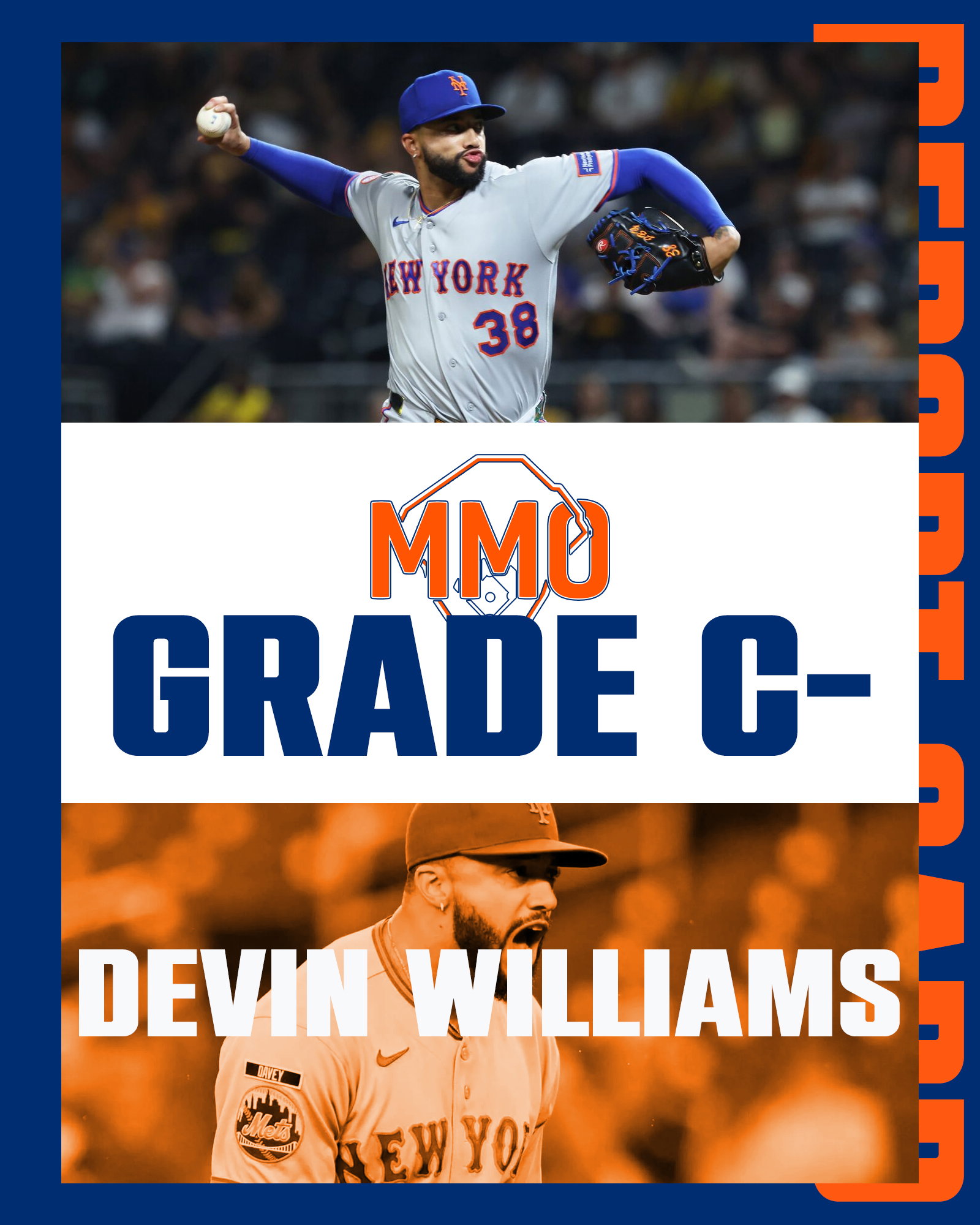
GRADE: C-
2026 REVIEW
When acquired this offseason, Devin Williams was expected to be an elite closer who would have a bounce-back year coming off of his struggles with the Yankees. Unfortunately, that was not the case. In his first year for the Mets, by pretty much any measure, 2026 was a major disappointment.
Williams comes in at a C- for an abundance of reasons: failure not only overall but also compared to expectations, time on the injured list, and creating major uncertainty in his role moving forward. Not counting a short stint in 2019, Williams posted a career-worst year in WHIP, FIP, strikeout rate and batting average against. He did not spend the entire year in the closing role that he was signed for, which really hurt the Mets in 2026. So, what really happened?
When writing about Williams earlier in the year, several comments were made about his arsenal and how it doesn’t feel the same as it did when he was at his peak. Not to say that it’s the only reason he struggled, but there is no doubt that his arsenal was not as good as when he was at Milwaukee. As a whole, Williams’ Stuff+ was a 109, much lower than his career average of 116. Most of that drop was due to the peripherals on his changeup. This year, whether it was intentional or not, Williams started throwing a “flatter” changeup. The vertical break on his changeup was tied for the lowest (on average) of his career. The average vertical drop was less than half of last year’s. Instead of dropping vertically, it had more arm-side run than it ever has in his career.
Whether it was because of the change or not, Williams’ changeup got demolished this year. Batters hit .283 and slugged .402 off the changeup this season; both were career worsts. It was the first time in his career that his changeup produced a negative run value (-1). These results are not acceptable for a Mets team that is hoping to turn it around very quickly and compete again. So, why was this year a C- and not an F? Most of it has to do with the fact that there are some encouraging signs that point towards better future results.
One of these signs mentioned is the big difference in bWAR versus fWAR. fWAR uses FIP to evaluate pitchers, whereas bWAR uses runs allowed per nine innings (RA9). fWAR focuses more on predictive outcomes, like what should’ve happened and what to expect in the future, whereas bWAR looks at what actually happened. Williams’ bWAR was the worst of his career because he had a very bad season. His RA9 (5.53) was the highest since 2019, when he only threw 13 2/3 innings. However, his fWAR was not a disaster because several things did not go his way.
Under the hood, Williams really was not that much different than his time on the Brewers. While his xERA (3.22) and xwOBA (2.78) were not elite, they were not nearly as bad as the results showed. Williams was incredibly snake-bitten by a staggeringly high BABIP. Williams .370 BABIP was not only a new career high, but was tied for the fourth highest of any pitcher who threw at least 40 innings. He generated tons of whiffs, limited barrels and hard contact, and didn’t really give up a ton of home runs. Part of the defense is that he couldn’t keep the ball on the ground, and his defense was significantly worse on the Mets than on the Brewers. In 2023 and 2024, the Brewers ranked first and sixth in fielding run value. The Mets in 2026 ranked 16th.
Nobody is going to tell you that Devin Williams was good, or even okay, in 2026. This nightmare of a season played a major part in the Mets underachieving in 2026. However, it is also fair to say that there were signs that point to him being at least somewhat of his old self in 2027. Williams is under contract for two more seasons, and will most likely be a Met for both of those years. He is going to be a very important piece of the team, and it is imperative that he pitches better moving forward.
2027 PREVIEW
It would take an injury or a massively disappointing spring for Williams to not make the opening day roster, and even that might not be enough. Whether people like it or not, he is going to be given a role as a high-leverage reliever in 2027. High leverage does not mean closer. It is unlikely that Devin Williams will be given the closing role outright. It’s reasonable to think the Mets will (and should!) add at least one other high-leverage reliever who can close games, and see who wins the job.
Hopefully, Williams regains his 2023-2024 form that can help stabilize the back end of the Mets bullpen. If not, he will likely slide into a middle-innings or setup role. The ceiling is there; the Mets just need him to find his old self again.