The Mets have multiple players they can consider extending. Young players, established players, and players who have not debuted yet. In this article, we will break down the pros and cons of extending players, examples of when this has worked and has not worked in other organizations, and the players that fit that on the Mets.
Pre-Arbitration Extensions
Pre-arbitration extensions are the most common extension you see. Players are considered pre-arbitration for their first three seasons (two if they are a super two), and during that time they make the league minimum salary. The benefit for the player is that they secure money early in their careers, while the benefit on the team is taking the gamble that the player will well outproduce their contract value.
The risk for this contract is largely on the team. We have seen players including Starlin Castro, Ke’Bryan Hayes and Andrés Giménez be examples where the player has not come close to the value of their contract. Hunter Greene and Luis Robert Jr. had injuries prevent them from hitting the value of their contracts. Colt Keith, meanwhile, is an example of someone who seems to be returning exactly his value. Ozzie Albies, Ronald Acuna Jr., and Bobby Witt Jr. are all players who seem like they will outperform their contracts.
These types of contracts, while not without risk, do tend to be at a dollar value that will likely not cripple a team, especially one like the Mets. At that dollar value and the age the player was signed at, it can be easier to move that player to a part-time role than someone you give $300 million in free agency to.
Who from the Mets fits this?
A.J. Ewing
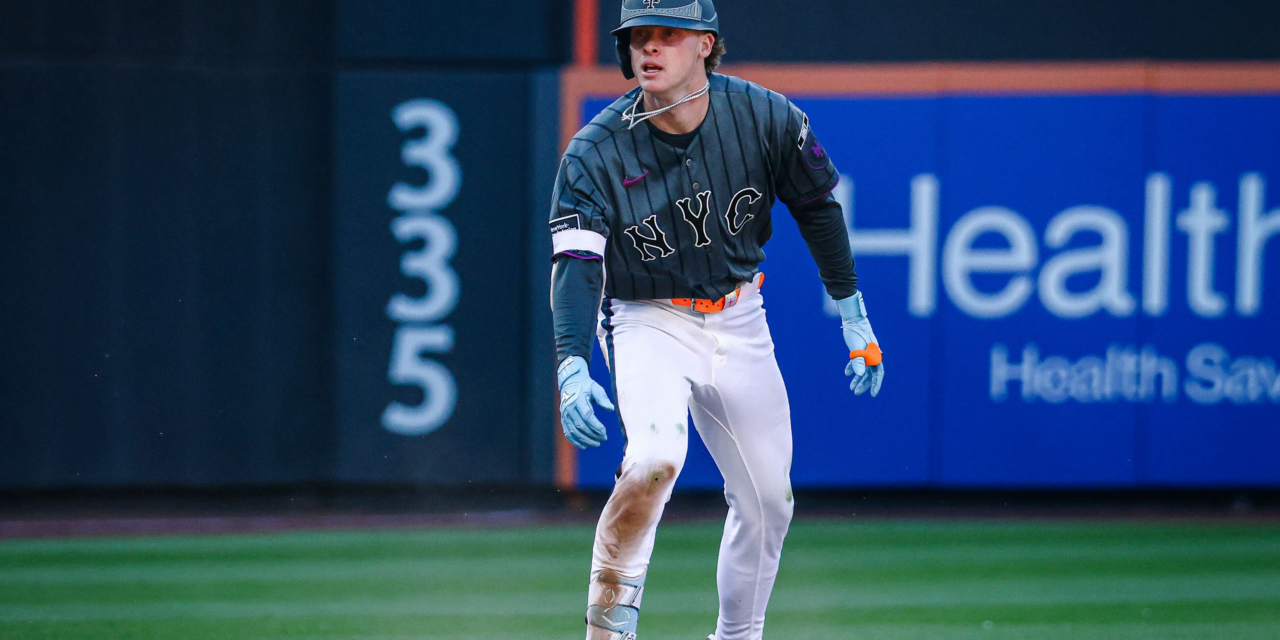
A.J. Ewing might be the player with the biggest argument to do this with. He plays plus defense in center field, so even if the bat does not develop much further, he will provide value with his glove at a premium position. We just saw the Brewers give an extension to Luis Lara based largely on his defense, and Ewing will likely be a significantly more productive player on the offensive side.
Ewing is also only 21 years old. If he signed a seven-year contract with three club options that began this year, he would enter free agency at the latest of age 31. Now, Ewing would likely require more in terms of dollars than Lara since, unlike Lara, he has already debuted in the majors and shown a level of offensive upside Lara has not.
Ewing’s age and defensive value make him the ideal candidate to give one of these extensions to.
Nolan McLean
Nolan McLean is 24 years old. He is currently tracking to hit free agency at age 30. That alone gives some reason to argue that he should not be extended. Having the entirety of a player’s 20s without having to commit to any of their 30s tends to be a perfect-world scenario. That said, McLean has less mileage on his arm because he was not a starting pitcher in college. He has a skill set that should lead to him aging well into his 30s. Any extension likely would not go deep into his 30s or the Mets likely would not make the commitment.
There is also an argument to lock him up before he starts racking up Cy Young placements and starts making money through that and All-Star appearances. There is not zero risk, though. The Spencer Strider extension does not look as good as it did a few years ago. As mentioned, the Hunter Greene extension has been marred by injuries, and he will likely miss the majority of that contract extension with injuries. To date, McLean has yet to have Tommy John surgery.
Would he sign something similar to the Chase Burns extension? If so, that could be tempting to the Mets.
Carson Benge
Carson Benge is a harder case to extend than Ewing and McLean, but there are still plenty of arguments in favor of it. That said, he signed at a decently high signing bonus so he is not likely hurting for money now as much as Ewing or McLean might be. He can play center field, but is really best utilized in a corner outfield spot.
At age 23, Benge is younger than McLean, but is also two years older than Ewing. Any contract extension he would sign would likely go into his mid-30s. Currently, the team has Benge under control through his age 28 season.
The reason to extend him is if you project him to continue to play at a high level past his age-28 season through the remainder of the contract. But it would likely come at the expense of an Ewing extension – you probably do not want to lock up the next decade of your outfield between Soto, Ewing and Benge, leaving yourself zero flexibility to add outfielders in free agency or via trade should you be able to acquire a star player.
Christian Scott
Christian Scott made one top 100 list before his 2024 debut, ranking 88th on Baseball Prospectus’s Top 101, and he has performed better than many of the names ahead of him on that list. He had an up-and-down 2024 that ended in Tommy John surgery, but he returned in 2026 with increased velocity and has been working in various changeup and splitter shapes to better attack left-handed hitters. Those issues against lefties have kept him more of a mid-rotation starter than a frontline one, but he should be a key rotation piece for years to come.
At age 27, the Mets’ team control extends through his age 31 season, so any extension would likely not look to buy out too many free agent years. He could be a candidate for a contract that only buys out arbitration, similar to what we will talk further about with Jared Young. But at age 27, with very little major league time under his belt, the risk is likely much higher than the reward for the Mets.
Jared Young
If you expected Jared Young to already be in arbitration or close to free agency, you would not be alone, but he does not even have a full year of service time yet. That means the Mets have him under control for five more years, running through his age-35 season. Any extension of Jared Young likely would not run past the control they already have. It may not even run through the entirety of the control they have.
What could make sense for the player and the team would be to do a contract inside that five-year span. Something that adds a bit more money to his last two pre-arbitration years to secure his first or potentially even all three years of arbitration at a lower cost than he would negotiate for if he continues to perform. The Mets may even push to have one or more of the arbitration years be club options. If they then turned down that option, Young would go into arbitration still under team control. We saw the Royals do this with Cole Ragans. They bought out his first two years of arbitration at a lower value than they likely expected him to be able to negotiate for. Ragans will still be able to negotiate his final year of arbitration in 2028.
Similar to the other pre-arbitration extensions, this arbitration buyout saves the team money with minimal risk while the player safeguards their future a bit by having some guaranteed money and a guaranteed roster spot.
Arbitration Extensions
Players who have already reached arbitration tend to cost more than those who extend before they hit arbitration. They have already begun to negotiate their annual salary to a degree and are closer to free agency.
On the player side, the incentives are the same – secure future money. Michael Conforto turned down a contract extension that was offered by the Mets before his 2021 season, and an injury entering free agency cost him millions in the years that followed.
On the team side, the risk is higher. The dollar amount is higher. The team likely needs to buy more years covered by free agency, meaning that they are likely buying years past the player’s “prime”.
The player is also likely more established. They may be viewed by the fans and industry as a homegrown “star”. This tends to come with role and playing time promises that make it harder to cut the player or demote them out of their role in the middle of the contract if their level of play falls off. We saw how long the Orioles continued to play Chris Davis, how Austin Riley is getting every day play on the Braves, and, going back further, Ryan Howard played regularly through his five-year extension despite playing well below average four of those years.
Obviously, we are not in the room to know what promises are directly made. But time and time again we see that even when these established players sign extensions, they continue to get playing time when they struggle. It also makes sense – wouldn’t another player the team wants to extend be more hesitant if the team regularly cut bait at the first sign of struggle? Wouldn’t free agents the team targeted avoid organizations that did not give their own homegrown stars a run to turn things around in fear they would be discarded themselves? These players are still people, and all of these factors do exist when teams debate whether to extend or not.
Francisco Alvarez
There have been rumors around a potential Francisco Alvarez extension for years, but none has materialized. As a super two, he is in his first year of arbitration with three more years before entering free agency. Since the start of his rookie season, among catchers he is eleventh in WRC+ at 109 and eleventh in WAR. This season, he is top nine in WRC+ at 121 and, despite missing time with injury, is also top nine in WAR.
On top of all of this, Alvarez is still only 24 years old. That is the same age Adley Rutschman and Cal Raleigh were as rookies. Right now, Alvarez is slated to hit free agency at 28 years old. Any extension would likely run into his early 30s.
On the flip side, Alvarez has shown an inability to stay healthy. He has also healed very quickly from his injuries, but youth could have aided him there. His defense has taken a step back, but it is possible that is only a short-term issue due to his knee injury that could be resolved the further he gets from that surgery.
Catcher is also overall a weak position in terms of everyday playing options. The Mets do not have any clear catchers to take over the position in the next few years. Most catchers debut older than Alvarez and therefore hit free agency older than you typically want your starting catcher to be. But with four years of control still, there is not really any need for urgency from the Mets.
Tylor Megill
It may seem crazy listing Tylor Megill here as he is more likely a candidate to be non-tendered than he would be to get an extension. It is also impossible for me, writing this right now, to know how his rehab from Tommy John surgery has gone and if he still looks the same as he did before his injury.
When Megill went down from injury, he was coming off a stretch dating back to his call-up in the middle of 2024, where he threw 107 1/3 innings to a 3.61 ERA, 3.55 FIP, and 1.30 WHIP with a 28.1% strikeout rate and 9.9% walk rate. In 2025, he ran a 30.9% whiff rate and 28.2% chase rate with multiple plus pitches. His 17 iVB fastball and 2548 rpm slider led his arsenal with plus whiff rates and movement profiles.
Entering his age 31 season with a long history of injuries, Megill’s days as a starter may be over for him. But his stuff looks similar to what it did in 2025; he may be able to follow his brother’s footsteps as a leverage reliever. In theory, he could throw harder and focus on his best pitches.
This is probably the least likely and most out-there consideration, but if the Mets want to get creative to lock down a pitcher they know at a big discount with real upside to a role that often costs upwards of $10-15 million in free agency, this is a way to do that.
Extend Before They Debut
We have seen more of these contracts recently, with the most recent and potentially biggest success story being Jackson Chourio. Of course, there are always examples where this strategy is less successful, like Eloy Jimenez.
The risk is clear for the Mets here: the player has never faced major league pitching or hitting before. The benefit is that these tend to be the contracts that come with the largest discount. None of these contracts have reached $100 million with Colt Emerson’s eight-year and $95 million being the largest so far. For the player, they lock down life-changing money before playing a single game in the majors.
Any of the Mets’ top prospects could be considered for this, but typically teams like to prioritize players at premium defensive positions including shortstop, center field and catcher. There are no catcher prospects that currently project to be starters in the majors, so it is unlikely any of their catching prospects will be extended.
With Soto, Ewing and Benge in the outfield, if they extend an outfield prospect it would likely be on a cheaper contract similar to the seven-year $31 million contract Luis Lara signed with the expectation that prospect would be largely utilized as a fourth outfielder.
At shortstop, the best candidate is likely Mitch Voit since he seems to be the only prospect that is close to the majors and would likely stick at the position. But Voit does not profile as a plus defender there at the moment. He does not have a true offensive carrying tool. Any pre-debut extension would likely need to be similar to the eight-year and $50.75 million extension Cooper Pratt signed, recognizing the utility player risk a player like Mitch Voit carries.
More likely than not, the best option the Mets have to give one of these extensions to is further a few years out from being in consideration –maybe a younger player like Wandy Asigen or Elian Peña. Maybe a player in the lower minors that has not broken out yet.
Verdict
Contract extensions can come at any point in a player’s career, even before it has truly begun. The risk to the team is clear: early career extensions are taking a gamble that the team’s projections are strong, while later career extensions come with a higher dollar value. Extensions can even come in contract restructures in the vein of the Manny Machado Padres restructure to void his opt-out. Would the Mets consider doing the same if Bo Bichette were to signal his intent to opt out?
Teams are also typically making more than just a monetary commitment. Extensions usually also come with a roster and playing time commitment. When you extend a player to a long-term contract, especially a beloved homegrown player, you may not be able to just cut them if they begin to struggle halfway through without negative repercussions in your ability to sign or extend future players. At the very least, we have not seen teams operate as if they are under the belief that they can give extended everyday playing time to struggling homegrown players like Chris Davis and Austin Riley and even large free-agent acquisitions like Taijuan Walker and Nick Castellanos.
Teams also want flexibility in their roster to add in the future via trades and free agency. If you lock up your entire roster long term, you have no way to make additions without first moving players you extended.
But when you have the right player and the right scenario, you make that extension, and maybe the Mets have that with some of the players they have now.
Writer’s Pick: A.J. Ewing