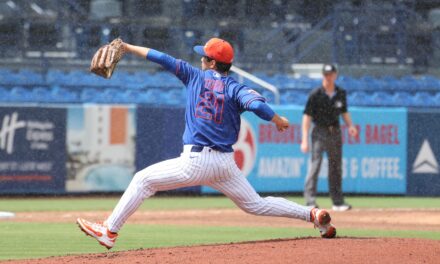
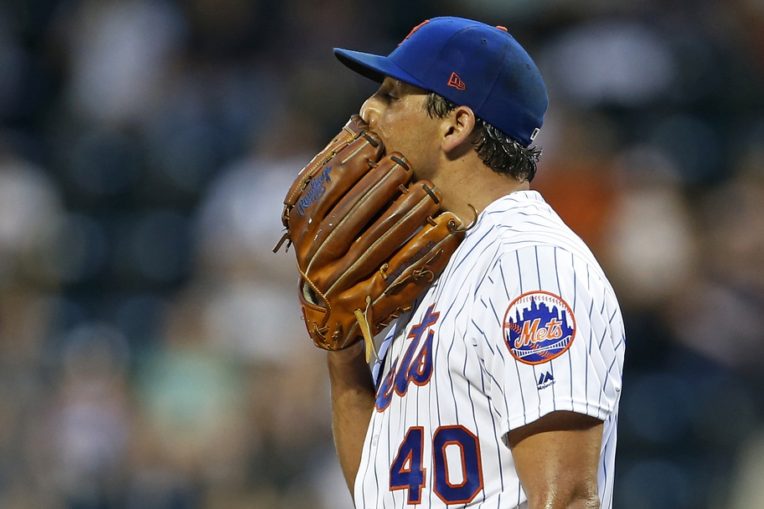
Jason Vargas started last night, allowed four earned runs in a measly five innings of work, and got the loss. There is nothing wrong with looking at this most recent performance through $16M glasses and judging it solely by the final outcome. When such a start lowers a pitcher’s season ERA to 8.23 and he’s already made 12 starts, it wouldn’t necessarily be wise to throw him any sort of bone.
For all intents and purposes, though – especially since it’s hard to envision anything happening to his current role with the team – I’m going to try unpacking whatever positives I can… be it in the name of open-mindedness, complacency, or a lack of respect for myself as a fan.
It’s always important to look out for patterns and indicators in baseball. For example, Jason Vargas entered last night’s contest averaging 2.6 home runs allowed per nine innings on the year. Just four times this season has the lefty gone a start without allowing a home run. Over those four starts and 19 innings pitched, Vargas has a 2.84 ERA, 1.05 WHIP, and 2.8 K/BB ratio. To put things another way, when Vargas manages to limit the meatballs, the results, however specifically spread out they may be, are far easier to digest.
Last night was the fifth such time Vargas was able to keep the ball in the yard. Granted, the start was yet another five-inning brick in the wall, and given the 62 pitches he needed to dig out of the first three innings, it’s not exactly fair to label the lack of homers a result of improved control. He certainly looked better at some points last night than at others, however.
For one thing, Vargas’ infatuation with the second inning once again showed itself. Opponent OPS in the second inning alone fell to .670 as the veteran followed his usual routine of settling in – striking out Tyler Flowers, Dansby Swanson, and Mike Foltynewicz consecutively in a semi-arduous 16-pitch frame.
The third inning was the most sobering aspect of Vargas’ night, and does little, if anything at all, to exempt him from scrutiny, seeing as it effectively cost him his shot at a win. Johan Camargo‘s two-run double to put the Mets in a 4-1 hole was the ideal combination of poor fastball location and solid, professional hitting. Up to this point, Vargas had notched just four total swings-and-misses on his fastball; and they’d all come in that spotless second inning.
While a lame number-one pitch may be a convenient alibi for yet another underwhelming start, the changeups and knuckle curves at hand were undoubtedly a cut above everything else Vargas had been throwing. Even Freddie Freeman‘s RBI single earlier in the third had come on a 55-foot curveball that he had somehow found a way to reach and flick into center field.
Freeman didn’t get away so easily the following frame, as Vargas fooled him inside with a devilish changeup to strike him out and retire the side. Not to mention, Wilmer Flores‘ high throw on the ensuing pickoff breathed new life into the two-out rally that Camargo promptly took the lead on.
Again, Vargas is by no means absolved of the losing start, but considering he was sliced and slow-roasted for six runs on 11 hits the last time Atlanta came to town, it’s also unfair to consider a stroke of good fortune the outs that followed, especially given his ERA in starts of five-plus innings (2.25). While the conditions under which Vargas has been able to make out on his own have been agonizingly specific, it’s still important to differentiate the layers of Vargas’ bad starts.
“I feel like I am making good pitches and sometimes they are not working out the way we want,” Vargas said to reporters after the game. “Whether that’s innings getting extended, just the wrong thing happening… I feel very competitive out there.”
Considering Vargas finished his night with a three-up, three-down inning against Nick Markakis, Adam Duvall, and Camargo (all of whom had beaten him to reach base earlier in the night), it may be in everyone’s best interests to try and run with whatever positives remain. If we were to erase the first two batters of the first inning as well as the entirety of the third, Vargas was only responsible for a hit and three walks.
It’s August. Obviously, the “bad stretch,” “tough inning,” and “wrong thing happening” should no longer be such common talking points. Nonetheless, there’s a different pitcher that has emerged on scattered occasions in some of these starts. And for that, even if he’s best off operating on a two-inning leash out of the pen, Jason Vargas deserves time in this lost season to try capturing whatever positives he can run with.