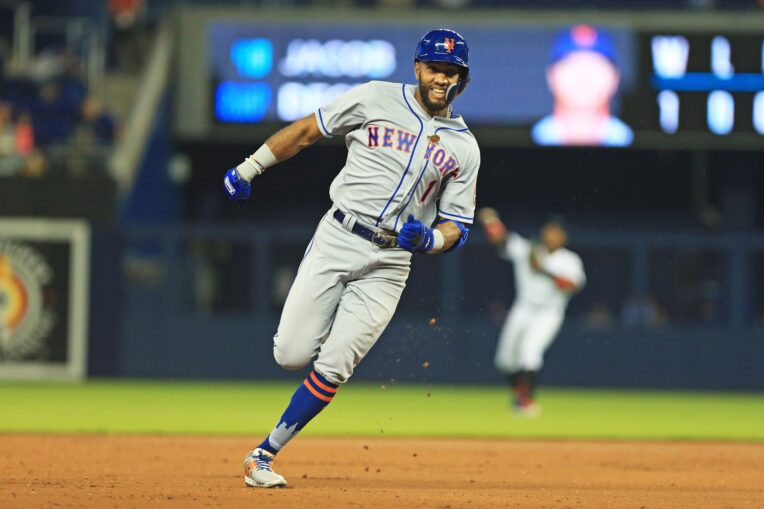
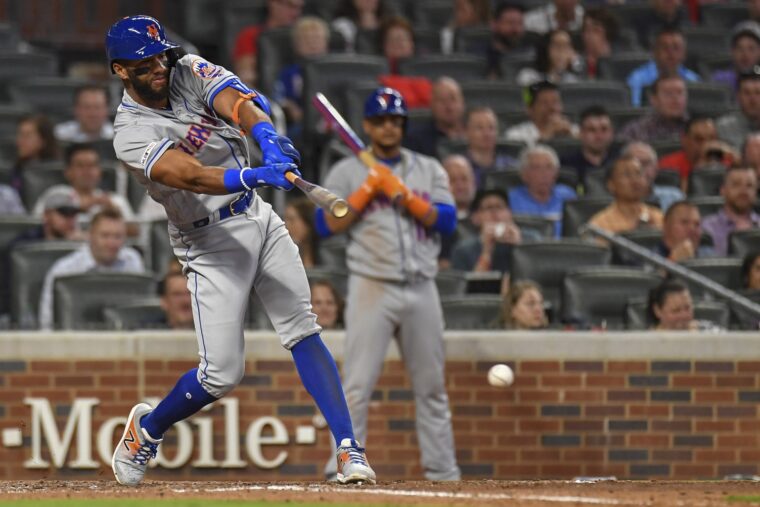
When focusing specifically on his offensive production thus far in 2019, New York Mets shortstop Amed Rosario has experienced a weird start.
He’s already had his fair share of big hits, which will happen when you collect 13 RBI through 93 plate appearances — it took him until May 20th to drive in that many runs last year. However, if you take a look at some of his season-long statistics, they look eerily similar to how 2018 ended up.
| Year | PA | BA | OBP | SLUG | wRC+ |
|---|---|---|---|---|---|
| 2018 | 592 | .256 | .295 | .381 | 85 |
| 2019 | 93 | .261 | .301 | .375 | 81 |
While the overall production hasn’t shown much progress, there are two aspects of Rosario’s approach that have improved since he suited up for Opening Day. One can hope that if these changes are sustained, it will eventually lead to the 23-year-old taking a huge step forward in his development this year.
Continued Improvement in Plate Discipline
Since debuting in 2017, Rosario has made it known that he likes to be aggressive in the batter’s box. Among hitters with at least 800 plate appearances during this time, Rosario’s 54.0% swing rate is inside the 15 highest. It has been going down over the years, though — ever so slightly.
Here’s a quick look at how his chase rate (O-Swing%), swing rate on strikes (Z-Swing%), and overall swing rate (Swing%) has changed each season thus far.
| Year | PA | O-Swing% | Z-Swing% | Swing% |
|---|---|---|---|---|
| 2017 | 170 | 45.5% | 66.6% | 55.3% |
| 2018 | 592 | 41.2% | 69.4% | 53.8% |
| 2019 | 89 | 37.0% | 74.6% | 52.1% |
There’s still some work to be done, but each of these scenarios is going in the right direction. It’s also coincided with a consistent rise in walk rate (1.8% in ’17, 4.9% in ’18, and 5.4% so far in ’19). The one area that currently isn’t on the same trajectory is Rosario’s contact rate.
After raising his contact rate inside the strike zone nearly 10 percentage points last year to 85.1%, it’s sitting at 79.0% at the moment. The same can be said about his overall contact rate — it jumped almost nine percentage points in ’18 to 76.0%, but is currently down at 70.1%.
Some of that can likely be attributed to a change in pitch mix from opposing hurlers. From 2017-18, he saw fastballs at least 52.0% of the time, but he’s only dug in against a fastball at a 44.6% clip so far this year. That’s led to a rise in many secondary pitches, but most notably sliders, cutters, and changeups. He’s produced a 137 wRC+ against four-seamers, but those numbers are down at 73, 42, and -20, respectively, against the three aforementioned secondary pitches.
Baseball is a game of adjustments, and this is yet another one Rosario must make along the way.
Changes in Quality of Contact
In keeping with the theme of eerily similar stats to last year, Rosario’s batted-ball profile doesn’t look all that different right now when compared to what he did in 2018.
| Year | LD% | GB% | FB% |
|---|---|---|---|
| 2018 | 20.9% | 49.5% | 29.6% |
| 2019 | 20.0% | 52.3% | 27.7% |
There has been a difference in his infield-fly rate, which was 11.6% in 2018 and is currently sitting at 5.6%. That can be attributed to — you guessed it — improved quality of contact. Rosario’s hard-hit rate is 40.0%, which would be a tremendous improvement over the previous two years if it can be sustained (24.1% in ’17, 27.7% in ’18). The shortstop has paired this with a 15.4% soft-hit rate, which would also be a single-season career-best mark by a wide margin (19.8% in ’17, 20.4% in ’18).
Although the overall numbers don’t exactly resemble a breakout year happening for Rosario just yet, there’s still plenty of time for that to come to pass. It’s encouraging to see his plate discipline and quality of contact making strides despite having to adjust to a pitch mix that’s less reliant on four-seamers.
If he can sustain this approach, good things are bound to happen. At least, you’d think so.