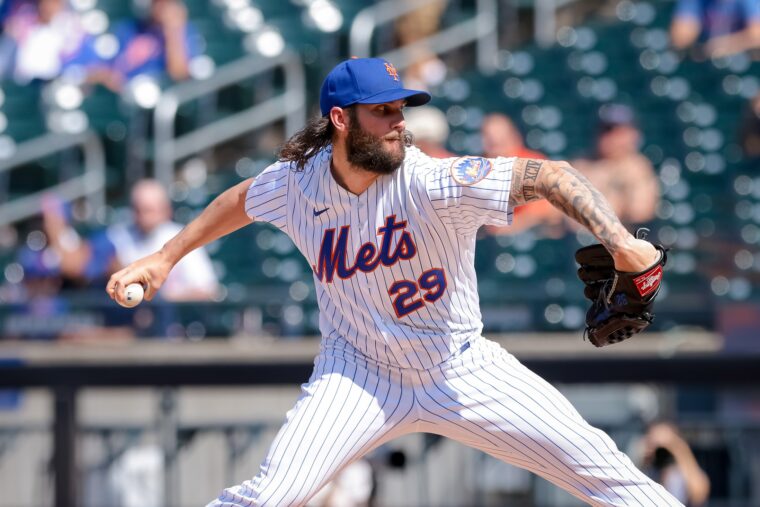
Credit: Vincent Carchietta-USA TODAY Sports
Making his Mets debut on Thursday afternoon, Trevor Williams showed real promise while limiting damage in an eventual 5-4 Mets win.
The former Cubs pitcher went 4 1/3 innings, allowing three hits and one earned run. Williams walked two batters, but struck out two Nationals as well.
Williams’ first two innings were nearly perfect as he did face the minimum through two frames. The lone baserunner was a single by Carter Kieboom in the second. He was soon thereafter retired on a 4-6-3 double play.
In the next inning, Williams retired all but one batter, walking Tres Barrera, who made it to second base on an ensuing sacrifice bunt.
In the fourth, Juan Soto was again the only baserunner, by way of a walk. Through four innings, Williams could not have pitched better in his team debut.
The fifth inning finally saw hits off Williams, which led to Seth Lugo entering the game. After allowing a double and a single, Williams was pulled. The lone run credited to him scored on a sacrifice fly off the bat of Yadiel Hernandez.
While Williams did not go tremendously deep into the ballgame, he kept most runners off base, kept the Nats off the scoreboard, and still put in enough innings to give the bullpen some rest before finishing off the game.
His pitch arsenal came with five offerings – a four-seam fastball, slider, sinker, changeup, and curveball. His fastball was thrown most often (37%), but it was the slider, thrown 23% of the time, that had the highest whiff percentage (25%).
Of the 22 swings that National batters took on Williams’ pitches, just three were whiffs, for a whiff percentage of 14%.
In terms of velocity, Williams’ fastball topped out at 92.2 miles per hour. On average, his fastball sat at 89.8 MPH. This is actually a 1.7% decrease from his year-to-date average of 91.5 MPH. In fact, each of his five pitch types thrown yesterday represented a decrease an average velocity from his annual numbers. His curveball, while thrown just twice all game, did have the lowest decrease in percentage compared to the annual average numbers. On the season, Williams’ curveball goes for 77.7 MPH, but his two offerings on Thursday afternoon averaged a tick below that at 77.0 MPH.
Considered the “secondary” piece in the Javier Baez trade, Williams showed tremendous poise on the mound in first appearance for the Mets. Yes, it’s just one start, but it’s a great sign for Williams moving forward as the team figures out where he slots into the rotation over the remainder of this season.