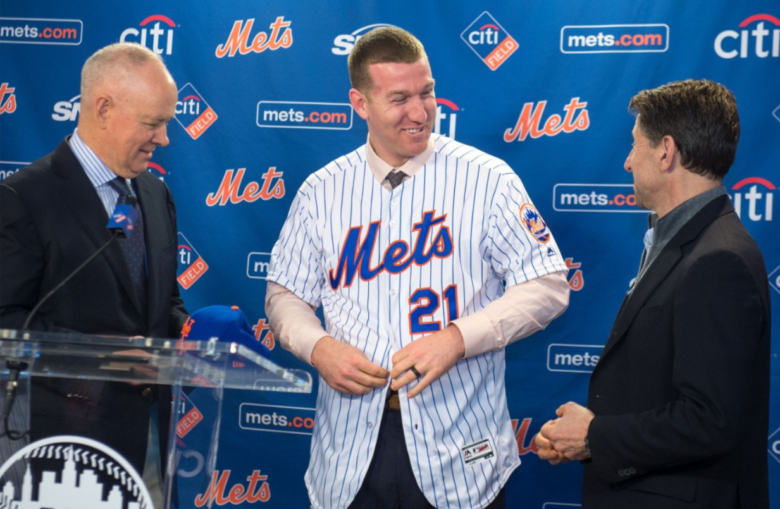

I have made zero attempts at hiding my fandom for Todd Frazier and the Mets signing him for two years, $17 million. Frazier through all his flaws was still a very good defensive third baseman who found ways to help his team despite a low batting average.
Frazier since 2014, has averaged a 4 WAR while slashing .243/.322/.464, good for a 113 OPS+. He’s also racked up 21 DRS at third base in that span. A huge plus on the left side of the Mets infield. Someone they have been lacking since David Wright.
So how can Todd get better for the Mets? Lets dig in. Todd is a air ball hitter which means he hates all things on the ground. The bad thing is, he hits a lot of infield pop ups and unless you’re playing against Luis Castillo, they tend to be easy outs. Frazier’s launch angle the last two seasons has been 20.2 degrees. Contrast that to say Daniel Murphy who’s a preacher of the air ball movement. Murphy’s average launch angle the last few years has been 17 degrees. Of course, you don’t want to go too low otherwise you’ll become Jonathan Lucroy and have his 11.3 degree launch angle. And we all know how bad Lucroy was in 2017. Something like this can be corrected fortunately which is why I think we can be optimistic about an uptick in Todd’s offense in 2018.
The next part of Frazier’s game is the walks. In 2017, Frazier saw his walk rate jump to 14.4%, the highest of his career and it was not particularly close. According to Fangraphs‘ plate discipline rating, Frazier swung at just 25% of pitches out of the zone. That was good for 27 out of 144 qualified hitters which would suggest he didn’t luck himself into his walks. It’s good to note he didn’t luck himself into those walks because that means he can sustain that walk rate heading into 2018.
Maybe 14% will be a tough number to attain again but something in the 10-11% range seems certainly attainable. Steamer and Fangraphs would agree because both have his walk rate at 10.6% and 12.8% respectively.
The final thing I’ll look at is Frazier’s exit velocity. Among players with 30 batted balls, Frazier ranked 139 of 540 in exit velocity on fly balls and line drives. That includes those weak popups I talked about earlier. Frazier also barreled the ball up in 6.1% of his plate appearances. A barreled ball is when the hitter gets the barrel of his bat on the ball. They generally tend to have good outcomes for hitters. Frazier ranked 97 out of 540 in barreled ball percentage among hitters with 30 batted balls. What do those two things tell us?
Well essentially it tells us that Frazier wasn’t lucky to hit for the power he does. The common narrative surrounding Frazier is that he only hit for a lot of power and home runs because he played in hitter friendly stadiums.
Well that is incorrect. Frazier hits for a lot of power because he makes hard contact. Take a look at the graph below, it’s his exit velocity per hit charted to Citi Field. You’ll notice how most of the balls hit to the deeper part of the stadium are all red. The redder the dots are, the harder the balls are hit. So please do not worry about his power decreasing just because he’s coming to Citi Field. His exit velocity would suggest he will maintain his power just fine.
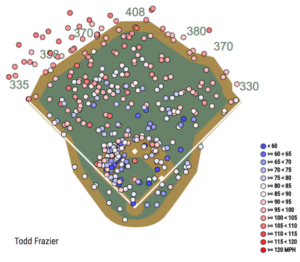
Photo Credit: Baseball Savant
Well there you have it, Todd Frazier is a good pickup for the Mets. Todd could be an even better player for the Mets in 2018 if he corrects his launch angle but even if he replicates his 2017 season, then he will still be a good pickup. His 2017 season was not lucky by every measure. He was a good player and he gives the Mets the third baseman they have needed for years at a very reasonable price.