
When looking back at last winter’s free-agent acquisitions, it’s safe to assume that Sandy Alderson would like a mulligan.
Anthony Swarzak has been hurt a lot and ineffective when he’s not, Adrian Gonzalez hasn’t been around in months, many wish Jose Reyes joined him, Jay Bruce may be next year’s first baseman, and it took Jason Vargas five months to resemble a capable big-league starter.
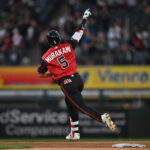
Even with a tough three-month stretch that ran from May to July, third baseman Todd Frazier has been the biggest “bright spot” of New York’s recent winter spending spree — at least by the Mets’ standards these days. When he signed that two-year, $17 million deal in February, it was easy to see why he ended up being a target for the front office.
And for the most part, he’s delivered what they likely expected on the field during his first year in Flushing.
Fitting Into the Offensive Philosophy
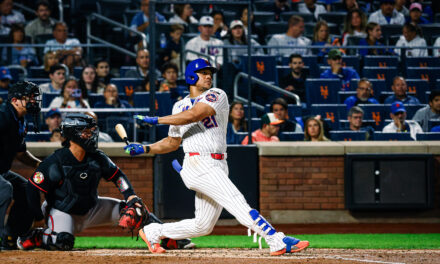
From an offensive standpoint, Frazier has done what the front office loves — he hits a lot of dingers and gets on base at a high clip. The 27 home runs he hit between the Chicago White Sox and New York Yankees in 2017 marked his fifth consecutive season of at least 25 homers, while his .344 on-base percentage was a career high-mark that was helped greatly by a 14.4% walk rate (also a career high).
Despite a drastic drop in chase rate between 2016 and 2017, that was the first time Frazier ever boasted a walk rate above 10.0%. He doubled down on the approach in April, though, as he posted a 135 wRC+ and .189 ISO off the strength of four home runs and a 17.5% walk rate.
That’s as good as it’d get over the next three months thanks to a couple stints on the disabled list and general lack of production. He made a charge back toward his April production in August, as he finished with a 116 wRC+ and a .225 ISO (his highest of any month this season). However, his monthly walk rate hasn’t gotten higher than 8.7% since that solid first month — which is more in line with his career norms anyway.
Frazier’s year at the plate has been bogged done by a three-month stretch where he slashed .191/.226/.346 with a 53 wRC+ in 146 plate appearances, but his production has at least been on par with the group that collectively manned the position last year.
Most of the work at third base in 2017 was taken up by Wilmer Flores, Asdrubal Cabrera, Reyes, and T.J. Rivera (with Matt Reynolds, Phillip Evans, Neil Walker, and Travis d’Arnaud also getting some work). Here’s a look at how their collective offensive numbers compare to what Frazier has done so far this year.
| Year | AB | HR | RBI | R | OBP | OPS | ISO |
|---|---|---|---|---|---|---|---|
| 2017 crew | 639 | 16 | 76 | 75 | .315 | .728 | .144 |
| 2018 Todd Frazier | 335 | 16 | 53 | 47 | .306 | .724 | .188 |
Frazier likely won’t match those RBI and runs scored totals, but he’s basically been the same — or a little better — than that entire group. There wasn’t necessarily a high bar set, but it’s not like New York was expecting him to come in and slug 40 homers again like he did in 2016 for Chicago.
A Huge Defensive Upgrade
Last year’s offensive production at third base was merely OK — not terrible, not great — but an overall lack of defense is what really sunk this ship. Their -17 Defensive Runs Saved was the worst in the National League and second-worst in all of baseball. Only the Detroit Tigers (-22) were worse, and they ended up moving the guy who got a bulk of the playing time there — Nick Castellanos — to the outfield this season.
So once again, there wasn’t a high bar for Frazier to surpass, but he still had to pass it. In the 772 innings he’s played the hot corner, the veteran has been worth five Defensive Runs Saved and a 2.4 Ultimate Zone Rating (it was -9.1 for New York last year).
Although defensive metrics haven’t been kind to Amed Rosario (-15 Defensive Runs Saved in 1,059 innings), this duo has been much better than the collective 2017 efforts. Then again, after posting a combined -46 Defensive Runs Saved on the left side of the infield, just about anything would’ve been better.
Moving Forward
The Mets have a potential roster logjam in the outfield next season between Brandon Nimmo, Michael Conforto, Bruce, Juan Lagares, and Yoenis Cespedes (depending on his health), but there’s also one brewing in the corner infield spots.
Frazier is sticking around for another year, it doesn’t seem like Flores is going anywhere, Bruce is going to get reps at first base, Peter Alonso will likely keep forcing the issue from his end, and who knows what Dominic Smith‘s role will be. And then there’s that whole David Wright thing. He probably won’t play close to every day if he sticks around, but if he does, it’s another person to work into the lineup.
It’ll be interesting to see how the Mets plan on dealing with this situation, even though we can assume they’ll choose the option that makes the least amount of sense. If Frazier brings the momentum he created from August into September and finishes 2018 strong, that plus his strong clubhouse reputation and affordable contract ($9 million in 2019) may make him a trade candidate.
I’d rather see him stick around because he holds more value to the Mets than some of their other current options, but his contract could be the easiest one to actually move. What eventually happens remains to be seen, but either way, the Mets pretty much got exactly what they paid for when it comes to Frazier’s on-field performance this season.