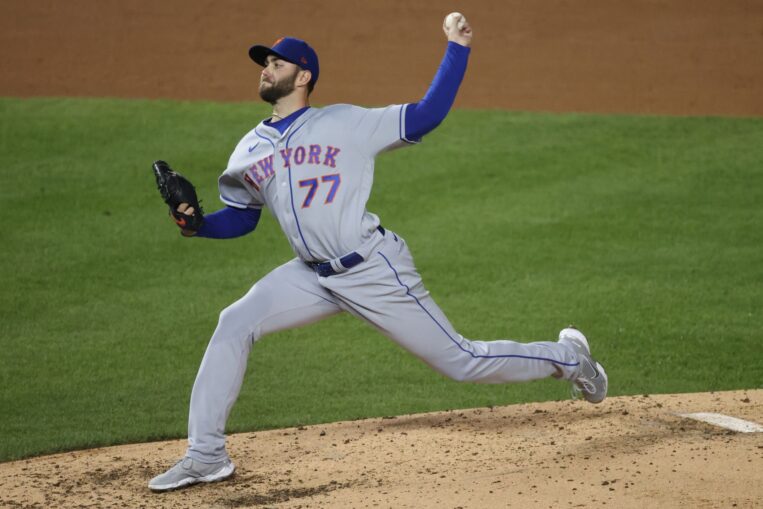
He didn’t actually, but it kind of felt like rookie starting pitcher David Peterson came out of nowhere to provide meaningful innings for the New York Mets. After all, who would’ve thought the 25-year-old southpaw was on the verge of tossing 49.2 frames and starting nine games in a shortened season when New York entered Spring Training with the “deepest rotation in baseball”?
Well, injuries (Noah Syndergaard), opt-outs (Marcus Stroman), and not-so-great performances (most starting pitchers not named Jacob deGrom) made his presence necessary. And during a year in which the Mets’ rotation underperformed outside of their ace, Peterson ended up being the club’s second-best hurler when solely looking at ERA. In those 49.2 innings, he compiled a 6-2 record with a 3.44 ERA and a 1.21 WHIP.
Upon peeking at some advanced statistics, though, it’s easy to think Peterson experienced some good fortune. Advanced ERA indicators, like xFIP (5.07) and SIERA (5.17) actually ranked him among the worst starting pitchers in baseball with at least 40 innings pitched in 2020. For the most part, the other hurlers around him on those lists finished with a much higher ERA, too.
Was this good fortune or will he just be this type of pitcher? After one (short) season, that conclusion is yet to be decided. As it looks like he’ll at least have a shot to fortify the back of the rotation (and deservedly so), here are three things to watch once he begins taking the mound in 2021.
Home/Road Splits
While ESPN’s Park Factors ranked Citi Field as the sixth-best stadium to hit homers at this past season, the park still ranked in the middle of the pack with regard to runs being scored overall. Citi Field has typically favored pitchers over the years, but that’s not an experience Peterson got to see first-hand with his own performance.
That is, at least when discussing the difference in his home ERA (4.50 in 22 innings) and road ERA (2.60 in 27.2 innings). Peterson’s home/road splits actually didn’t show opposing hitters ripping the cover off the ball against him at Citi Field. There was a sizable difference in wOBA (.312 vs. .270), but the slash lines (.190/.340/.342 at home, .212/.278/.333 on the road) aren’t terribly different.
The one stat that jumps out here is the on-base percentage at home (.340). Although Peterson enjoyed a higher strikeout rate at Citi Field (22.7%) than on the road (16.7%), his walk rate was quite elevated in Flushing (16.5% to 7.4%). If we couple that with more homers allowed per nine innings (1.23 to 0.65), that’s enough to bloat someone’s ERA over a small sample size.
Performance With Runners On Base
If we put all of Peterson’s production together, his 11.7% season-long walk rate is a smidge high. Since he worked with runners on base a little more often, it was important for him to put the clamps on in those situations. Fortunately, it looks like he’s enrolled at the Jacob deGrom School of Pitching with Runners on Base, and with freshman year complete, he’s currently on the Dean’s List.
Peterson’s 75.0% strand rate as a starter was among the top 50 hurlers with at least 40 innings pitched in 2020, and was even a tad better than Zack Wheeler (74.6%). Not that I’m comparing and still bitter that he’s not a Met, but whatever. What’s good to see here for Peterson, though, is how he improved as the situation became more conducive to runs being scored on his watch. Here’s how certain stats progressed through each scenario:

You love to see a young pitcher rising to the occasion when he’s pitching stressful innings instead of crumbling.
Usage and Results of Four-Seam Fastball
Unless something drastic changes, it doesn’t appear that Peterson will be a high-strikeout kind of pitcher. He’s hovered around 20.0% with regard to strikeout rate throughout his minor league career and finished with a 19.5% mark with the Mets in 2020.
From a results standpoint, Peterson’s slider — which he threw at a 25.6% clip last year — is his out pitch. Among the four pitches he tossed at least 150 times, his slider easily produced the lowest opponent wRC+ (36). However, he throws a fastball just over half the time (four-seamer and sinker). His four-seamer was more popular of the two and his most-thrown pitch in 2020 (he threw it 276 times).
Although opposing hitters produced just a 90 wRC+ against that offering, there are ways for him to improve its performance. For instance, it’ll be helpful for this pitch to have a lower walk rate than strikeout rate, which didn’t happen this past year (18.2% walk rate, 15.2% strikeout rate). Heck, even the sinker followed this pattern (12.9% walk rate, 6.5% strikeout rate). This also happened despite his four-seamer (59.1%) and sinker (42.9%) getting thrown in the strike zone more often than any of his other pitches.
This is something worth watching because the more effective his four-seamer (or, fastball in general) gets, the more effective his slider can be. Also, walking fewer hitters will allow for some less stressful pitches being thrown, which would be a wonderful thing.
Peterson put together a terrific rookie year for the Mets, especially considering the circumstances. It’ll be interesting to see how he builds on it all in 2021 and whether he continues working against his peripherals or things start falling in line.