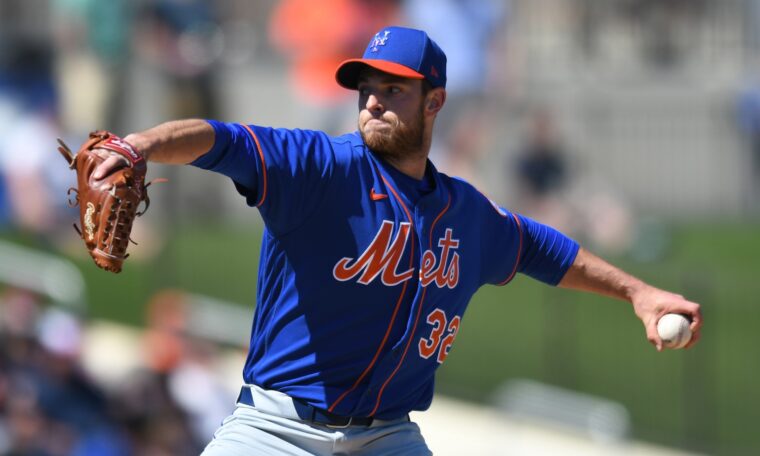

Around this time last year, I wrote an article that focused on how 2019 could finally be the breakout year we’ve been waiting for from Steven Matz. He ended up reaching a bunch of single-season career-high marks, but it didn’t exactly happen in the form of a breakout.
After all, your general manager doesn’t bring in more competition for your rotation spot if you’re supposed to be on solid ground, ya know? The competition has brought out the best in Matz so far this spring, as he’s thrown six innings of 1.50 ERA ball with no walks and five strikeouts.
In Saturday’s start against the Washington Nationals, he looked very sharp and ready to stake claim to a rotation spot he’s already had for a number of years. In his short outing, I couldn’t help but notice that his secondary pitches — the curveball and changeup in particular — were also looking very crisp. Watching his curveball perform in that manner wasn’t overly shocking because it’s been one of, if not the most effective pitch in his arsenal from year-to-year when using opponent wRC+ as the barometer.
The performance Matz’s changeup over the weekend, on the other hand, is what caught my eye, especially after looking into a little more.
Since debuting with the New York Mets in 2015, the southpaw has steadily increased the usage of his changeup with each year of big-league service time he’s accrued. The other interesting part, though, is that the offering’s effectiveness hasn’t exactly shot through the roof with this increased usage. The below table shows how Matz’s changeup usage has changed each year since 2015, along with the corresponding wRC+ and ISO from opposing hitters.

The left-hander has also experienced some inconsistent results with his strikeout rate during this same period of time. Since 2015, his yearly strikeout rate when throwing a changeup looks like this: 26.7%, 12.7%, 8.5%, 21.9%, and 12.9%. Upon looking at all these numbers, it’s not exactly what a pitcher wants to see from his second-most used pitch in game situations. If we use FanGraphs’ pitch values on a per-100-pitch basis, Matz’s changeup has finished as a positive number each year except once, but all of his results don’t hold a candle to how the offering produced in his rookie year (2.16 pitch value in ’15, never higher than 0.42 in any season since).
Matz did finish 2019 strong with a 3.52 second-half ERA (4.89 prior to the All-Star break) and it actually didn’t have much to do with his changeup. It likely had more to do with increased slider usage, which was a rotation-wide trend among Mets starting pitchers upon returning from the midsummer respite.
But a changeup being key to finally seeing a breakout season from Matz isn’t predicated on the fact that it remains the second-most used pitch in his arsenal. Maybe he continues leaning on his breaking pitches and busts out the changeup less often and at strategic times to help boost its overall effectiveness.
Maybe his strong spring performance thus far has been a side effect of working with pitching coach Jeremy Hefner on understanding the analytics side of things and how it can benefit him on the mound, too. Spring Training stats obviously don’t mean anything, but between 2016 and 2019, his Grapefruit League ERA never dipped lower than 4.26, which has included 30 walks allowed in 72 innings pitched. That’s about one walk in every couple innings or so.
There certainly seems to be some kind of growth going on here, and we can hope that the southpaw finds a way to carry the momentum he’s generating into the regular season. It’s important for the Mets to have someone like Matz healthy and productive in the rotation because he’s the only left-handed hurler they have available. Having that different look can help keep hitters on their toes throughout a series.
There was a chance that Matz could’ve finally broken out last year, but he ended up taking just a small step in the right direction. With some new coaches and new motivation in the form of rotation competition, there should be optimism that 2019’s small step turns into a sizable leap in 2020. It’d be a boon for New York to have a significant contributor rounding out the back end of manager Luis Rojas‘ rotation.