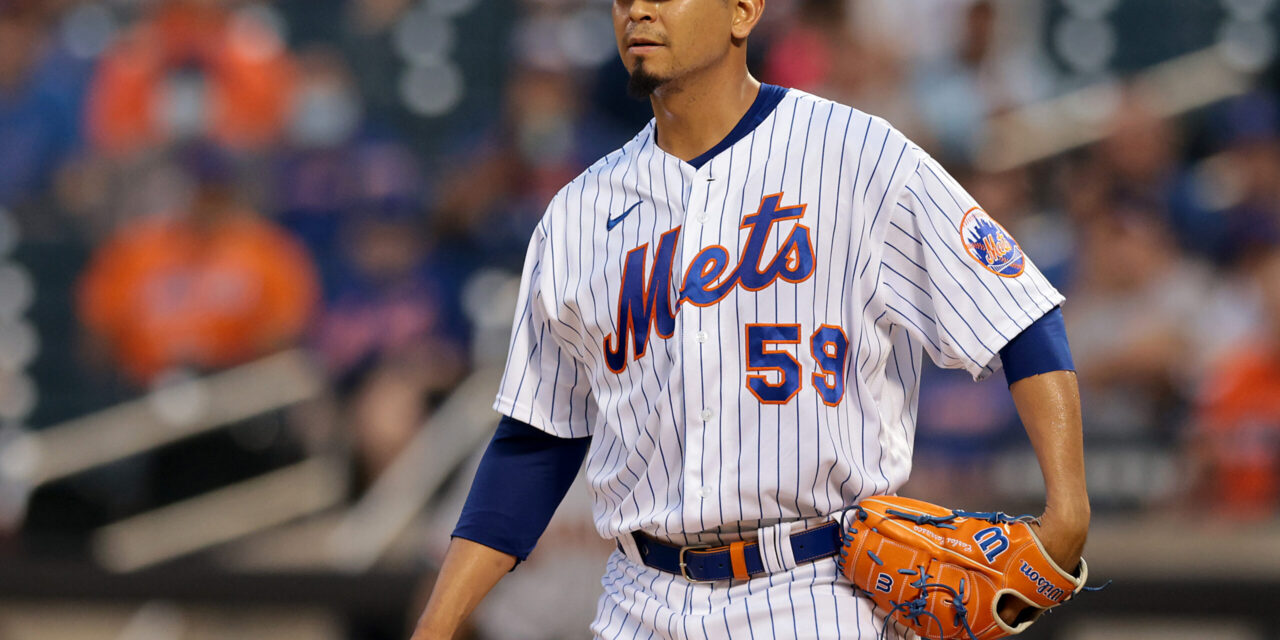

There’s no way around it — Carlos Carrasco‘s first year with the New York Mets was a complete disaster.
Between his season starting late because of injury and the lack of effectiveness once he finally took the mound, not much went right for the veteran right-hander. While he’s put together a solid track record throughout the course of his career, Carrasco is one of the many question marks residing in the Mets’ current Opening Day rotation. The injury and underperformance are enough to make any New Yorker cringe, but throw in the fact that he’ll be entering his age-35 campaign in 2022 and that’s enough to make some fans think he’s “done”.
At least, that’s what Twitter tells me, which sources say is always true and accurate.
Jokes aside, there’s a lot riding on next season for Carrasco after putting up a disappointing 6.04 ERA with a 1.43 WHIP, which was accompanied by a 21.1% strikeout rate in 53 2/3 innings of work. Even in an abbreviated season, there appears to be some stark outliers when it comes to certain statistical categories in Cookie’s performance. For instance, he stranded runners at a 63.1% clip in 2021. This number hasn’t been that low since 2013 (60.7%) and it’s obviously much worse than his career mark (73.5%). The same could be said about his 2.01 home runs allowed per nine innings rate. Sure, it’s the second time it’s been above 2.00 in the last three seasons, but his career rate is still just 1.09.
And, of course, it’s impossible to forget his first-inning struggles, which have been well documented in most places. When looking at some other areas of his profile, though, there aren’t any huge differences from past successful years. Carrasco’s ground-ball rate has dropped and his fly-ball rate has risen in recent seasons, but not necessarily at an alarming rate, while his 16.6% soft-hit rate allowed and 34.3% hard-hit rate allowed aren’t far from his career average (16.9%, 32.2%, respectively).
So what’s that leave us with? His pitch mix. There’s some interesting stuff to dissect here, too.
Sudden Reliance on His Fastball
Between 2009 and 2016, Carrasco never finished a season with a fastball usage rate lower than 50.0%. Among all these seasons, his lowest was in 2016, when he threw it 52.7% of the time. That began a mostly steady decline in fastball usage, as his numbers from 2017-20 were as follows: 48.4%, 44.8%, 46.1%, and 39.3%.
For someone who went from having a mid-90s fastball to a low-90s fastball over the years, this progression makes sense. It just screams “crafty veteran figures out other ways to get opposing hitters out”, right? After all, among the pitches Carrasco has thrown at least 2,000 times in his career, his four-seamer has produced the worst wRC+ (160), and the second-worst strikeout rate (12.9%). It’s one of those pitches that’s likely more effective if hitters don’t see it constantly.
That’s the trend Carrasco was on…until 2021 when that number skyrocketed back up to 50.0%. He also paired it with an average velocity of 93.3 mph — his lowest in a single season since 2011 (92.5). Six of the 12 homers he allowed this past season came off his four-seamer while opposing hitters knocked this pitch around the most to the tune of a .999 OPS and 168 wRC+.
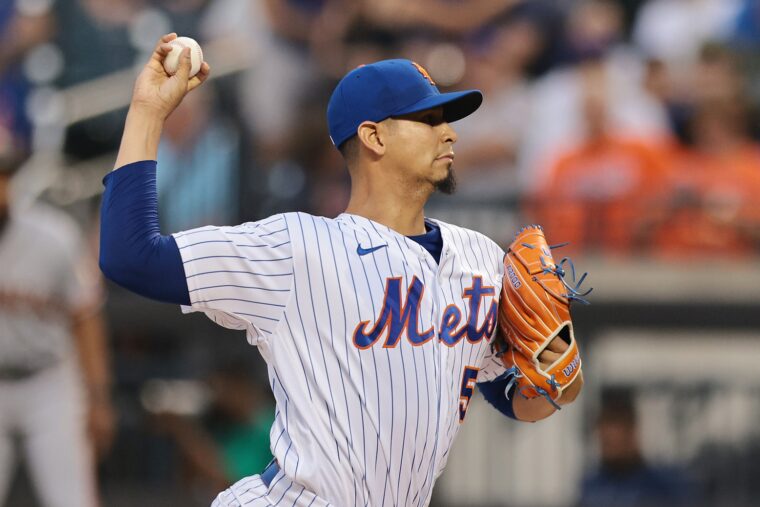
Mandatory Credit: Vincent Carchietta-USA TODAY Sports
Declining Usage of Breaking Pitches
One of the concerning things to come out of Carrasco’s season was a significant decline in strikeout rate. After finishing with a strikeout rate of at least 28.0% in five of the last six years heading into 2021, it settled in at 21.1%. However, upon seeing his pitch mix, that kind of drop isn’t very surprising.
As mentioned before, Carrasco’s fastball usage went up to 50.0%, and whether we’re talking about the four-seamer or the sinker, neither of those offerings generate a ton of whiffs. His two most effective pitches from the standpoint of strikeouts are his slider and curveball. Cookie’s slider generated a 33.3% strikeout rate in 2021 (41.8% for his career), and his curveball checked in at 40.0% (45.5% for his career).
If only he threw both of those pitches more often last year.
Carrasco’s slider usage crested over 20.0% for the fourth straight year in 2021, but it’s now firmly on a downward trend. Here’s the progression from 2016 through this past year: 16.0%, 19.8%, 26.7%, 31.5%, 22.6%, 20.2%.
The progression of his curveball usage isn’t as linear, but it still makes you scratch your head. After not using it less than 12.0% of the time between 2016 and 2018, he’s finished with a usage rate above 10.0% once and below 5.0% twice in the past three seasons. The actual cause here is anyone’s guess, but one has to wonder how much the actual baseballs themselves played a role, too.
Looking Ahead to 2022
It’s easy for someone like me to look at Carrasco’s statistics and say he needs to throw his breaking pitches more to be successful, but he’s the one that actually has to do it. Maybe the balls did play a role in his decreased usage. Maybe it had something to do with his rehab and not feeling like his arm was where it needed to be when he officially came back. Maybe it was something else — I’m just speculating at this point.
Carrasco has been one of the league’s more consistent rotation performers in recent years, but none of his performances were better than 2017 and 2018 when he posted consecutive seasons of at least 5.0 fWAR. Looking at how things have progressed since then, it may not a coincidence that it happened as he relied less often on his fastball and more on his breaking pitches.
It’s hard for me to think Carrasco is “done” after a poor debut season in Flushing. There were a lot of variables in play that made the buildup to his first start anything but routine. Hopefully, a regular winter and spring training will allow him to get his body and arm to a point where he’ll feel comfortable executing his pitches consistently and effectively for the Mets next season.