Photo by Ed Delany, MMO
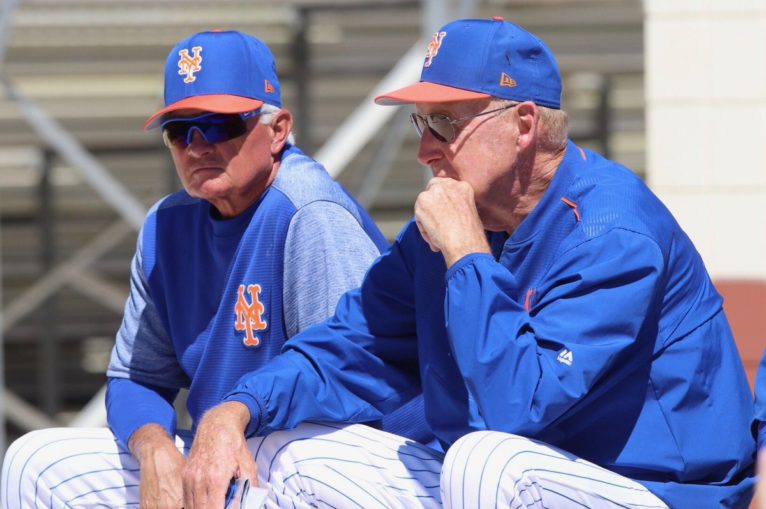
Shortly after the Mets’ coaching staff shakeup on Thursday, the internet trolls came out in full force. They wanted a more progressive pitching coach than Dave Eiland so they named an 82-year-old to the position? Clearly, the naysayers had no idea what Phil Regan is all about.
Regan has given 60-plus years of his life to professional baseball, the last 11 of which have been spent with the Mets. From 2009-2015 he served as the pitching coach for the St. Lucie Mets of the Class-A Florida State League. Here’s just a sampling of the players Regan worked with during that time who have gone on to have major league success to varying degrees:
Matt Bowman, Chasen Bradford, Jacob deGrom, Jeurys Familia, Michael Fulmer, John Gant, Robert Gsellman, Matt Harvey, Adam Kolarek, Seth Lugo, Steven Matz, Collin McHugh, Hansel Robles, Noah Syndergaard, and Zack Wheeler.
“He reminds me of Kerry Wood,” Regan said of Syndergaard in 2013. “A lot like him, but a better body. He has that tall Texan style.” Regan would know. He was Wood’s first major league pitching coach with the Cubs in 1998.
Since 2016, Regan had settled into the role of assistant minor league pitching coordinator, spending his time on the backfields of the Port St. Lucie complex working with young pitchers in extended spring training or rehabbing from an injury.
Regan is known for making subtle but significant tweaks to his pitchers’ mechanics. Back in 2016, Syndergaard called Regan a “delivery guru.” When the two paired up during the 2013 season, Regan encouraged his prized prospect to focus on his legs and core and getting lower during his windup. Syndergaard’s velocity spiked from that point and he simply hasn’t looked back.
Fulmer, the 2016 American League Rookie of the Year, worked with Regan to recover from major injuries in 2013 and regain top prospect status in 2014.
“It’s staying back a little longer on my backside. And then really getting over on top of the ball and keeping my front side strong and keeping it closed,” Fulmer said at the time. “It’s just little things. I think everything is going in the right direction.”
That’s been Regan’s philosophy: focus on the little things. “I try to come in and not change their whole delivery,” Regan said earlier this month. “I’m not a big believer in doing that or taking pitches away from them. But there’s a lot of little fundamental things that you have to do as a pitcher. And sometimes a person can see that, maybe just one little thing. Try it, and if you like it stick with it.”
Despite the immense impact that he has had on the organization’s development of pitchers over the past decade, many were shocked when, after Friday’s win over the Cubs, Regan demonstrated the same proficiency as the coaches half his age who are changing the way the game is being analyzed. Here’s a fascinating anecdote that he shared with reporters in Chicago:
“You have to adjust. You have to adjust to new things — the computers, the analytics, the high-speed cameras where you can stop and show the rotation. I had an interesting thing last year where Houston led all of minor-league baseball with swings-and-misses on four-seam fastballs. We were second, and I wanted to know why we were second. I came to find out they had a perfect 180-degree rotation on their fastballs and we were just this much off. I went to Brooklyn when they were playing Houston, and I saw their rookie team and I went out early to see what they were doing. I saw some things they were working on to get that rotation, and we’ve incorporated that, too, into our organization.”
“You never stop learning,” Regan said. “You’ve got to keep up with it, because if you don’t, the other teams are going to do it and you’re going to be left behind.”
Regan obviously is not a long-term solution to solidifying the coaching staff, but his impact on the Mets’ arms cannot be understated. And, at 82, he isn’t watching the game pass him by; he’s running along with it.