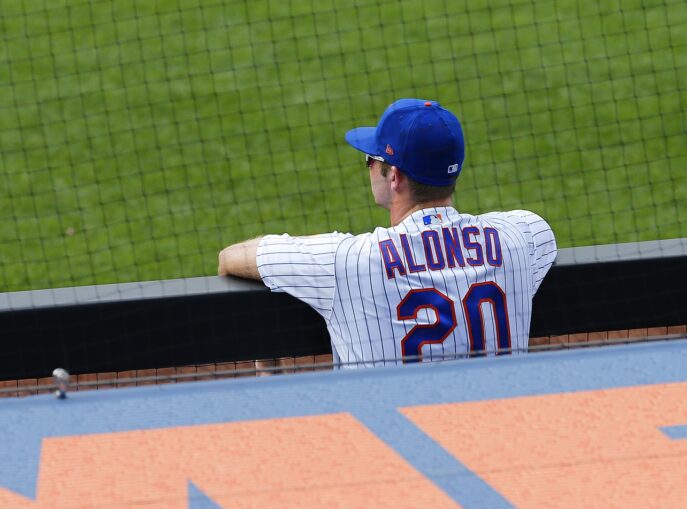

New York Mets first baseman Pete Alonso is experiencing the other extreme compared last year’s Rookie of the Year performance.
He got his season off to a terrific start in 2019, slashing .292/.382/.642 through 123 plate appearances in March and April. Sure, that included a 28.5% strikeout rate, but nobody thought much about that because it was accompanied with nine home runs, 26 RBI, and a 164 wRC+. However, his performance has been on the other end of the spectrum since Opening Day on July 24th. Through 47 plate appearances, Polar Bear is slashing just .175/.298/.250 with one homer, three RBI, a 31.9% strikeout rate and a 70 wRC+.
There have already been points when it seemed like he was ready to snap out of this early-season funk. Like when he hit a laser over the Green Monster at Fenway Park, or when he followed that with a four-hit performance a couple nights later at Citi Field.
But unfortunately, we’re now 10 games into the season and the 2019 home run king is still struggling mightily. Starting the season off quick is something every ballplayer aspires to achieve. In a 162-game scenario, a slow start isn’t necessarily a doomsday scenario because there’s plenty of time to make up for it. This year, though, nearly one-fifth of the season is already complete, and the Mets’ biggest power source from last year hasn’t gotten his footing yet.
And now that there’s no chance of Yoenis Cespedes getting hot and helping carry the load, this responsibility is fully on Pete’s shoulders. (Yes, I know there are others who can help out here, but when Alonso is firing on all cylinders, this lineup looks a lot scarier.)
So what’s been going on? The most obvious thing missing is Alonso’s prolific power. Last year’s 53 dingers were a huge reason behind his .323 ISO, which ranked fifth best in baseball. That number is only at a measly .075 this far in 2020.
His 34.8% hard-hit rate isn’t too far off the 42.2% mark he posted last year, but it’s been accompanied by a noticeable rise in ground-ball rate (44.0%) and an equally noticeable drop in fly-ball rate (36.0%). Opposing pitchers have clearly made some adjustments to their collective approach against Alonso, which is evidenced by a shift in pitch mix (2020 numbers were taken prior to Sunday’s game).

When looking at how he’s performed against these pitches, he’s weathered the increase in cutters reasonably well — Alonso owned a 199 wRC+ on that offering heading into Sunday’s finale against the Atlanta Braves. However, the power still hasn’t been there based off a .400/.571/.400 triple slash.
The one glaring change here has been his performance against four-seam fastballs.
This was an offering Alonso tattooed last season. He saw that pitch 888 times, slashing .284/.416/.728 with 21 homers and a 194 wRC+. A shift in pitch mix from opposing hurlers has led to Alonso seeing fewer four-seamers, and he hasn’t taken advantage of the limited opportunities he’s had.
Heading into Sunday, the first baseman still hadn’t recorded a hit off a four-seamer and paired that with a 44.4% strikeout rate and -47 wRC+. These numbers are extreme because we’re only talking about 10 games, but this is also what happens when his contact rate within the strike zone goes down nearly 10 percentage points while only hitting ground balls, which is what he’s doing.
Should there be cause for greater concern here? No. It’s the start of a weird season, and with New York collectively struggling as a squad, his personal struggles are magnified. In addition to trying to force his way out of this slump, he’s likely also trying to do that in order to help his team get out of its current funk.
He’s not chasing a ton of balls out of the zone — compared to last year — and pitchers are actually staying within the zone slightly more often. There’s been a rise in first-pitch strikes to Alonso, which makes it easier for the opposition to dictate how an at-bat goes from a sequencing standpoint.
Moving forward, it’ll be crucial for him to stay within himself enough to pounce on one of those opportunities where he does see a four-seamer. I had hoped the homer in Boston would’ve done the trick with regard to snapping out of his funk and getting back on track. Since his four-hit game came just a couple nights later, I was still holding out hope this would be the case, but it clearly hasn’t happened yet.
Whenever it does, let’s hope it’s soon enough for the Mets to climb out of the NL East basement and into playoff contention. Even with an expanded postseason field in play this year, New York has already seen their odds of playing in October drop more than 20 percentage points (69.0% on Opening Day to 48.1% as of Sunday evening).
The first step would be getting hits with runners on base the next three days and experiencing some positive results heading into Thursday’s scheduled off day.