Brandon Nimmo enjoyed a true breakout campaign for the New York Mets in 2018, and it had many of us excited for how he’d back that up in the year that followed. It unfortunately didn’t go how anyone wanted.
While his September 2019 production was what we were hoping to see, nothing else went according to plan, including a slow start and a prolonged period on the Injured List. Nimmo was ultimately limited to just 69 games played (nice) and 254 plate appearances.
The 2020 campaign was mostly a return to normal for Nimmo, or at least, back to his 2018 levels of production. He racked up 225 plate appearances and played all but five games while slashing .280/.404/.484 with eight home runs, 18 RBI, and 33 runs scored. All that led to a healthy 158 wRC+ and 1.5 fWAR.
Nimmo’s rebound included a few different things: good stuff we’re used to seeing, new stuff that’ll hopefully stick, and some weird stuff that hopefully changes in 2021.
The Usual Good Stuff
Since nearly the minute Nimmo made his big-league debut, he’s flashed elite plate discipline and walk rate numbers. For the most part, these trends continued.
His 14.7% walk rate is actually the lowest single-season mark he’s posted in a year with 200-plus plate appearances, but it was still a top-15 mark among qualified hitters. His .404 on-base percentage was a notch above that, squeaking into the top-10 among the same group.
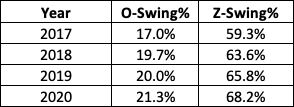
As usual, this is fueled by excellent plate discipline. Nimmo has constantly showed that he simply won’t chase many balls outside the strike zone. He’s continued to pair that with an increased aggression within the strike zone. Here’s a look at how his chase rate and swing rate on strikes has progressed since 2017:
Getting on base consistently whether he’s swinging the bat well or not obviously helps prop up his overall offensive value. Since 2017, he hasn’t finished with a wRC+ lower than 114, and this year’s 148 mark is tied with 2018 for his best single-season performance.
Some New Good Stuff
It’ll be impossible to know what would’ve actually lasted through a 162-game season, but there were a handful of encouraging improvements within Nimmo’s offensive game in 2020.
The most notable one was a drop in strikeouts. Here’s how Nimmo’s strikeout rate has changed from year to year since 2017: 27.9%, 26.2%, 28.0%, and 19.1%. As one would imagine, this drop (along with a lower walk rate) resulted from a rise in contact.
If we continue looking at the last four seasons in particular (since 2017), his 78.9% contact rate from this past year is a single-season career high. There was a slight bump in contact within the strike zone (83.6% to 84.8%), but most of the difference came from making contact outside the zone (52.1% to 65.0%). More on that in a bit, though.
There has appeared to be a continued effort in using the whole field more, and there’s a clear trend going on in the below table — especially since 2018.
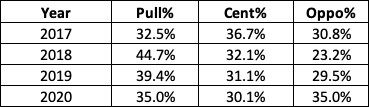
It’s interesting that the percentage of balls getting hit up the middle has largely stayed the same over the last three seasons, leaving the biggest change happening between his pull rate to oppo rate. He must be taking a page out of Michael Conforto’s book.
The Weird New Stuff
All the things discussed so far about Nimmo’s offense in 2020 has been great. The consistency in his approach is likely the main driver to the results he’s experienced. However, there was one glaring statistic that made me scratch my head: his quality of contact.
Check out how his soft-, medium-, and hard-hit rate has compared over the years since 2017.
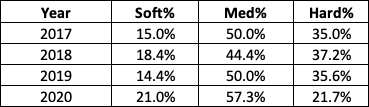
This is a curious development because while his ground-ball rate rose and his fly-ball rate dropped, he still produced a healthy BABIP (.326) and ISO (.204). One explanation can be the increased contact he experienced outside the strike zone. However, it gets even more curious when looking at how things have shifted from one year to the next for each batted-ball event.
Here’s a look at how Nimmo’s quality of contact and results for grounders, fly balls, and liners differ between 2019 and 2020.
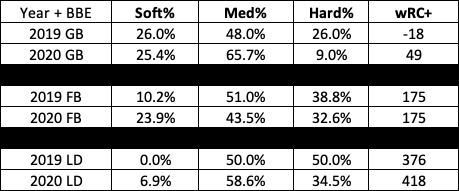
That drop in ground-ball quality of contact certainly doesn’t make the corresponding rise in wRC+ look sustainable.
As Steve Cohen gets settled in as the Mets’ new owner and they get “off and running”, it’ll be intriguing to see how the front office decides to handle certain parts of a crowded roster. Nimmo has done his best in center field, but he should be in a corner outfield position.
If he doesn’t get traded, who does? Where does Dominic Smith and his potent bat fit into the lineup, especially if there is no Designated Hitter in 2021? It’ll be vital for the Mets to find ways to not only alleviate specific roster crunches, but also find the right trade partners to appropriately bolster the pitching staff.
There will be tough decisions along the way, but it sure sounds like things will be interesting this winter. After a disappointing 2019, Brandon Nimmo did enough this past season to be an attractive trade option for potentially interested suitors if that’s the route New York heads down.