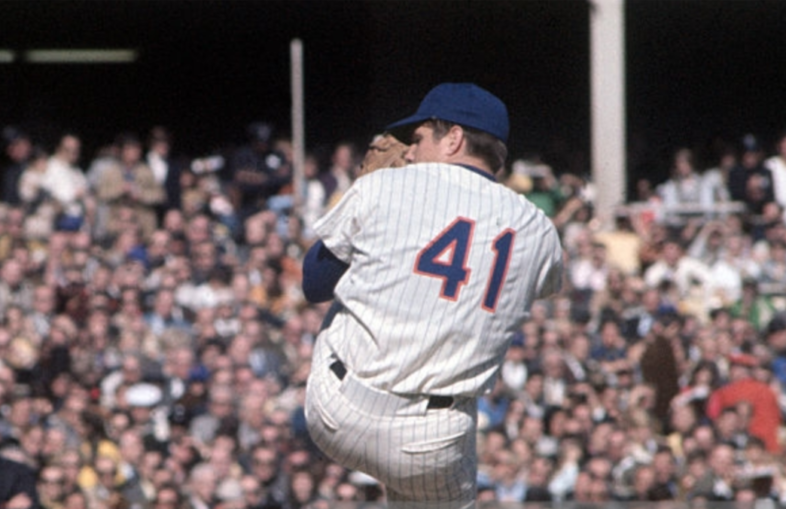
Note: With the tragic news that Mets icon Tom Seaver is suffering from dementia, I wanted to share an article I wrote for The Village Voice on July 26, 1988, right before the Mets retired his number. I make the case for Seaver being the greatest right-handed pitcher of all time. Enjoy.
* * * * * * * * * *
I’ve never been rational about Tom Seaver, a hero to me of such mythic proportions that it would take a conference on the mound between Bob Costas, Tim McCarver, and Sigmund Freud to analyze it. So go ahead and accuse me of being completely non-objective, but I don’t believe it’s irrational to make the following statement:
TOM SEAVER IS THE GREATEST RIGHT-HANDED PITCHER IN BASEBALL HISTORY.
I realize the Hall of Fame Veteran’s Committee would scream “Holy Gil Hodges!” at hearing Tom Seaver mentioned in the same breath as Walter Johnson, Cy Young, and other statistical marvels of early 20th century baseball, and I’ll address that argument later.
The true measure of number 41’s greatness lies in how the man who won 311 games (18th all-time) struck out 3,640 (sixth), threw 61 shutouts (seventh), and compiled the second best ERA (2.74) in National League history (among pitchers with over 200 wins), stacks up against contemporaries who are or will be in the Hall of Fame.
You can scratch Don Drysdale (209 wins), Catfish Hunter (224), Juan Marichal (243), and Ferguson Jenkins (284 wins, but 226 losses and a 3.34 ERA). The same goes for Don Sutton, Phil Niekro, and Gaylord Perry. Those three won a few more games than Seaver, but none surpasses Tom in any other major category.
And as opposed to Sutton and Niekro, who never won a Cy Young Award, and Perry, who won two, Seaver nailed down three of these awards himself and arguably deserved two more:
I’m still pissed about 1971 when, despite Seaver’s 1.76 ERA and 20 wins, the award went to Jenkins (2.77 ERA, 24 wins) because the writers wanted to reward Fergie’s cumulative achievements. Tom also should have won the Cy Young in the strike shortened season of 1981, when he went 14-2, but the writers gave into Fernando Valenzuela mania.
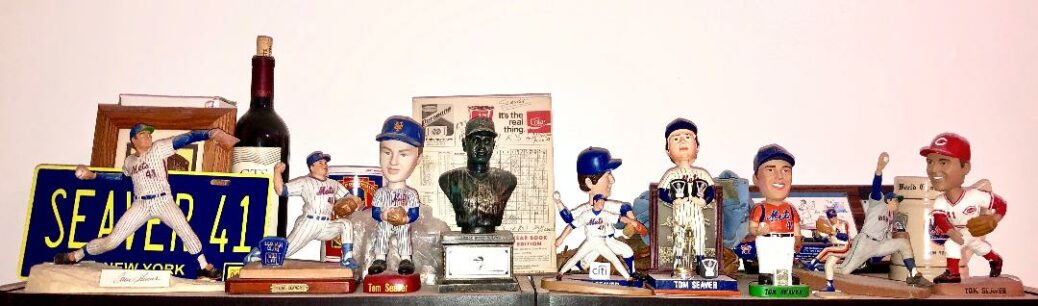
Photo by Stephen Hanks. My personal Tom Seaver bobble head collection.
Then you have Nolan Ryan, Bob Gibson and Jim Palmer. Without question, Ryan possesses the best right-handed arm of all time, but his lifetime winning percentage was only slightly above .500. He never won the Cy, won 20 just twice, and beats his buddy Tom in only three categories: no-hitters (seven to one), hits-to-innings pitched ratio, and of course, strikeouts.
[Current Writer’s Note: Since this piece was first published, I realize that both Greg Maddux and Roger Clemens fashioned careers with more than 350 wins. While I revere Maddux, he accumulated most of those wins pitching for the great Atlanta Braves teams of the 1990s and had a higher career ERA than Seaver. As for Clemens, all I’ll say is that Tom Seaver never had to pitch or hang on for years using PEDs. Case closed.]
But it’s Seaver, not Ryan, who holds the record for the most consecutive seasons of striking out 200 or more hitters (nine). And if the odds against pitching a no-hitter are high, what are the odds against the last 10 straight hitters not even putting a ball in play?
If those who witnessed Seaver set that consecutive strikeout record at Shea on April 22, 1970, didn’t feel, as I did, as if they were being levitated from their seats, they must have been cricket fans just in town for the week.
Bob Gibson won only 251 games, but for the eight years between 1963 and 1970 he may have been the most dominant righty ever (his 1.12 ERA in ‘68 is still THE single-season record). And Jim Palmer (268 Ws) won 20 games eight times (more than any hurler of the era), took three Cys, matched Seaver’s lifetime 2.86 ERA, and compiled a better winning percentage (.638 to .603).
But the stat that clearly establishes Seaver’s superiority over all his contemporaries is the difference between the pitcher’s winning percentage and the rest of his team’s.
In only seven of his 20 seasons did Seaver pitch for a team that played over .500 when he wasn’t on the mound. His lifetime percentage was approximately 120 points higher than his team’s. Palmer never pitched for an under .500 team. Gibson’s clubs played under .500 when he didn’t pitch just five times. Nolan Ryan hasn’t exactly pitched on powerhouses, but he’s rarely been able to overcome his team’s weaknesses.
Seaver managed to win even with the no-hit Mets of the ‘70s. But I still remember countless, agonizing games when Tom would enter the late innings with the game tied 1-1, or he was losing 1-0 or 2-1 or 3-2. I sweated, paced and prayed in front of the TV for the Mets to score, only to see Seaver yanked for a pinch-hitter in the seventh, eighth or ninth.
If Terrific had pitched for the Orioles or the Reds of that period, or if he’d had a DH, he might have flirted with Christy Mathewson and Grover Alexander (373 Ws each) on the all-time wins list.
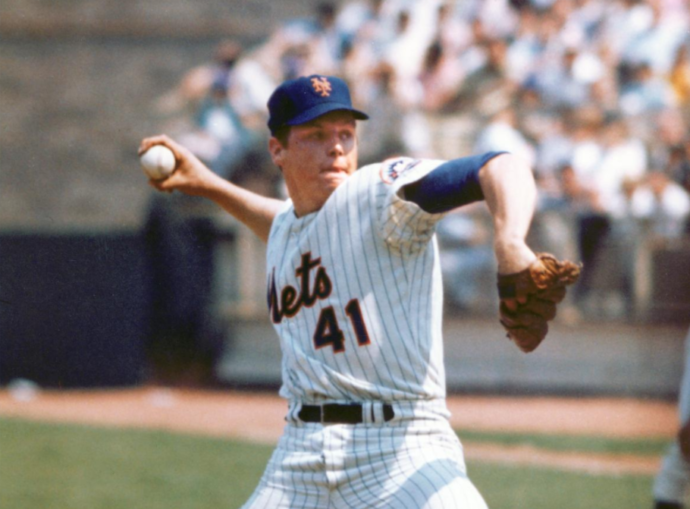
Which brings us back to the Veterans Committee and Walter Johnson, Cy Young, et al. In his Historical Abstract, writer Bill James ranks Seaver third on his “career value” list of the 30 greatest right-handed starters, behind Johnson (416 wins) and Young (511), and ahead of Mathewson and Alexander.
Now I know most Jamesians would cut their hearts out before comparing players of different eras, but I don’t see how any pitcher who threw in the first two decades of this century–the dead ball, pre-slugger, pre-black era– could be considered superior to someone who compiled Seaver’s stats pitching to the National Leaguers of the late ‘60s to early ‘80s, an era which boasts many of the most prolific hitters and base stealers in baseball history.
One more point: I’m sure we’d agree that baseball players rely more on finely honed skills than do football and basketball players, but if athletes in the latter two sports are bigger, stronger, faster, and more skilled than their counterparts of 20 years ago, wouldn’t the same hold true for baseball pitchers separated by a half a century?
Twenty or thirty years from now, when most pitchers are the size of NBA small forwards and NFL middle linebackers, some wise-ass can cavalierly dismiss Seaver as the best of all time, with my blessing. But until then, Tom “Terrific” Seaver is the greatest!