The New York Mets’ rotation in the first half has been quite the enigma. On the exterior, there’s reason to be optimistic: starters have combined for the fifth-most innings in baseball (507.2), and their contact and control peripherals feature a second-highest soft-hit rate (19.4%), fourth-lowest hard-hit rate (35.1%), seventh-highest strikeouts per nine innings (9.24), and tenth-lowest FIP (4.10). And yet, despite all having a shot at cracking 30 starts, each of the five pitchers has struggled in one area or another.
Perhaps a symptom of having one of the game’s worst defenses or even the seams on the baseball being noticeably lower, the general inconsistency came to a head last month when the team made a controversial decision to fire pitching coach Dave Eiland, replacing him with longtime minor-league coordinator Phil Regan. Though they’ve made strides in missing bats (chase rate has climbed 6.5% and swinging-strike rate 0.9%), the rotation ERA of 5.34 with Regan is the eighth-highest, and their 68% strand-rate the league’s seventh-lowest mark. In less mathematical terms, every step forward has brought with it a new kind of step back. Given the expectations heading into the 2019 season, each misstep has seemed more frustrating than the last. Like the bullpen, nobody has been particularly safe.
***
Jacob deGrom: Defending a National League Cy Young award and living up to a five-year contract extension at the same time is no easy task, but for the most part, deGrom has been up to the challenge. Just one of three Mets selected to play in this year’s All-Star Game, deGrom’s 3.3 bWAR is the second-highest on the team, and double that of the next-best pitcher, Zack Wheeler. With a 3.27 ERA, 3.14 FIP, and 5.52 K/BB ratio, the righty enters the second half riding a seven-game quality start streak.
Since May 18, he’s worked to a 2.68 ERA, though home runs have crept into his line more frequently, as he’s still averaging one per nine innings (he averaged a league-best 0.4 per nine last season). He’s cracked seven innings in seven of his 18 starts to this point, a step down from his 11 in the first half last year, but all-in-all, deGrom has been a breath of fresh air in an otherwise bleak pitching staff.
Grade: A
Noah Syndergaard: While some could have seen slight regression following a year that saw fewer strikeouts across the board through even fewer innings in 2018, very few could have seen the righty struggling this mightily through the first half of 2019. He’s allowed a career-worst 1.2 HR/9 while sporting an ugly 4.68 ERA (albeit a 3.98 FIP), and it’s almost completely correlated with a loss for both his fastball and his slider (for what it’s worth, his changeup value of 9.6 runs above average is the third-highest in the National League behind Hyun-Jin Ryu and Cole Hamels).
Syndergaard may best embody the inconsistency that has plagued most of the pitching staff through an aggravating first half, as he’s strung together consecutive quality starts just twice in 2019. The 67% strand rate hasn’t helped him get through innings cleanly, and his NL-leading 19 stolen bases allowed have only made matters worse. As the Mets prepare (or at least should prepare) to sell off assets at the deadline, they may need to reconsider moving Syndergaard until his value comes back to the surface.
Grade: D+
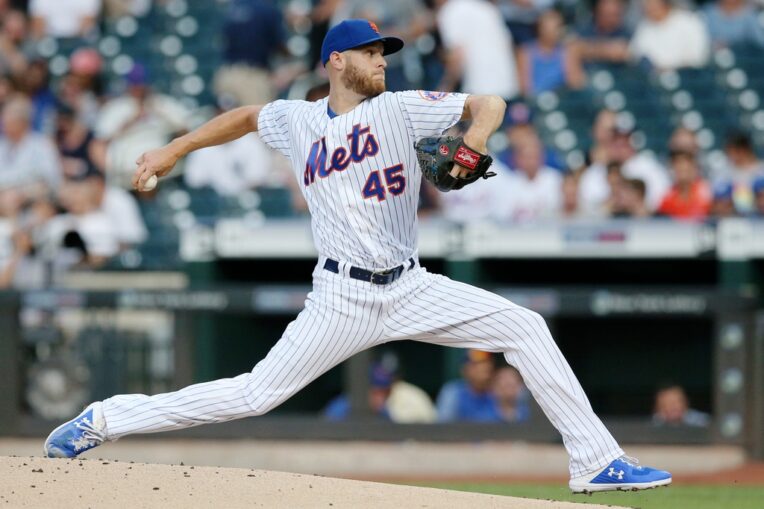
Zack Wheeler: Wheeler has, to an extent, been extremely unlucky through the first half. He’s brought his walk rate down to a career-best 2.6 per nine, while his strikeouts per nine are at a career-high 9.8. The 3.65 FIP contrasts a 4.69 ERA, but he still hasn’t pushed the latter below 4.42. Like Syndergaard, he’s struggled to get a move on despite maintaining some of the wipeout stuff that headlined a smoother 2018. Baserunners have been tough to control – as the rotation-worst 65.9% strand-rate can confirm.
Despite picking up another mile per hour on his fastball, Wheeler still hasn’t been able to harness it through his outings, as he’s only worked seven innings twice since June. His prior seven starts were far more encouraging, with 56 strikeouts to 8 walks in 48.1 innings. The makeup hasn’t gone anywhere; he simply hasn’t executed as often.
Grade: C
Steven Matz: Home runs have dampened another healthy campaign for the Long Island native, who as a prospect consistently kept the ball on the ground, but couldn’t stay healthy. His 5.39 FIP doesn’t help an already-tough 4.89 ERA, and it’s almost entirely attributable to the two homers he’s averaged per nine innings. His groundball and strand-rates are almost identical to his figures from last year, when he worked 30 starts and managed a 3.97 ERA.
A quarter of Matz’s repertoire consists of sliders and curveballs, even though they’ve both been hit pretty hard through the course of the season. He hasn’t gone more than six innings in a start since April 28, and his eight homers allowed in June is tied for the second-most in the National League with Jon Lester and Chris Archer. He toiled in the bullpen through the last week of the first half, but his role at the back of the rotation has come into question at this point.
Grade: D
Jason Vargas: The 14-year veteran has had a polarizing first half, but has represented himself well as a pitcher despite his unacceptable behavior around reporters. He is just one of two Met pitchers to pull off a complete game this season – a rather noteworthy feat for somebody who couldn’t make it through the sixth inning until early-May. Since April 19, his 2.76 ERA and .209/.287/.356 opponent line has made for perhaps the biggest surprise amongst the staff.
Once an obstruction in a rotation that desperately needed a better option at the back-end, the soft-tossing lefty has redefined his value to not only the Mets, but potentially other contending teams as well. He’s managed to make the 85th percentile in exit velocity, but the career-high 3.8 BB/9 and now-lowest-in-baseball 84.9 mph average on his fastball could make for a harsh fall down to earth. His season may only have value in the long-run if the Mets can successfully trade him.
Grade: B+
Walker Lockett: The only other starting option to get consecutive looks (besides now-reliever Wilmer Font), Lockett has done little to separate himself from his mediocre numbers in the San Diego and Cleveland systems. Though in fairness, he has only gotten two starts at the big-league level. His first go-around against the Chicago Cubs lasted just 2 1/3 innings, with six earned runs coming across on five hits. Lockett’s second start in Philadelphia looked better: four earned runs on five hits with five strikeouts through 5 1/3 innings, though he also allowed two homers.
The jury’s still out on whether Lockett can be a serviceable depth piece, but the 25-year old groundball pitcher hasn’t necessarily been promising thus far. He’s currently in Triple-A Syracuse, where he’s averaging 4.5 K/9.
Grade: Incomplete