Mandatory Credit: Troy Taormina-USA TODAY Sports
As expected, Major League Baseball imposed a lockout when the Collective Bargaining Agreement with the Major League Baseball Players’ Association expired at midnight on December 1. Also as expected, both sides spent day one of the freeze on player activity pointing at the other side as the reason for impasse.
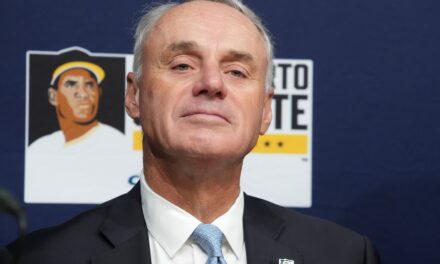
Commissioner Rob Manfred issued a statement on behalf of the clubs. From Anthony Franco and Tim Dierkes MLB Trade Rumors, here is an excerpt of Manfred’s comments:
“Simply put, we believe that an offseason lockout is the best mechanism to protect the 2022 season. We hope that the lockout will jumpstart the negotiations and get us to an agreement that will allow the season to start on time. This defensive lockout was necessary because the Players Association’s vision for Major League Baseball would threaten the ability of most teams to be competitive. It’s simply not a viable option. From the beginning, the MLBPA has been unwilling to move from their starting position, compromise, or collaborate on solutions.”
The owners chose to impose the lockout, they were not required to do so. Whether that moves the process forward remains to be seen. The MLBPA responded with this, also from the article noted above:
“Major League Baseball has announced a lockout of Players, shutting down our industry. This shutdown is a dramatic measure, regardless of the timing. It is not required by law or for any other reason. It was the owners’ choice, plain and simple, specifically calculate to pressure Players into relinquishing rights and benefits, and abandoning good faith bargaining proposals that will benefit not just Players, but the game and industry as a whole. … We remain determined to return to the field under the terms of a negotiated collective bargaining agreement that is fair to all parties, and provides fans with the best version of the game we all love.”
The key issues, as described here on MMO, are the level of competition in the game (trying to reduce or eliminate “tanking”), the compensation method for pre-free agency players, when free agency is awarded to players, the Competitive Balance Tax threshold, and the structure of the post season.
The owners, as has been noted by Manfred, have made creative proposals to the players. Among these proposals are instituting a salary floor that teams must meet, and starting a draft lottery so teams are not given higher draft picks by having the worst records.
The players do not see those proposals as adequate, and they may have a point. As can be seen below, the minimum salary in baseball has slowed in growth over the years. Those are the players the union is most interested in protecting, as players such as Max Scherzer, Francisco Lindor, and Bryce Harper have done quite well in free agency. From Tim Dierkes of MLB Trade Rumors, here is the response of the MLB minimum salary after new CBAs:
- 1968: Minimum salary went from $6K to $10K, a 66.7% increase
- 1970: $10K to $12K, a 20% increase
- 1973: $13.5K to $15K, an 11.1% increase
- 1976: $16K to $19K, an 18.8% increase
- 1980: $21K to $30K, a 42.9% increase
- 1985: $40K to $60K, a 50% increase
- 1990: $68K to $100K, a 47.1% increase
- 1997: $109K to $150K, a 37.6% increase
- 2003: $200K to $300K, a 50% increase
- 2007: $327K to $380K, a 16.2% increase
- 2012: $414K to $480K, a 15.9% increase
- 2017: $507.5K to $535K, a 5.4% increase
Further evidence that the players have lost ground revenue-wise comes from FanGraphs shown below. The players are getting a smaller and smaller share of league revenues over time.
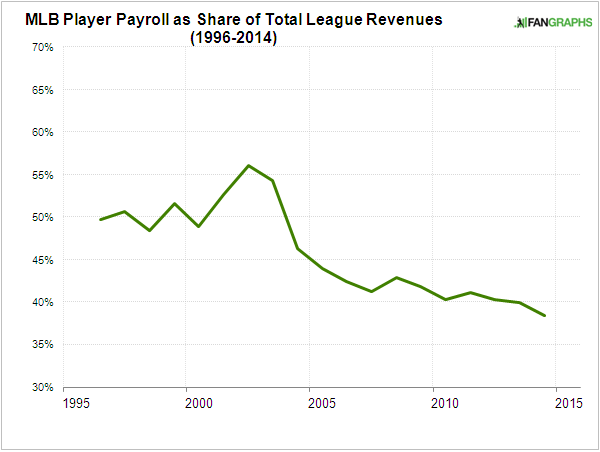
This is not to suggest that the players’ side in the dispute is “right” or more noble. However, the game’s revenues have gone up, and the players’ share has gone down. In 2001, MLB revenues were $3.58 billion. Those revenues increased every year through 2019, topping at $10.37 billion.
Manfred expressed that he’s optimistic that the current labor strife will not impact the 2022 season. That’s a nice sentiment, but the sides are far apart on almost all the issues (they seem to have agreed on the universal DH). The posturing that took place today is par for the course early in any labor dispute. What matters is how quickly they get back to the table and try to hash out an agreement.
The owners clearly feel that the lockout, and the associated uncertainty about where some players will play and how and when all players will be paid, will instill a sense of urgency for them to roll their sleeves up and work on an agreement. The players have touted that they have a “war chest” of funds, that they can provide to union members to partially offset missed salaries.
Both sides think they have right on their side, and seem, at least publicly, to be prepared for a long battle to get what they want in the negotiations. Here’s one thing owners, players, and fans do not want-missed games or a an entirely missed 2022 season.
It’s time, folks, to stop blaming the other side and get to work on an agreement. How quickly they do, and seriously so, will go a long way to when we will be able to enjoy the one/two punch of Scherzer and Jacob deGrom.