

Marcus Stroman took the mound for the New York Mets on Tuesday in a crucial series opener at Citi Field against the Chicago Cubs. Unfortunately, he was out-dueled by Yu Darvish, and although he did strike out seven hitters in six innings, he also allowed four runs on six hits and two walks.
This was Stroman’s fifth start with the Mets, and he’s yet to record a quality start while donning the orange and blue, something he did 14 times in 21 starts with the Toronto Blue Jays before getting traded. Through 25.2 innings with his new squad, the 28-year-old has posted a 21.7% strikeout rate, but that’s been accompanied with a 10.4% walk rate, a 4.91 ERA, 1.68 WHIP, and 1.75 homers allowed per nine innings.
Is there something to really be worried about? No, I don’t think so. Let’s not forget that he’s human — he just got traded for the first time in his career. He’s getting used to his new surroundings (even if they’re familiar for him) and a new league, all while trying to keep his regular routine.
Despite the sample sizes being uneven when comparing what he’s done in Toronto with what he’s done thus far with New York this season, it’s interesting to see a clear change in parts of his pitch mix. Thanks to Brooks Baseball, check out how the usage of his sinker and slider have changed throughout 2019:
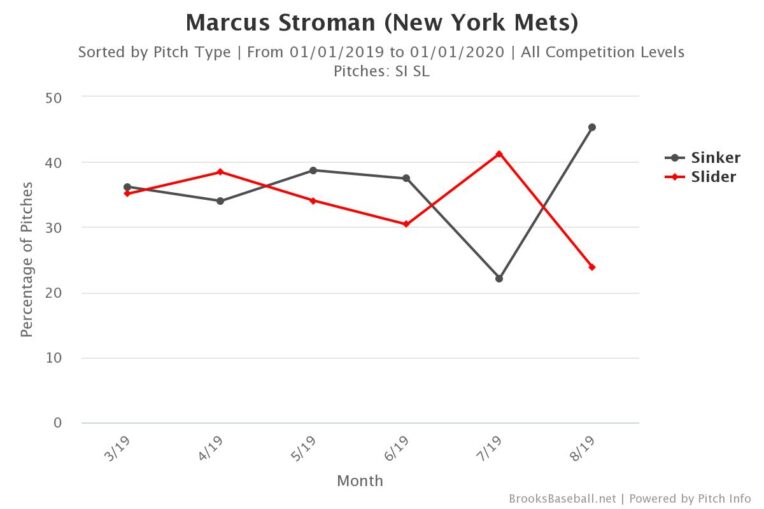
Stroman’s sinker is where he generates a ton of ground balls from (65.5% ground-ball rate so far in ’19), but it’s also the pitch that opposing hitters have produced the highest walk rate (11.8%) and second-highest wRC+ (121) among the offerings he’s tossed at least 100 times this year.
On the flip side, Stroman’s slider has probably been his most effective pitch when looking at his results from across the board. That pitch has produced the lowest walk rate (2.9%) and highest strikeout rate (32.0%), along with the second-lowest opponent OPS (.420) and wRC+ (19). It’s also produced the second-highest ground-ball rate among all the pitches in his arsenal (48.9%).
Although the right-hander has dropped his hard-hit rate nearly five percentage points since joining the Mets, his soft-hit rate has worsened by just a smidge more than six percentage points. The big difference comes in via his batted-ball profile — the ground-ball machine has seen his ground-ball rate drop from 56.3% in Toronto to 47.4% in New York, while virtually all of that difference has gone to an increased line-drive rate (16.7% to 26.9%).

For someone as cerebral on the mound like Stroman is, taking control of at-bats on a consistent basis is huge since he’s not a huge strikeout guy and depends more on controlling the quality of contact. Getting that first-pitch strike has been an important piece of his game over the years. That rate has never been below 58.0% in a single season and has been better than 60.0% three different times.
After tossing first-pitch strikes at a 59.5% clip with the Blue Jays this year, that number is down at 53.9% so far with the Mets. This has also coincided with leaving the ball in the strike zone more often than he had been doing earlier in the season (39.2% to 42.6%).
Is this splitting hairs a little bit? Well, yes, of course it is. And it’s also much easier to say, “Well, just throw more sliders again” compared to actually getting on a big-league mound and getting it done. This change in pitch mix could very well have something to do with the game plan that was put together for each of his five starts, and maybe he’s still trying to get used to having Wilson Ramos as his battery mate.
There are plenty of variables going into this conversation that can explain why Stroman’s pitch mix has changed. It’s not fair to jump to any conclusions with regard to his performance in New York because it’s only been a handful of innings. Based on his past track record of success pitching in the American League East, he’ll probably be just fine. Let’s just hope he hits a groove sooner rather than later since the Mets are at a crucial juncture in their season with regard to their potential playoff hopes.