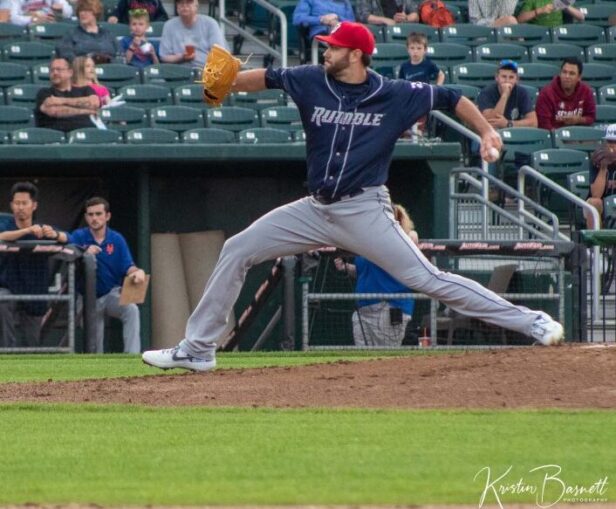
Photo by Kristin Basnett
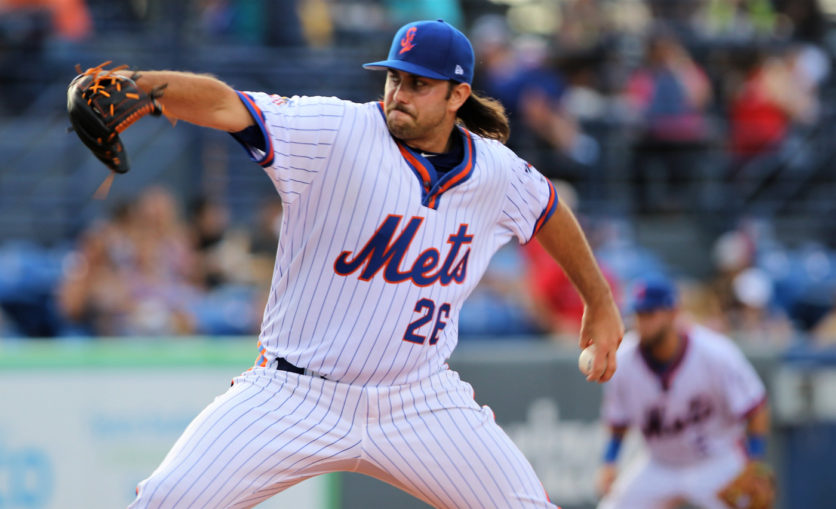
David Peterson, LHP
Position: Starter
Bat/Throw: L/L
Age: 25 (September 3, 1995)
Acquired: Mets 1st round selection in 2017 MLB Draft (20th player taken overall)
The New York Mets asked 15 non-roster players to join the team in spring training prior to the start of the 2020 season. Among those that will certainly bear watching is LHP David Peterson. The six-foot-six inch, 240 pound southpaw was drafted from the University of Oregon in 2017 and now ranks in the top ten of every Mets prospect list.
David John Peterson was born in Arcadia, California. He attended high school in Aurora, Colorado where he quickly became a starting pitcher. In 2014, he was drafted in the 28th round of the MLB draft by the Boston Red Sox but having signed a commitment letter to the University of Oregon, he did not sign with Boston and instead played four years with the Ducks.
He became the Ducks’ number one starter his senior year and set a school record by striking out 20 in a game. He also played on the United States national team the summer between his junior and senior years. The Mets drafted him in 2017 and assigned him to the Brooklyn Cyclones where he spent the entire season. He pitched in a limited capacity for Brooklyn due to injury and fear of a dead-arm owing to his extensive use at Oregon.
Peterson was ranked the Mets number two prospect by MLB.com as he began his 2018 campaign with the Columbia Fireflies. He quickly excelled and was promoted in June to St. Lucie, where, after a brief struggle, ended the season strong. Over the two levels combined, he posted a 3.16 ERA over 128.0 innings, allowing 120 hits, walking 30, and striking out 115.
In 2019, Peterson was promoted to Double-A Binghamton where he put up similar numbers as in 2018. He posted a 4.19 ERA in 116.0 innings, allowing 119 hits, walking 37, and striking out 122.
Peterson’s go-to pitch is his slider which tends to sweep rather than dip. It is hittable if it flattens out, and his opponents often put the ball in play against him. His fastball tops out in the high 80s to low 90s. He is not considered a power pitcher although he did strikeout 9.47 batters per nine innings in 2019. Rather, his claim to fame in the minors has been his control as he is able to locate all of his pitches to each quadrant of the strike zone.
The control of his pitches is one of the reasons that Peterson is one of the most recognizable ground ball pitchers in the minor leagues. Peterson’s career ground ball rate is over 60% and that’s been his issue so far. If the defense behind him is poor, then Peterson will run into some trouble. The Mets had among the worst defenses in the league in 2019 and Peterson’s pitching style may not mesh with the big league club as it is presently constructed.
Key Numbers
Peterson’s knack of pitching to contact is why in each of the last two years Peterson’s FIP has greatly outproduced his ERA. Last season Peterson had a 4.19 ERA, but his FIP was 3.19 and his xFIP was 2.91. That shows that Peterson was pitching well, but his defense was letting him down more times than not.
Steamer600 projection is confident on Peterson’s prospects as a big-leaguer for 2020. They project a 2.6 WAR for Peterson, which is higher than that of teammates Steven Matz and Rick Porcello.
2020 Outlook
The Mets have three first rate starters in Jacob deGrom, Noah Syndergaard and Marcus Stroman. That number can even go higher if Steven Matz has a solid year and either (or both) new acquisitions Rick Porcello and Michael Wacha have a bounce back season. So at season’s start, there probably won’t be room for a pitcher who hasn’t even tasted Triple-A.
Peterson is scheduled to start his season with Syracuse and it will be of interest to track his progress. His penchant for control makes him a viable major league candidate, though the lack of velocity could limit his ceiling
The lefty has been invited to big league camp this spring and Mets GM Brodie Van Wagenen expects him to make his Major League debut in 2020.