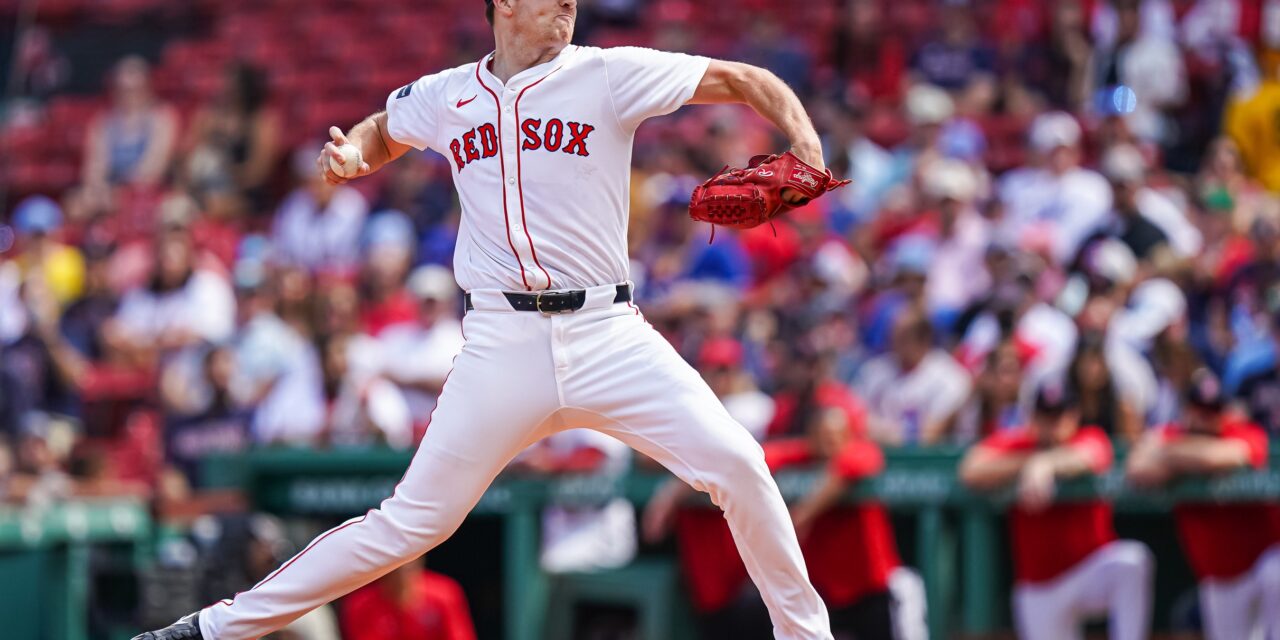
Nick Pivetta
Position: SP B/T: R/R
Age: 31 (02/14/1993)
2024 Traditional Stats: 27 G (26 GS), 145 2/3 IP, 6-12, 4.14 ERA, 1.126 WHIP, 172 SO, 36 BB
2024 Advanced Stats: 103 ERA+, 28.9% SO%, 6.1% BB%, 3.59 xERA, 4.07 FIP, 3.50 xFIP, 2.0 fWAR, 1.8 bWAR
Rundown
After leaving Philadelphia after parts of four seasons of dire struggle (5.50 career ERA with the Phillies), Nick Pivetta revitalized his career over the last four-plus seasons with the Boston Red Sox. Now, the 31-year-old gets the opportunity to test the open market, poised for a raise.
Since leaving the Phillies, Pivetta has established himself as a reliable back-of-the-rotation starter. Since 2021, the right-handed pitcher has thrown at least 142 innings while seeing his strikeout rate plateau above both his career and the league’s average as well as his walk rate steadily decrease in each season.
What has made Pivetta so successful over his last four-plus seasons is how filthy his different pitches are. The statistic, “Stuff+,” evaluates each pitch type based on the velocity, spin rate, and movement characteristics (a 100 Stuff+ is the average number).
In 2024, Pivetta owned a Stuff+ of 133 which was the highest in the majors of 126 pitchers who threw at least 100 innings. In 2023, he ranked 10th among 127 pitchers who threw at least 100 innings. Over the last three seasons as a whole, he ranks 13th in Stuff+ among 140 starters that have thrown at least 250 innings. Basically, ever since he left Philadelphia, Pivetta has had one of the best arsenals of pitches, based off velocity, spin rate, and movement characteristics, in the major leagues.
Speaking of that arsenal, Pivetta threw five different pitch types in 2024; four-seam fastball, sweeper, curveball, cutter, and slider. Of those pitches, his sweeper/curveball is by far the best. His sweeper owned a .196 xBA in 2024. But, overall, as evident by the Stuff+ ratings, all of Pivetta pitches fair very well outside his cutter, which he only threw less than 7% of the time in each of the last two seasons.

Mandatory Credit: David Butler II-USA TODAY Sports
Over the last two seasons, the above analyzed strong shaping metrics have resulted in terrific strikeout and chase rates. Pivetta’s strikeout rate the last two years ranked above the league’s 88th percentile while his chase rate over the league’s 65th percentile in each season. As mentioned, in doing so, he has also cut down on the walks considerably. In every season since 2020, Pivetta has decreased his walk rate, culminating in a career-low 6.1% walk rate in 2024 (80th percentile). The strong strikeout performances and the low walk rate have also resulted in expected ERA numbers around the 60th percentile over the last two seasons and expected batting average figures above the league’s 75th percentile.
So, with all that being said, why haven’t the actual results (4.29 ERA with Boston) been a bit better? Over the last few years, when opposing batters actually make contact against Pivetta’s filthy stuff, they are barreling up well and hitting the ball hard. Over this recent four-plus year stretch of success, Pivetta’s home run rate has been inflated, and always finishes higher than the league average each year. Hitters don’t hit Pivetta much at all, given all the chases, whiffs, and strikeouts, however, when they are able to, the damage is not usually singles, it’s home runs and extra-base hits.
Also worth nothing, ever since he broke into the league, with the Phillies and Red Sox, a majority of his games have come in extremely unfriendly parks to pitchers. Fenway Park in Boston has a park factor of 107, which ranks second to only Colorado’s Coors Field. Meanwhile, Citizens Bank Park in Philadelphia ranks 12th in park value and is the fifth most homer-happy ballpark in the majors. If he came to New York, he would mainly be pitching in a park that is extremely pitcher-friendly, ranking 24th in park factor. After all, Pivetta’s OPS+ against is 10 points lower in his career on the road than at home.
Overall, Pivetta has quietly emerged as one of the better back-of-the-rotation options in the majors since leaving the Phillies. He would immediately provide an upgrade to most team’s No. 4 starter slot. Especially one that plays at a ballpark that favors pitchers more than hitters.
Contract
Pivetta is coming off a one-year deal worth $7.5 million. Sportstrac is projecting a four-year deal worth a shade over $60 million which is good for an annual average value of roughly $15 million. Interestingly, one of the notable comparisons Sportstrac references for Pivetta’s next deal is the two-year deal Sean Manaea signed with the Mets last offseason worth $14 million per season.
At the projected $15 million mark, Pivetta would be in essence receiving No. 3 to No. 4 starter money.
Note, Pivetta declined the Red Sox $21.05 million qualifying offer, indicating he feels he can fetch a multi-year deal on the market for around the $18-plus million range.
Recommendation
Entering the offseason, president of baseball operations David Stearns and staff will in essence need to rebuild the close to the whole Mets’ rotation. No. 1 and No.2 starters from 2024 in Sean Manaea and Luis Severino are going to be free agents. While Jose Quintana, who threw 170 1/3 innings in 2024, is also a free agent. That leaves a hopefully fully healthy Kodai Senga, David Peterson, Tylor Megill, Paul Blackburn, and Joey Lucchesi as potential rotation options. The Mets need to add several starters this offseason.
As it relates to Pivetta, there is no doubt he has the stuff. Adding him to a team that plays 81 of their games at one of the more pitcher-friendly ballparks in the majors would help even further. At the end of the day, it of course comes down to the contract.
If the Mets and staff can replicate a Manaea-type deal, which brings Pivetta to Queens short term while paying him in the range of $13 to $15 million annually, New York would certainly be better by it. Bringing in a talent like Pivetta would be the first step, of many needed, to start filling out the 2025 rotation.