As any 162-game span would be categorized, the MLB regular season is a marathon, not a sprint.
A fast start — whether it’s by one player or one team — doesn’t guarantee a successful year. On the flip side of the equation, a slow start also doesn’t mean a player or team will consistently struggle. Regardless of this, there isn’t a big league player or organization that wouldn’t take a fast start to any season with open arms. There’s just something about getting a season off on the right foot that allows a player or a group of players to build off that momentum with the majority of their regular-season schedule still left to play.
For the New York Mets, a strong March and April would be beneficial because of how competitive the National League East division is expected to be in 2020. That doesn’t excuse them from actually showing up for all the other months, but it’s helpful in building a solid foundation of a contending team.
In order to do this, New York will need key contributors to be mostly firing on all cylinders once Opening Day rolls around. The following four players all got off to varying degrees of slow starts to the 2019 season and will be hoping to do just the opposite in 2020. While Amed Rosario would’ve fit into this group, I just talked about him and the importance of a fast start the other day, so he’s not included below.
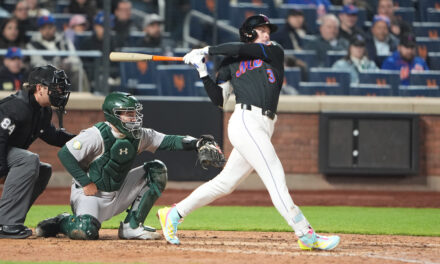
Brandon Nimmo
Most importantly, Brandon Nimmo needs to stay on the field after being limited to just 254 plate appearances in 69 games last season. This will be a significant hurdle for him to jump over because it was recently reported that the neck issue he dealt with in 2019 is something he’ll have to continue managing moving forward.
Injury-shortened campaign or not, Nimmo’s March/April wasn’t anything worth writing home about. His wRC+ heading into May was actually slightly above average at 105 thanks to a .365 on-base percentage that was mostly powered by a 14.3% walk rate, but his strikeouts were out of control.
Nimmo finished April with a 34.3% strikeout rate, which was among the worst in baseball during that period of time. Following a prolonged visit to the Injured List, he did at least finish with a solid September, which included a greatly improved walk rate (21.5%) and strikeout rate (24.7%), leading to a 159 wRC+.
If the outfielder ends up leading off on a daily basis, this offense will need the September version of Nimmo to get rolling.
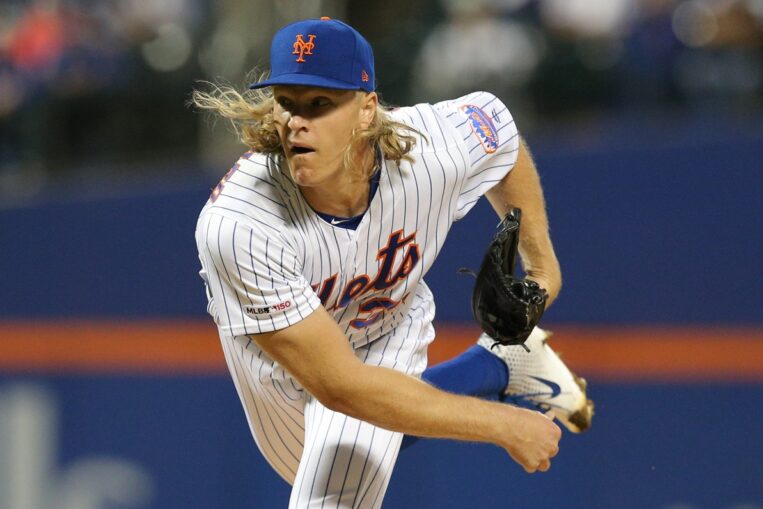
Noah Syndergaard
We just heard the other day from Noah Syndergaard, who is eager to live up to the expectation that’s been set for him, and that journey starts in the first month of 2020.
His 4.28 season-long ERA from 2019 was easily a career-worst mark from the right-hander. However, his 4.4 fWAR was the second best of any season to this point, so there were some positives to take from his most recent campaign. Like a number of Mets pitchers, Syndergaard struggled through a rough March/April last year, which yielded a 6.35 ERA in 34.1 innings pitched.
The 27-year-old did follow that tough start with a three-month stretch of 3.33 ERA ball before watching that number spike back up to 4.66 over the final two months. Two keys for Syndergaard will be taking advantage of pitching at home again (he had a 5.02 ERA at Citi Field last season) and getting back to trusting his slider.
He certainly moved in that direction between the first and second half of 2019 — his usage rate went from 10.5% to 21.0% during these two periods of time. On a per-100-pitch basis, the value of his slider also went from -2.42 to 2.06, according to FanGraphs.

Jeurys Familia
All eyes are on Jeurys Familia for a couple of reasons. One is for the dramatic physical transformation he underwent this winter, and the second is because he must bounce back after a truly dreadful 2019. Most of the campaign is one the reliever would like to forget, but it was the beginning of his campaign that had him on a historically bad trend.
Familia toed the slab for 14.1 innings last March/April, twirling a 6.28 ERA, which was paired with a .399 wOBA against, a 21.4% strikeout rate, and an alarmingly-high 18.6% walk rate. If we simply look at how his ERA improved from the first half (7.50) to the second half (3.90), it’d be easy to think he truly got his stuff together following the All-Star break.
However, his walk rate barely changed (15.6% to 15.0%) and neither did his WHIP (1.83 to 1.63). The one thing that did improve greatly was his strand rate, which jumped from 62.8% to 77.9%.
One of the keys for Familia to hit the ground running in 2020 will be to get his sinker under control. It was hist most used pitch last season, yet yielded an 18.3% walk rate and 151 wRC+ from opposing hitters.
Wilson Ramos
A hot second half that included a prolonged hitting streak helped save Wilson Ramos‘ overall offensive numbers in his first full season with the Mets. It was sorely needed after posting a 65 wRC+ through the end of April, which was among the worst in baseball when looking at qualified hitters.
The most concerning part about this slow start was his complete lack of power. Through his first 99 plate appearances of 2019, Ramos had mustered just a .056 ISO, which was baseball’s third worst mark during that period of time. He recovered by posting a .146 ISO from May 1st through the end of the year, but one thing that didn’t change was his high ground-ball rate.
Ramos has always been heavy on grounders throughout his big-league career, but this past year went to a new level, as his 62.7% rate was easily the highest in baseball among qualified hitters. Bringing that number down into the low 50% range will be helpful in the backstop getting 2020 off to a more fruitful start.