
As September 1 was rapidly approaching, Sandy Alderson knew he needed to add a viable arm for a bullpen that has had inconsistencies and injuries throughout the 2016 season. Jim Henderson being overused and then succumbing to a DL stint due to bicep tendinitis comes to mind. Or Hansel Robles losing command and control in August, putting up an ugly 9.00 ERA in 13 games, and having as many walks (12) as he did strikeouts (13). And Jonathan Niese was also given a shot at earning a bullpen role, after the team reacquired him from the Pittsburgh Pirates at the deadline for LHP Antonio Bastardo. But in six-innings out of the pen, Niese gave up seven earned runs, walked five, and gave up two home runs, before injuring his meniscus in a August 23 start in St. Louis, requiring arthroscopic knee surgery in his left knee.
Even the impeccable Jeurys Familia had a bad month in May, where in 14 games he posted a 5.40 ERA, giving up 13 hits and eight runs in 13.1 innings pitched, illustrating how even the best in the game have their underperforming moments.
Alderson was scouring the waiver wire throughout August, hoping to make a trade that would help strengthen the pen for the playoff push. So on August 31, Alderson pulled off a deal with the Los Angeles Angels for RHP Fernando Salas, a 31-year-old reliever from Mexico, in exchange for minor league right-hander Erik Manoah, a 20-year-old who was pitching for the Brooklyn Cyclones after being drafted in the 13th round in the 2014 draft. Dealing for Salas before September 1 guarantees that he can be on the postseason roster for the Mets, giving the veteran a month to showcase what he can offer.
The move went somewhat under the radar, since Salas was having a subpar season, at least in the first half of the year with the Angels. But with Salas making only $2.4 million in his final year of arbitration, the Mets would only be on the hook for $419K, so adding him was a no-brainer, and gave them another low-risk, high reward type reliever.
His numbers this year weren’t that particularly impressive for the Angels: a 3-6 record with a 4.47 ERA in 58 games. He held opponents to a .248 average and had a 1.26 WHIP. Not terrible stats, but let’s be honest, we weren’t acquiring Andrew Miller or Aroldis Chapman for the stretch run here.
However, digging deeper into Salas’ stats this season, he’s actually pitched better than his numbers advertise. For April and May, Salas appeared in 24 games and had a combined ERA of 2.48, with 22 strikeouts to only five walks. Salas held the opposition to a .617 OPS during that stretch, and had eight holds through May 23.
When May turned to June, that’s when Salas had his worst month of the year. In 12 games, Salas’ ERA ballooned to 10.32, giving up 13 runs on 14 hits in 11.1 innings. The strong strikeout-to-walk ratio he had in the first two months disappeared, as he gave up more walks (6), than strikeouts (5).
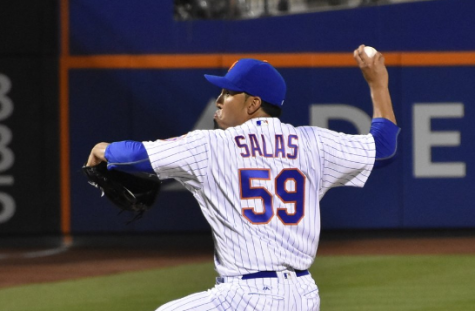
Injuries to Huston Street and Cam Bedrosian in August led Angels’ manager Mike Scioscia to put Salas into the closers role for the time being. Salas has ninth-inning experience from his days with the St. Louis Cardinals, saving 24-of-30 games in 2011. Salas put up more respectable numbers in his final month with the Angels, posting a 3.48 ERA in 11 games, holding opponents to a .211 average and earning the save in all four of his chances.
And looking at his post All-Star game numbers with the Angels, numbers Alderson and Co. were most likely turning to when judging whether he’d be of use with the Mets, Salas posted a 2.93 ERA in 15.1 innings, holding opponents to a .224 average in that timeframe.
It wasn’t too long ago, 2014 to be exact, that Salas was thriving and having one of his best seasons as a pro, appearing in 57 games for the Angels, pitching to a 3.38 ERA with 61 strikeouts in 58.2 innings pitched. He held the opposition to a .228 average, and had the second best WHIP of his career, at 1.09.
With the back end of the Mets’ bullpen solidified with Addison Reed and Familia, Salas will get plenty of chances to showcase his talent in the seventh inning for Terry Collins. And so far, Salas has looked strong in the four outings he’s made including in Tuesday night’s 5-3 win in Cincinnati, tossing 4.1 innings giving up only two hits, no runs, no walks, and five strikeouts with a .133 batting average against. If he can provide the Mets with a trustworthy arm in the seventh, along with Jerry Blevins against tough lefties, then passing the baton off to Reed and Familia in the eighth and ninth, that might be the winning formula for the Mets to have their best chance at shutting down games late.
This trade almost has the same feel as the Reed trade last August with the Arizona Diamondbacks, when Alderson acquired the former closer who had been struggling last year and was even optioned to Triple A Reno in June for Arizona. Reed has excelled sine being with the Mets, becoming a dominant set-up man for Familia, and posting fantastic splits and being considered one of the best relievers in the game, posting the 6th best reliever’s WAR (2.2) in baseball.
Salas has an opportunity to show Collins why he belongs in the 7th inning, and looks to gain his trust during the final month. While his numbers haven’t been sparkling throughout the 2016 campaign, Salas has the opportunity to right the ship with the Mets, in similar fashion to what Reed did last year. The palindromic right-hander might turn out to be another successful under-the-radar move for Alderson, and give the Mets a veteran option for the back-end of the bullpen.