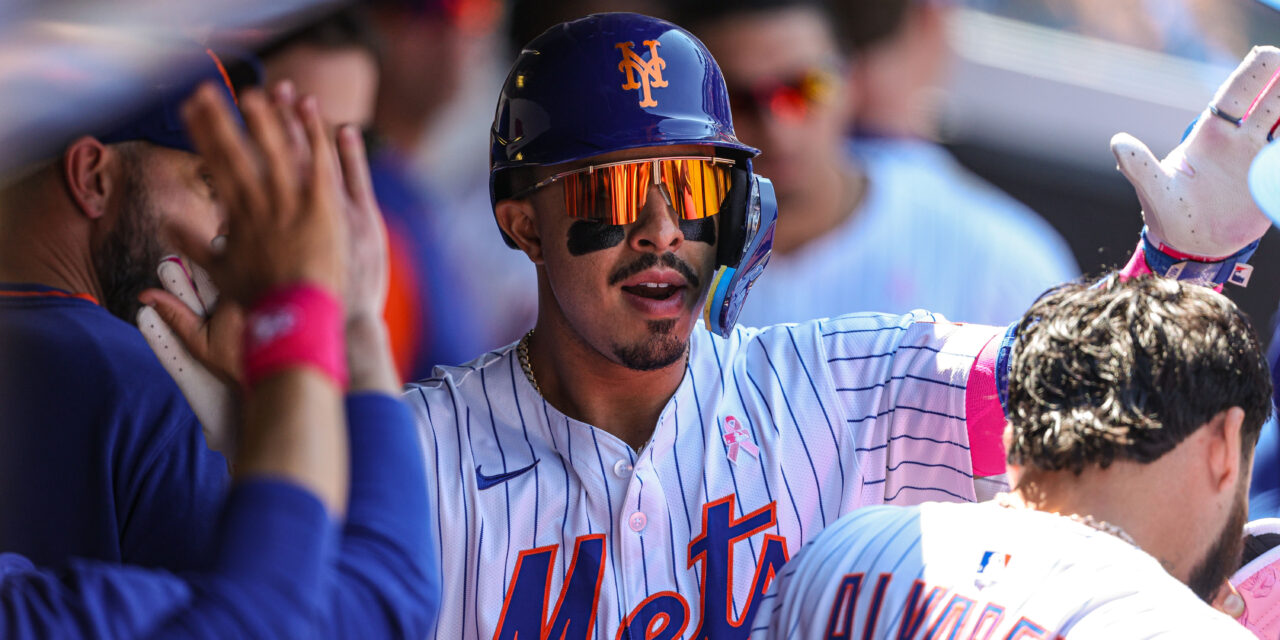
Mark Vientos homered in the series finale against the White Sox in an otherwise forgettable game for the Mets. It was only his sixth home run of the season—a surprising total for a player known for his raw power. While the overall results have been solid, Vientos has yet to repeat the success from a season ago.
Following a rough first six games of the season, Vientos has been an above-average hitter. Over Vientos’ last 43 games, he has a slash line of .263/.333/.428, measuring out to a 118 wRC+. One number stands out: his (.428) slugging percentage, a steep drop for someone who profiles as a middle-of-the-order threat. So, where has the power gone?
In an attempt to answer that question, I’d like to explore Vientos’ process at the plate. Coming up through the minors, Vientos was a bat-first prospect who dominated at every level. After bouncing between Syracuse and the big league club, Vientos broke through last season with 27 home runs in 111 regular-season games. Then, Vientos went supernova in the postseason, slashing .327/.362/.636.
However, that success did not come without some warning signs. According to Baseball Savant, Vientos was in the fourth percentile in whiff rate, eighth percentile in strikeout rate, and 24th percentile in chase rate. Vientos thrived because when he made contact, he crushed the ball. He was a high-risk, high-reward kind of hitter. Vientos was 80th percentile in hard hit rate, 82nd percentile in average exit velocity, and 92nd percentile in barrel rate. Most of Vientos’ damage was done against fastballs. Vientos’ xSLG in 2024 against fastballs was (.569), and 18 of his 27 regular-season home runs were against fastballs. However, Vientos’ xSLG (.316) against breaking balls was in part the result of his high strikeout rate and whiff rate. Heading into the offseason, many expected a strategic adjustment from opponents, fewer fastballs, and more breaking balls.
Contrary to expectation, pitchers are actually throwing Vientos more fastballs: 50.7% this year vs. 47.2% last year. Vientos has actually improved against breaking balls (xSLG .420 this year vs .316 in ’24), but that hasn’t offset the enormous drop off against fastballs. This year on fastballs, his xSLG is just .372.
So what happened? Did Vientos forget how to hit a fastball? Of course not. The more likely explanation is a deliberate change in approach. This year, Vientos has made a concerted effort to cut down his strikeout rate and increase his walk rate. To this point, Vientos has succeeded (21.5% strikeout rate vs 29.7 % and 8.7% walk rate vs 7.3%). These are signs of improved plate discipline and pitch recognition. But they may also be the reason his power has vanished. Here are three data points to drive home this message:
- Vientos is pulling only 26.3% of his batted balls (last year he pulled 41.3%). Not only is Vientos pulling less, but he is also pulling fewer balls in the air. Only 12.7% of Vientos’ batted balls have been pulled thus far in 2025. That is down from 15.2% in 2024. Coinciding with this dip in pulled balls, Vientos has seen an increase in opposite-field fly ball rate (17% in 2024 to 23.1% this year). Vientos is trading pull-side power for an all-fields approach.
- Vientos is swinging with reduced bat speed on average, down from 71.8 mph to 70.4mph. One of the contributing factors to the slower bat speed is Vientos’ reduced fast swing rate, 20.6% last year vs 9.7%. While not a complete indicator of elite production, high bat speed on batted balls does correlate to increased production. By reducing the number of high-speed swings, Mark is reducing his opportunities for slugging.
- Vientos is making contact with the ball much closer to the plate. In 2024, Vientos made contact with the ball 2.6 inches in front of the plate. This year, Vientos is making contact just .5 inches in front of the plate. The goal of hitting the ball closer to the plate (letting the ball travel) is to reduce chase and improve plate coverage, which, again, he has done, but at the expense of the easiest way to slug, pull-side fly balls.
Add it all up, and you get a more patient hitter who has sacrificed his elite tool for league-average production. Every player wants to be a complete hitter with Juan Soto‘s plate discipline, Luis Arraez‘s bat-to-ball skills, and Aaron Judge‘s power, but few players can. Vientos should lean into his strength (elite slugging) and, as Gary Cohen often says, “swing for downs”.