Entering MLB’s 2020 regular season — you know, before the world started to end and a 162-game schedule was still on tap — the New York Mets’ bullpen was projected to be a top performer. Some projections were so good that this group was expected to be the National League’s best.
While it was encouraging to see virtual ink be that bullish on the Mets’ relief corps, the vast majority of us knew there were many needles to thread for this to take place, whether it involved hurlers coming off injuries (Dellin Betances) or bouncing back from horrific performances (Jeurys Familia and Edwin Diaz). Unfortunately, the bullpen didn’t exactly live up to those best-in-the-Senior-Circuit projects from this past December.
From the perspective of fWAR, New York posted a cumulative mark of 0.5, which ranked 22nd in baseball. They also produced a 4.60 ERA, which ranked slightly better at 18th in the league. While both of these marks were trending better than what the Mets’ bullpen did in a full 2019 season (0.7 fWAR and 4.99 ERA), there’s one similarity: one reliever was propping up the squad’s overall value much more than anyone else.
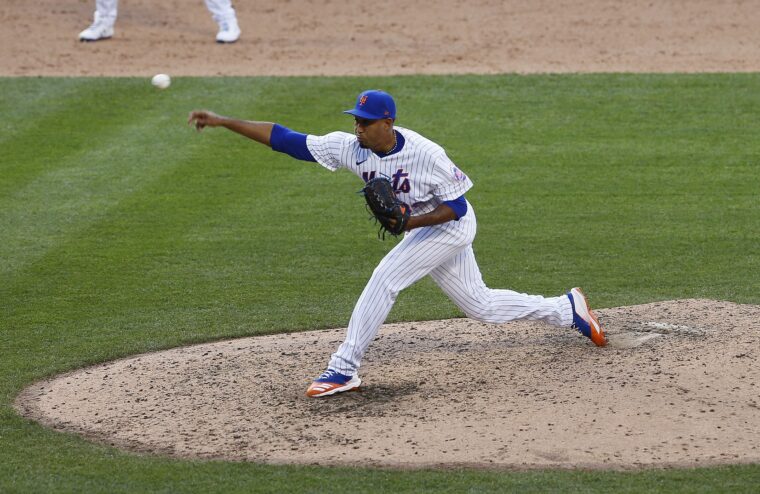
Last year, it was Seth Lugo, who posted one of the best reliever seasons in baseball. Edwin Diaz was supposed to provide a large chunk of value in 2019 with Lugo and Co., but that didn’t happen. In fact, he produced a 0.0 fWAR en route to a disappointing season. But in 2020? Diaz took Lugo’s spot as the dude who was more valuable than the rest of the bullpen’s combined performance. Obviously, 2020 continues to stay weird.
Through 25.2 innings this past season, Diaz posted a 0.9 fWAR, which tied him for the third-highest reliever total in baseball. The rest of the bullpen combined for 209.1 innings and produced an fWAR of just -0.3. Other than Diaz, there were just five pitchers with an fWAR greater than one, seven with an fWAR of 0.0 (six if you exclude Todd Frazier), and nine who finished with a negative fWAR.
This is quite the about-face for Diaz, and a welcome sight, even if he still needs to prove he can be trusted consistently in the ninth inning during close games. It was also interesting to see his progression through this shortened season. Opening Day went well with getting the save, but things unraveled the next day against the Atlanta Braves, and an abbreviated July put him in a tough spot moving forward.
Here’s how his strikeout rate, walk rate, wOBA allowed, and ERA changed between July, August, and September.

Diaz’s season-long numbers ended up being rather impressive. Through those 25.2 innings, he twirled a 1.75 ERA and 2.29 xFIP with a 45.5% strikeout rate and 12.7% walk rate. If we solely focus on August and September, though, these numbers jump to 1.16, 1.95, 46.4%, and 11.3%, respectively.
Sure, we can merely shave off his first three outings of the season like they didn’t happen, but it would’ve been easy for him to keep going down the unfortunate road he put himself on. After allowing a run in two of his first three appearances, he held opponents scoreless in 21 of his final 23 appearances, including 11 of his final 12.
The key was getting his slider back in check. Having a 97 mph fastball at one’s disposal is a great weapon, but that’s never been Diaz’s out pitch — it’s been his slider. Opposing hitters posted a .942 OPS and 147 wRC+ against his breaking ball in 2019, but those numbers dropped to .417 and 34 in 2020, respectively, which is also more in line with this career norms.
The resurgence of this offering in the right-hander’s arsenal helped a number of troubling 2019 statistics go back in the right direction.
Diaz’s 2.33 homers allowed per nine innings in 2019 was the worst in baseball among qualified relievers, but that number dropped back down to 0.70 this past year. He only allowed two homers all season, with none coming on his slider (he allowed six off that pitch in ’19). Diaz’s 45.5% strikeout rate is an improvement from the year before, but it’s still in the same vicinity (39.0% in ’19).
The difference between these two campaigns was that when hitters made contact ’19, it was usually hard.
Again by looking at 2019’s qualified relievers, Diaz’s 48.1% hard-hit rate allowed was the third-highest percentage. This past season was a completely different story. While his soft-hit rate allowed didn’t shift much (16.3% to 15.9%), his hard-hit rate dropped all the way down to 25.0%. That’s a new single-season career-high mark and also landed among the top 30.
The 2020 MLB season brought a lot of weird things into focus, with a 60-game schedule and no fans in the stands being the biggest changes. Despite that and a sub-optimal start, Diaz found a way to get into a groove and flash some of the brilliance New York thought it was trading for in the first place.
Looking ahead to 2021, let’s hope Familia and Betances join him so the Mets’ bullpen value doesn’t have to be fortified (or salvaged, if we’re being more accurate) by just one dude.