It’s been a while since we could legitimately think about the New York Mets going after and signing top MLB talent via free agency. Things are changing just in time to make a big splash behind the dish, too.
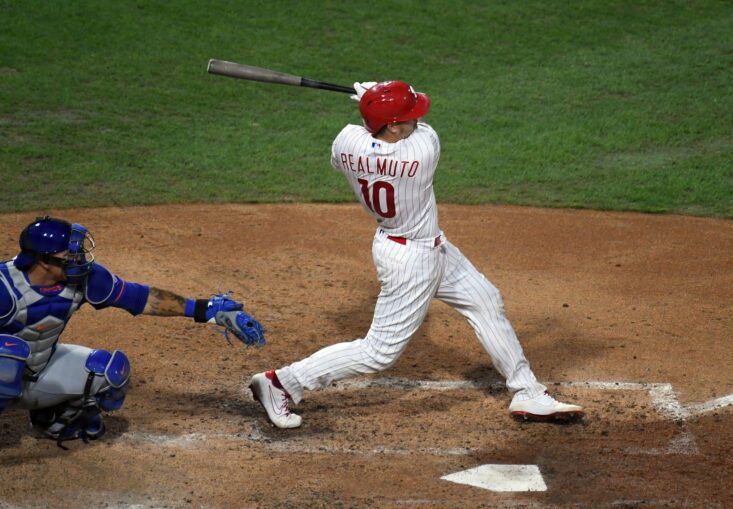
The Mets own a $10 million team option on Wilson Ramos for 2021, but it’s likely he’ll get bought out after a rough year. This impending roster void could conveniently be filled by one of the league’s top soon-to-be free agents, Philadelphia Phillies catcher, J.T. Realmuto.
I wasn’t thinking about Realmuto-to-the-Mets much lately until I read this MMO article by Ryan Finkelstein discussing how pandemic-related economic losses could impact free-agent spending this winter. So with that in mind, let’s put his production in perspective to see just how tremendous of an upgrade the soon-to-be 30-year-old would be if he dons the orange and blue in 2021 and beyond.
But first, let’s talk about how bad New York’s catcher production has mostly been in recent years.
A Lack of Consistent, Top-Tier Production
The 1992 season was when the Mets began getting some consistency at the catcher position again following the departure of Gary Carter, as it was the first of six straight seasons where Todd Hundley led the team in games played behind the dish. If we look at catcher production among Mets players with at least 300 plate appearances between then and 2020, there have been 10 different seasons with an individual fWAR of at least 2.0.
If we take out all the times Mike Piazza accomplished that feat, it’s down to five. If we also take out the times Hundley accomplished the feat, the number drops down to two: Paul Lo Duca in 2006 and Travis d’Arnaud in 2014.
So, yes, since Piazza left the team in 2005, there have only been two times where a Mets catcher produced at least 2.0 fWAR in a single season. There’s also been a fair amount of turnover. D’Arnaud did lead the squad in games played at catcher for four straight seasons from 2014-17, but nobody else has done so for more than two straight years.
The ones who did lead the catching squad in games played for two years? Lo Duca, Ramos, and Josh Thole.
Out-Producing All the Mets’ Catchers…All The Time
After reading what’s above, it shouldn’t be surprising to hear that the Mets’ catching group hasn’t performed too well in the fWAR department in recent years, either. Since 2010, cumulative catcher fWAR has finished 15th or better in baseball three times (2015, 2016, and 2017), which was honestly more than I thought it’d be. But then I looked strictly at offensive production, and it made more sense.
When using the same time period (since 2010), the Mets’ highest cumulative wRC+ at catcher was 89, which came in 2017. The lowest was 56, which came in 2012, courtesy of guys like Thole, Kelly Shoppach, Mike Nickeas, and Rob Johnson. Talk about an offensive juggernaut.
Have I spent enough time detailing why New York could use Realmuto? Well, just wait, it gets better.
Realmuto’s first breakout came in 2016 with the Miami Marlins when he slashed .303/.343/.428 with 11 home runs, 48 RBI, and a 111 wRC+. That led to a 2.1 fWAR over 137 games played (545 plate appearances). Among qualified backstops, that fWAR was sixth-best in baseball. He’s been on an upward trajectory ever since, as he ranked second best in 2017 (4.4 fWAR), first in 2018 (4.9) and in 2019 (5.7), as well as tied for first in 2020 (1.7).
Just for funzies, here’s a side-by-side view of how Realmuto has performed compared to the Mets’ entire catching squad since that initial 2016 breakout:
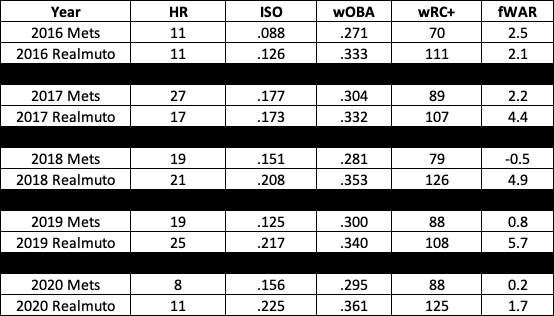
This comparison is eye-opening regardless of the parameters and the situation, let alone the fact that this puts the production of one player against a team of three or four different guys every time. And in nearly all circumstances, Realmuto out-produced his counterparts.
Are the Stars Aligning?
It’s easy to get our hopes up with Cohen ready to be installed as the next Mets owner, especially since we deserve one nice thing to happen in 2020. For the first time in a while, though, this sort of optimism is warranted. When a dude is worth $14 billion and is a lifelong fan of the team he’ll soon own, one has to imagine the only way New York gets outbid is that the soon-to-be beefed up analytics team doesn’t think whatever on the table is a good idea.
Without the presence of a global pandemic, we probably would’ve seen bidding for Realmuto’s services get into the five-to-seven year range for his next contract. That hypothetical contract length would’ve put him in his mid- to late-30s by the end, which obviously isn’t an ideal time for most ballplayers with regard to production — especially catchers.
But now, the market may dictate Realmuto taking a shorter-term deal, which would play into the Mets’ hands. If they seriously wanted to pursue him, the negotiation could include some sort of short-term pact with a high average annual value to pay him at a premium while he’s still expected to produce as one of the league’s better catchers.
Maybe that’ll happen, and maybe it won’t. Either way, Realmuto would be a massive upgrade over what the Mets have mostly had in recent years. For the first time in a long time, going out and grabbing a talent like this doesn’t seem like a pipe dream, and that’s an incredible feeling.