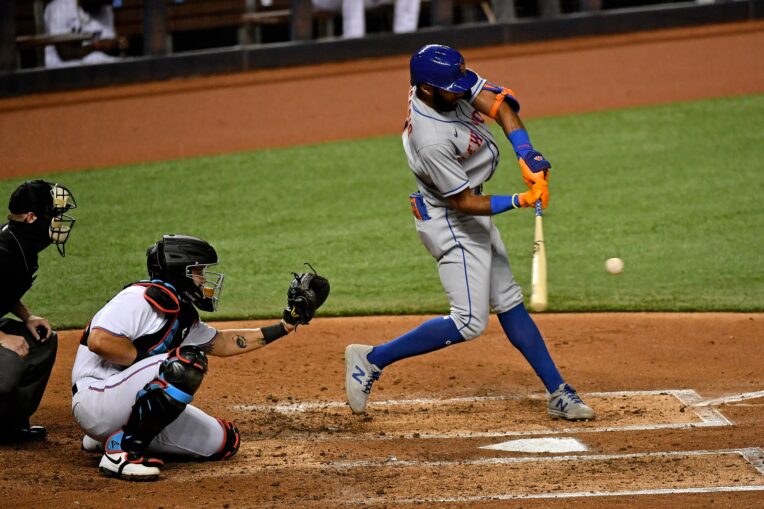
Off the heels of his best year yet, Amed Rosario’s offensive progression likely had people within the New York Mets organization optimistic about his 2020 campaign. However, all the soon-to-be 25-year-old did was make things more difficult for Mets decision makers — whomever they may be once Steve Cohen takes over as owner.
While Rosario’s overall stats took a step back in this shortened season, there’s a trend with regard to his performance that’s continued to stay strong.
Another Terrible First Half
To say that Rosario’s first half wasn’t very good is being nice about it. With Andres Gimenez also on the big-league roster and mostly shining in the opportunities he was getting, Rosario’s worst-case scenario was coming true.
While advanced defensive metrics still weren’t kind to the former top prospect, it was his total lack of offense that tanked him in the first portion of the season. His 46 wRC+ was certainly among the worst in baseball for qualified hitters, and he completed the challenge of not drawing a single walk during that time — a challenge nobody presented him with.
Not drawing a walk is so ridiculous that I’m actually impressed he accomplished such a feat through 80 plate appearances. The rest of his offensive stats didn’t look so hot, either — he slashed .213/.213/.338 with five extra-base hits, eight RBI, and 10 runs scored.
Seeing this from him isn’t exactly anything new — in his previous two full seasons leading up to 2020, Rosario got off to slow starts, although they weren’t as slow as this past year’s (81 wRC+ in ‘18, 88 in ‘19). Left quad tightness didn’t force Rosario to the Injured List at the beginning of August, but he was sidelined for a few days. Once I wrote about his worst nightmare coming true, he began turning things around upon getting back on the field consistently.
Yet Another Good Second Half
Between the three calendar months MLB’s 2020 regular season spanned, Rosario’s wRC+ progression was 62, 39, 145. Not exactly a linear progression, I’d say.
Still, if we break everything down by first half and second half of this shortened campaign, Rosario truly saved his season from being a complete and utter disaster. His season-long statistics of a .252/.272/.371 line with four homers and 20 RBI in 145 plate appearances weren’t that great. But just imagine how much worse it would’ve been if he didn’t slash .302/.343/.413 with a 111 wRC+ 67 second-half plate appearances.
If you’re thinking a second-half surge from the shortstop feels familiar, that’s because it’s happened in each full year of his big-league career. While the lift in production appeared to be slight in 2018 (81 wRC+ in first half, 89 in second half), it was more pronounced in 2019, as his 88 wRC+ from the first half improved to 114 following the midsummer classic.
And since we need to be bend the rules a little bit for the premise of this article to keep making sense, check out Rosario’s monthly wRC+ progression throughout 2018: 70, 97, 65, 57, 102, 102. So, August and September were clearly his best. So, even in a shortened season when “first half” and “second half” sound silly to talk about, Rosario still found a way to keep this trend going.
But Was It Legit?
Any rise in production is a welcome sight for a ballplayer donning the orange and blue. However, it’s hard not to be skeptical of Rosario’s improvements after taking a peek at his batted-ball profile. Check out how each aspect of it shifted between these two periods of time:

Yes, these sample sizes are small and could potentially normalize with more plate appearances, but it’s still concerning. The young shortstop didn’t pull the ball nearly as often (41.7% to 30.6% pull rate progression) and his soft contact improved by a significant margin, but it clearly didn’t go to his hard-hit rate. Throw in a 10-percentage-point increase in ground balls and I’m definitely scratching my head.
The confusion continued when I saw that his BABIP improved more than 100 points from .259 to .362. This also included a welcome improvement in walk rate (0.0% to 6.0%) and strikeout rate (25.0% to 20.9%), but it’s hard to think this rebound from a tough first half is overly legit because of what he did with balls put in play.
In case you’re wondering, there were some similarities between this most recent second-half surge and what he did in 2019.
What Lies Ahead
Times, they’ll be a-changin’ for the Mets this winter with Cohen expected to take over operations as majority owner. With Sandy Alderson re-joining the club in the baseball operations department, it sure doesn’t feel like Brodie Van Wagenen has much more time as New York’s general manager.
If a change happens, there will be fresh perspectives on what to do with a roster that appears quite crowded in a few spots (position-player side) and full of questions in others (the starting rotation). Will it be time for the Mets to move on from Rosario?
Does that mean it’s Gimenez’s job for the time being?
Do the Mets make a run at Francisco Lindor or another external option?
Who the heck knows — that’s what the hot stove is for. Whatever happens from here, Rosario’s patented second-half surge will likely do one of two things. It’ll either buy him some more time in Queens, or it’s propped up his trade value a little bit following what was a horrendous first half.