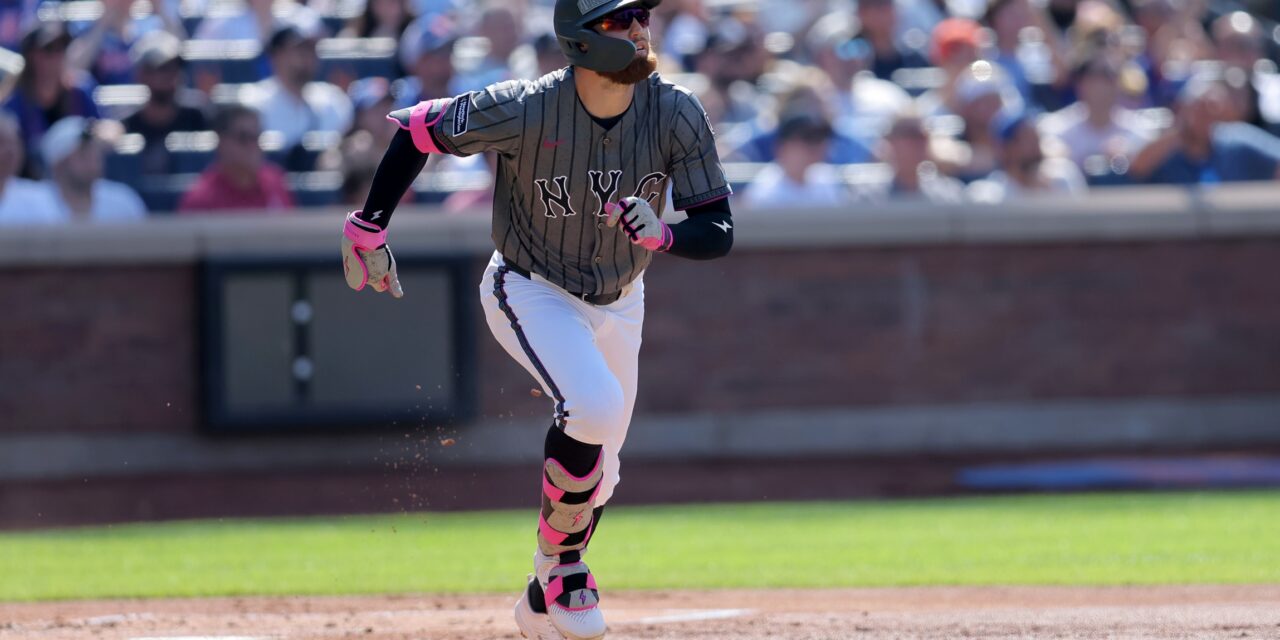
Last November, the Mets traded Brandon Nimmo to the Texas Rangers for Marcus Semien. When you frame the trade like that it is easy to look at Semien’s .624 OPS and Nimmo’s .731 OPS and think it is a trade the Mets should regret, but it was never truly a one-for-one trade in that sense. Semien was never acquired with the expectation that he would replicate Nimmo’s offense. He was the best return the Mets could get for the albatross that Nimmo’s contract had become, and one the Mets felt did not fit into their short- or long-term plans.
The expectation was that the Mets were moving Nimmo a year early because you cannot move that contract a year late. Seeing how the 2026 season went for Nimmo, it is hard to argue they even traded him a year early instead of at just the right time. I do not think this is a trade the Mets regret making, even with the struggles of Semien.
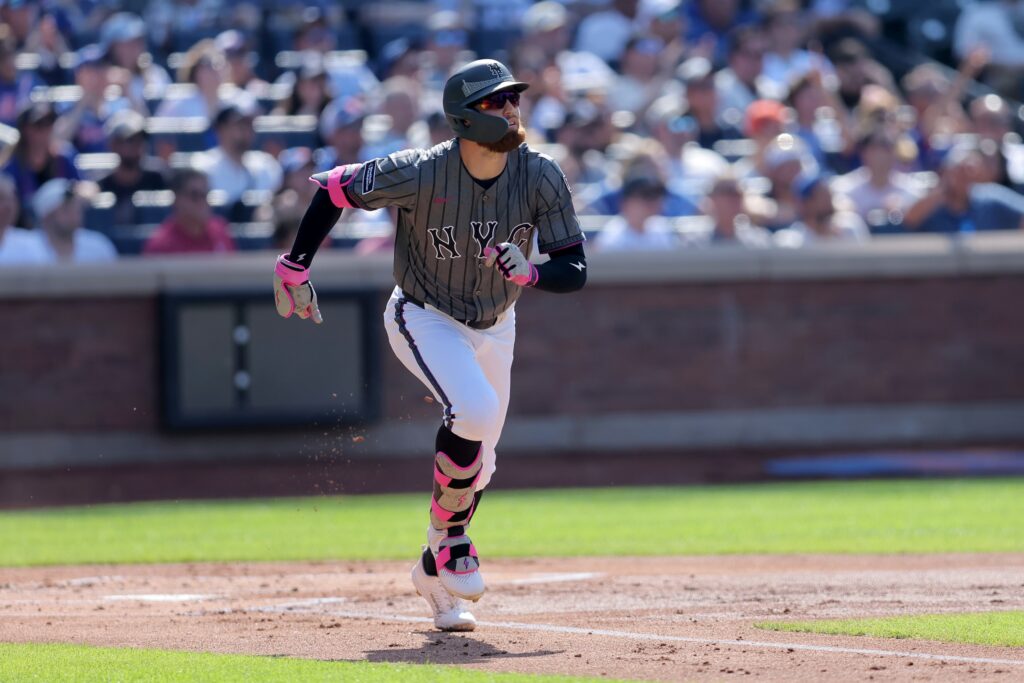
Brandon Nimmo. Photo Credit: Brad Penner-Imagn Images
Why This Trade Had to Happen
The main reason this trade was an unfortunate necessity was outlined well by Danny Abrino of SNY. He wrote, “As far as Nimmo, who wouldn’t have even had a regular spot on this current iteration of the Mets, it might have been close to impossible to DFA him if he remained in New York and things got bad — as they very well could during the final two years of his deal or even sooner. A homegrown fan favorite in the twilight of his career is a different consideration than Semien, who just arrived after spending the first 13 years of his career elsewhere.”
The argument made there is that it is easier to cut a player like Semien who has no ties to the organization than a homegrown star like Nimmo.
Roster construction also played a big part of the Mets’ decision here, with Carson Benge and A.J Ewing both on the cusp of the majors and expected to man the outfield for the majority of the five years Nimmo’s remaining contract would have run for with the Mets. Ewing forced his way the majors faster than the Mets expected him to as well, making it even better that they had that flexibility.
It does not seem likely Nimmo would have been happy moving to the designated hitter spot, as he has stated in multiple interviews that discussions of a potential move to DH played a big part in his decision to waive his no-trade clause. It also does not seem likely that the Mets would have made Ewing the everyday second baseman, as the Mets only used him sparingly there even when Luis Robert Jr. was in center field or Semien was injured, leaving that spot open. While Semien was on the injured list, Zack Short played more innings at second base than Ewing.
Even if Nimmo were to accept a move to DH, would you want that spot taken up by a hitter with a .733 OPS and four more years to go on his deal? And what led to this rapid offensive fall-out by Nimmo?
Nimmo’s Decline in 2026
Nimmo’s contact rates have been falling for years now. When he signed his contract, he was an 87.9% zone-contact and 5% contact over-expected hitter. In 2026, he has fallen down to an 85.7% zone-contact rate and 1.4% contact over expected. It seems clear his once great eye at the plate is no longer there. He has fallen from a plus 55% selectivity rate in 2023 to a below average 47.5% in 2026. For context, that is 3% worse than 2026 Brett Baty. This is likely why Nimmo has fallen from a player who walked 11.6% in 2024 to one who has walked less than 8% in 2025 and 2026.
These selectivity and contact issues began during the 2023 season, and as reported by Tim Britton of the Athletic, Nimmo worked with Mets hitting coach Jeremy Barnes on increasing his damage rates as that season went on. It is possible this focus on power was done to make up for his declining contact rates by trading contact for power. Whatever the reason, it worked and he put up three seasons in a row with over 20 home runs.
Unfortunately, that approach does not seem to be working as well this season. He has only hit 14 home runs, his 5.1% pulled fastball rate is lower than any of the previous five years and continues his trend of struggling more each year against velocity. His 90% exit velocity dropped to 105.5 miles per hour and he has yet to hit a ball over 110.6 miles per hour. He is still running a strong hard-hit rate, but he is not lifting the ball nearly as much, meaning far more of those hard hit balls are hit into the ground.
Nimmo has also struggled with injuries in 2026, dealing with recurring plantar fasciitis, hamstring issues, and a shoulder sprain. Nimmo also has a long history of neck and back issues through his career. All of this combined could be part of why he has been one of the worst outfield defenders in the spot with a -6 fielding run value (13th percentile). But his rapid defensive decline has been an issue since the 2024 season. He has also accumulated less than 2 WAR according to both FanGraphs and Baseball Reference.
None of this is what you want to see from a player who has four years left on a deal. At the time he was traded, there were discussions about what Nimmo would look like in year four or five, but it looks like the question should be more about what he looks like in year two and how long the Rangers can afford to give him everyday playing time, especially in the outfield.
Semien’s Struggles
Semien, meanwhile, has played rather poorly and dealt with his own injuries, specifically a hip injury that sidelined him for a good chunk of the season. Since returning from the injured list, he still has not been the elite defender that was expected to be coming into the year, though he has been better.
Offensively, he has been closer to what he was in 2025 but still not good. It should be noted that second base is also a position where the offensive bar tends to be lower.
While the offensive bar is much lower for second base, I would not want to give Semien the 2026 job. Especially not with Jefferson Rojas and Émilien Pitre in Triple-A and Mitch Voit not far behind. Even Baty has had an offensive resurgence. The biggest role I would want to see Semien in would be either on the bench or a short-side platoon until one of the prospects named above was ready.
Truthfully, if I was in charge I would eat money and move him in the offseason. A benefit over the Nimmo contract is that Semien does not have a no-trade clause. Only two years remain with the final year only costing $20 million. We saw Nolan Arenado traded with money eaten by the Cardinals after his dreadful 2025. Arenado did not have as long of a track record of struggling as Semien, but he also had a no-trade clause. If you cannot trade Semien, I would consider cutting him and have second base be a competition in spring training.
To me, a benefit of trading for Semien is that you should be able to cut him much easier than a homegrown star like Nimmo. Robinson Cano was a bit different with the steroid suspension, and the Mets did keep him around at the start of 2022, but there is some precedent in the Cohen era. Maybe the early May Cano timeline is what you give Semien to show he should keep his spot in the organization.
Conclusion
This was a trade that had to be made even with Semien providing worse production than expected in 2026. You could even argue that Semien’s drop in production is largely offset by Nimmo’s drop-off being larger and more rapid than any projection model had him at in 2026.
Overall, this trade gave the Mets the flexibility to give everyday playing time to Benge and Ewing, both of whom have significantly out-performed Nimmo this year.