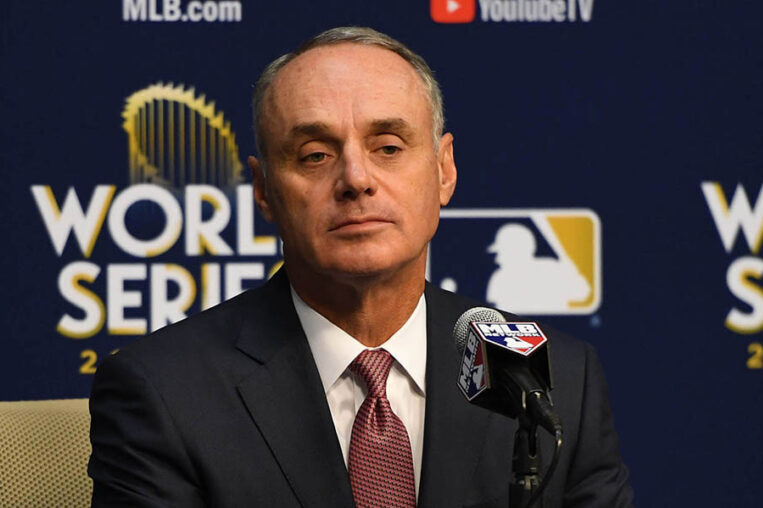
Major League Baseball and the Major League Baseball Players’ Association met for a second consecutive day in Jupiter, Florida on Tuesday. As has been the case whenever the two sides have met since the lockout was imposed on December 2, there was no significant progress toward a new Collective Bargaining Agreement.
MLB and the MLBPA agreed to meet daily this week to try to get a new deal in place before February 28, the date that MLB has established as the last possible day for an agreement in order to allow the regular season to start on time, March 31. In the first two days of negotiations this week, the players and owners seem to be heavyweight boxers in the early rounds, throwing jabs and trying to size up their opponent before getting serious about the task at hand.
As a recap from Tuesday’s session, the MLBPA put an offer on the table in response to MLB’s proposal from Monday. In their offer, the MLBPA made a small concession to one of the three core economic issues. From Jeff Passan of ESPN.com on Twitter:
Another day of small moves on the labor front. MLBPA dropped its ask from 80% of 2+ players receiving salary arbitration to 75%. Additionally, the union bumped the major league minimums slightly while sticking with $775K in the first year and went from 8 picks in lottery to 7.
— Jeff Passan (@JeffPassan) February 22, 2022
This movement is at best modest, as currently “Super Two” players are eligible for salary arbitration, and that group represents 22% of players with more than two but less than three years of service. The concept of a bonus pool tied to performance (perhaps fWAR) would replace arbitration for the group in question. The two sides are far apart on how many players to whom this will pertain. As Passan notes, the MLBPA tweaked their position on minimum salary, which now stands (in their current offer) at $775K in year one of a new agreement, escalating to $895K in year five.
The bottom line on the core economic issue of pre-arbitration players (along with minimum salary) is that it is far from resolved. Moving to another core economic issue, the Competitive Balance Tax, the players did not adjust their proposal on this topic in Tuesday’s offer. Many believe that the CBT will be the biggest obstacle to a new CBA, and at this point, there is quite a gulf between the stances of MLB and the MLBPA.
There is no report that the third core economic issue, revenue sharing, was discussed Tuesday. This is concerning since the players want a change from the 48% of local revenues that are currently shared among the clubs (they want less revenue shared).
In possibly the most disturbing development of the day, MLB once again is asking for mediation to help resolve the dispute. According to Evan Drellich of The Athletic on Twitter:
MLB again today pushed for third-party mediation, sources said. The players’ stance on that has not changed: they want to talk to the league directly.
— Evan Drellich (@EvanDrellich) February 22, 2022
The MLBPA has already rejected the idea of mediation when MLB offered it earlier this month. If one side is seeking third-party involvement, it’s a sign that at least one of the parties is sensing a stalemate. It’s unlikely that mediation could help save the start of the season at this point, as a mediator would require time to become familiar with the issues before actually getting involved to bring the sides together on an agreement.
It’s a simple matter to keep score in these negotiation sessions. While there are several open issues (such as the number of teams in the draft lottery as Passan notes above), the three core economic issues will determine if there is a new CBA in place by next Monday, and thus an on-time start of the season. Three check marks are needed, and there is none in place.
We know the sense of urgency as much as the players and owners do. It could be that this is part of the process, use the first few days of the week to make proposals with modest movement to judge the desperation on the other side. Then, when the sand starts to be more in the bottom than the top of the hourglass, intensify negotiations and make a deal at the wire. Or, it could be that what we are seeing is what we will get–two sides that are so locked in their positions that they are willing to sacrifice regular-season games to get what they perceive to be the best deal.
On Wednesday, it’s fair to say that the new round of sessions this week will move to their midpoint. Each side has made an offer this week. Neither offer represents progress, and both offers seem to suggest that neither side is blinking. We will see what happens on Wednesday and Thursday, which will shape how the end of the week plays out. Either the end of the week will consist of sessions that take advantage of any momentum created, or they will be the end of negotiations for now as both sides hunker down for an elongated star-off.
At this point, it’s hard to predict what will happen. Let’s hope that MLB and the MLBPA realize that shutting down a $10 billion dollar industry is not good business.