

Credit: Orlando Ramirez-USA TODAY Sports
Desperately needing an upgrade behind the plate, the New York Mets targeted multiple all-star catchers in free agency over the offseason and ultimately landed James McCann, signing him to a four-year, $40.6 million contract.
Since McCann enjoyed another impressive offensive performance in 2020, where he posted career-highs in wRC+ (143) and offensive WAR (6.2), the Mets were confident he’d be able to maintain his recent success in the batter’s box over the next several seasons. But unfortunately, the former Chicago White Sox didn’t play up to his high expectations and became a major liability through the first month and a half of the regular season.
Falling flat out of the gate, the 31-year-old struggled to hit for power and contact early on, as he produced just one home run, seven RBIs, a .032 ISO, a .273 BABIP, a .228 wOBA, a 7.8% walk rate, a 27.2% strikeout rate, a 47 wRC+ score and a slashing line of .200/.262/.232/.494 over his first 103 plate appearances.
Due to McCann’s early-season struggles, the veteran catcher started to lose playing time to backup Tomas Nido and was also forced to fill in at first base, which was a position he had never played before throughout his professional career. Though these were definitely challenging times for the 2019 American League All-Star, his commitment to this team never waivered as he attempted to work through his struggles at the plate.
Thanks to the assistance from New York’s coaching staff along with his determination to improve, the right-hander started to turn the corner on these offensive woes in the second half of May and hasn’t looked back since then. While he’s still sharing the starting catcher gig with Nido, the 6′ 3″ backstop has been forcing manager Luis Rojas to keep his bat in the lineup on a regular basis.
Making up for his slow start, McCann has excelled offensively since May 17, creating five doubles, five home runs, 16 RBIs, a .267 ISO, a .356 BABIP, a .382 wOBA, an 8.4% walk rate, a 30.1% strikeout rate, a 149 wRC+ score and a slashing line of .280/.349/.547/.896 through 83 plate appearances.

Credit: Matt Kartozian-USA TODAY Sports
Even though the former second-round pick hasn’t made any dramatic adjustments to his swing, he’s witnessed significant increases in his ability to generate additional hard contact and line drives over the last month and a half. In addition, the veteran righty has also been much more effective at utilizing the middle of the diamond, allowing him to reduce the number of balls that have been hit to the pull side of the field.
After recording a 1.5% barrel rate, a 44.8% hard-hit rate and an 86.9 mph average exit velocity over his first 103 plate appearances, McCann has since improved all three of those metrics over his last 83 plate appearances, resulting in a 14.0% barrel rate, a 50.0% hard-hit rate and a 90.8 mph average exit velocity.
As for his batted ball results, the Arkansas standout posted a 17.9% LD rate, a 58.2% GB rate, a 23.9% FB rate, a 38.8% pull percentage and a 29.9% center percentage through the first month and a half of the schedule. But since May 17, the former Razorback has posted a 20.0% LD rate, a 52.0% GB rate, a 28.0% FB rate, a 38.0% pull percentage and a 40.0% center percentage.
Digging deeper into McCann’s offensive resurgence, he’s made significant strides while facing right-handed pitchers and has completely overcome his early-season woes against them. Despite producing a 39 wRC+ score and a slashing line of .195/.262/.195/.457 over his first 84 plate appearances, the former Detroit Tiger has generated a 143 wRC+ score and a slashing line of .293/.349/.517/.866 over his last 63 plate appearances.
In particular, the California native has enjoyed plenty of success when those same righties have thrown him breaking balls, which are pitches he struggled mightily with earlier this season.
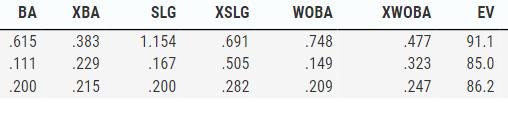
Here’s McCann’s month-by-month performance against right-handers who’ve thrown him breaking balls:
Source: BaseballSavant.com
As shown above, the highly-paid backstop was essentially an easy out in April when right-handers would throw him curveballs or sliders, and unfortunately, it seems he was also a little unlucky at times against those same offerings last month as well. Changing that narrative so far this month, he hasn’t encountered nearly as much bad luck and has been creating plenty of damage off breaking balls.
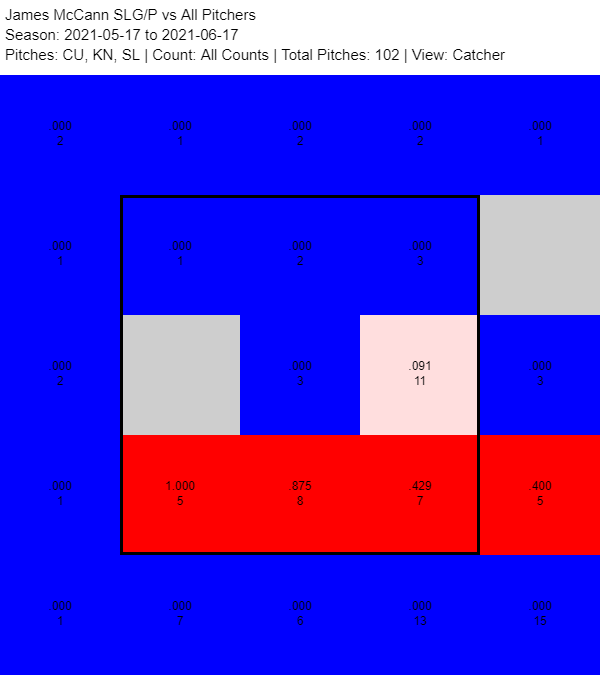
Unlike earlier in the season, McCann has been much more effective at covering the entire plate during his recent turnaround, especially against breaking balls. Though he still has some room to improve, particularly in the upper half of the strike zone, this improved plate coverage has certainly played a key factor in his offensive resurgence.
Here are McCann’s slugging percentages by zone against breaking balls from Apr. 5 – May 16:

Source: FanGraphs.com
In comparison, here are McCann’s slugging percentages by zone against breaking balls from May 17 – Jun. 17:
Source: FanGraphs.com
While McCann effectively covered the inside corners of the zone through the first month and a half of the season, he failed to replicate that same success against breaking balls that were located in the middle and on the outside half of the plate. But since the middle of May, he’s dominated against those offerings at the bottom of the zone and has also covered some pitches off the plate as well.
Considering the Mets’ backstop is currently slashing a .111 AVG, a .140 xAVG, a .111 SLG and a .183 xSLG against fastballs this month, there’s no question he still has a few adjustments to make in the batter’s box moving forward. Having said that, the coaching staff has to be extremely impressed with the way he’s recovered from his extremely disappointing start to the campaign.
With three and a half months remaining in the regular season, receiving continued success from McCann through the rest of the way should help almost everyone forget the miserable beginning of his inaugural season in Queens. Though setting new career highs is probably out of the question at this point, maintaining his current pace should allow him to salvage his overall metrics by the end of September.
If McCann reaches that point, he could be in a prime position to help the Mets enjoy a deep postseason run this fall, which would definitely be a welcome occurrence by everyone involved.