It is too early to panic with David Peterson three starts into the season, even if in his two previous starts, he gave up five runs. His start to the season has been uneven, with most of the damage coming in two innings. There are some positives – for example, his 31.1% chase rate so far is well above average. But overall, Peterson looks like he has taken a step back across the board. His velocity is down across the board; he is not generating as much horizontal movement on his pitches, his pitches are generating fewer whiffs, and he is struggling to find the zone.
While it is too early to smash the panic button, it is worth it to dive into the alternatives if a future rotation shake-up is needed.
Sean Manaea
Sean Manaea has had his own issues since the start of spring training, when he was unable to hit even 90 miles per hour on his fastball. The good news is that eight of his twenty-five four-seam fastballs and sinkers have been over 90 miles per hour so far this season, and he has reached 91.3. The bad news is that he has not been consistent in his velocity, throwing as slow as 85.3 miles per hour. This very much showed up as he tired towards the end of his most recent appearance on April 8. On his first 35 pitches, Manaea averaged 90 miles per hour on his sinker. On his last 35 pitches, he averaged 87.6 miles per hour.
It is hard to pinpoint what the level of concern should be here. The velocity is slowly starting to come back. The sweeper still looks very good. His chase rate is climbing, and he is now throwing five usable pitches. But if he is going to rejoin the rotation, he needs to maintain everything past 35 pitches. There has been progress, and as it stands, he probably profiles as a backend starter. There may even be arguments that he still currently profiles better than Peterson. His pitches still profile better per most stuff models; he is doing much better limiting hard contact, and he is locating his pitches better. He is also still tunneling his pitches well.
Manaea still is not where you want him to be, but it is not very clear what the solution is to keep moving forward is. According to the team, the bone chips are not pressing on his ligaments, so removing them would lead to a lot of risk for likely not much reward. In his last appearance, he raised his arm angle up two ticks and started to see some velocity increase without much horizontal break loss. This all may just click at some point. It is also possible that he does not improve much past here, and the Mets will need to figure out what they want to do.
Tobias Myers
Tobias Myers may already be the Mets’ third or fourth best starter despite not being in the rotation at all. His stuff has taken a huge step forward from 2025, and while he will not likely stay a 1.13 ERA and 0.38 WHIP pitcher, he currently profiles like a mid-rotation starter. He has become a pro at tunneling his pitches, and his pitch movement continues to befuddle hitters. Myers has yet to give up a barrel, has only walked one batter, and his 24% strikeout rate is a big jump from his 17.3% in 2025. So far, he is building on all of his gains from spring training.
Part of Myers’ success comes from his new slider, which has more depth to it than his old slider. Myers described it as mimicking a curveball despite being thrown with a slider grip. While it has not generated significant swing and miss so far, he has yet to give up a hit with it. His cutter took a step forward this year with more glove-side movement, and so far it is generating a 50% chase rate and 33.3% whiff rate. He is using the pitch far less than in 2025, utilizing it more when he is ahead in the count. Meanwhile, his splitter has become his go-to pitch to get strikeouts when he gets to two strikes.
Myers looks like one of the Mets’ best pitchers, and that is a testament to how he has grown as a pitcher. If he continues this, he may force his way into the rotation at some point in 2026.
Christian Scott
Christian Scott is still working his way back from Tommy John surgery, but under the hood, he might look even better than he did before he got injured. You can largely hand-wave the 16.20 ERA and 2.70 WHIP from his first start as a mixture of his first start back from injury and pitching in Syracuse in April. Scott’s velocity is up 1.5 miles per hour on his fastball (95.7), his sweeper has significantly more horizontal movement, his splitter is tighter, he is throwing his slider harder with more break, and his movement profiles overall look strong from his lower arm slot.
The biggest question will be how Scott attacks left-handed hitters. That was an issue for him in 2024. His sweeper/splitter combo could be the key here. Scott has referred to his splitter as a changeup and in the offseason, discussed how he felt that pitch could help him better sequence against and attack left-handed hitters. This will be the key for him to develop into the star he was projected to be before his injury.
Jonah Tong
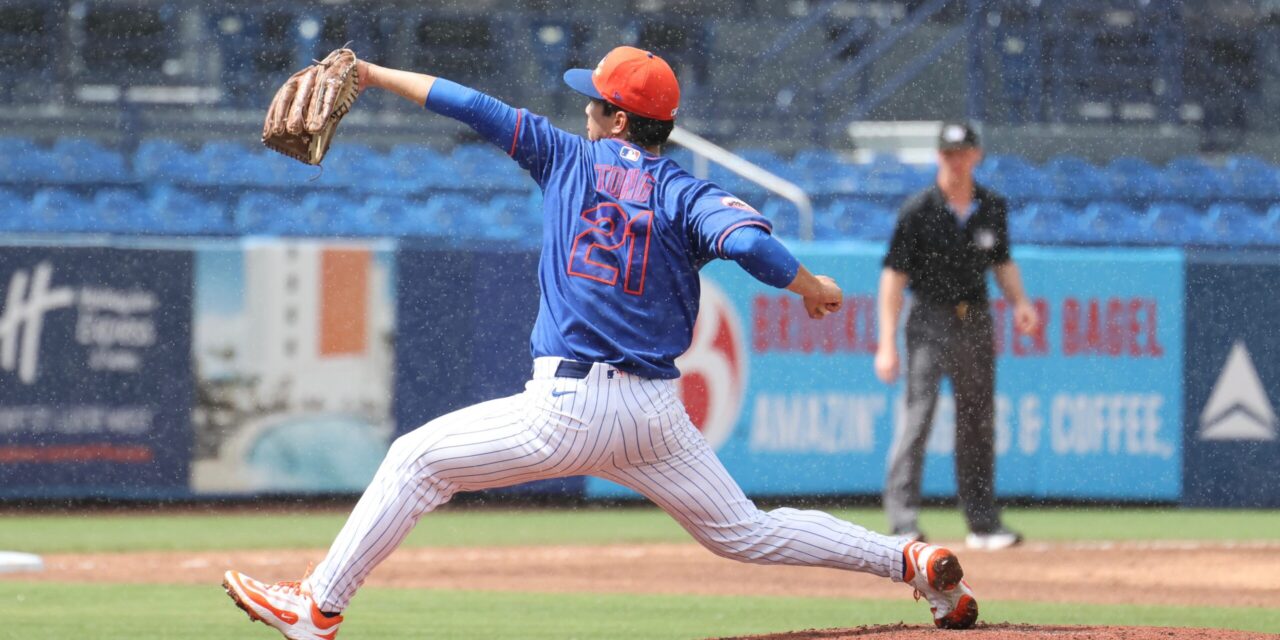
A week ago, this Jonah Tong breakdown would have been quite different, but in his last start, he showed that he may be making a breakthrough. His cutter showed actual, real glove-side movement! He generated -5.3 inches of horizontal break to go alongside his 7.5 inches of induced vertical break. It is by no means a plus pitch, but it went from a useless pitch to a roughly average pitch. Progress is progress.
Tong likely needs significant time in Syracuse to continue to refine his pitch mix and control. Being effectively wild does not work as well in the majors as it does in Triple-A. But having more usable pitches will allow him to sequence better and should help his pitches play up. In his most recent start, when he was mostly just throwing fastballs and changeups through the first inning, he gave up two runs and failed to generate a whiff on his fastball. As he mixed in more pitches throughout the outing and sequenced better, his whiff rate skyrocketed, and he ended with a 26.1% whiff rate on his fastball.
Tong has finally started to show real progress, but he is still very much developing. Barring some massive strides in the short term, he is more likely a second-half consideration.
Jack Wenninger
Jack Wenninger is another “effectively wild” pitcher dicing up Triple-A pitching with his 28.2% whiff rate. But with a 43.5% zone rate, non-amazing spin rates, and non-elite velocity, he likely profiles more as a fourth or fifth starter than a frontline pitcher. Where he does excel is in his movement profile. But any improvements in his control could greatly raise his stock. As it stands, he could make his way to the majors in 2026, but the Mets will likely want to improve his command and control before then.
Wenninger throws multiple above-average pitches, and even though he does not always know where they are going, they do generate swing and miss. Without elite metrics, control, or chase, he will need to either improve some of those areas or rely on the diversification of his large repertoire if he wants to be a successful major league starter.
Jonathan Pintaro
What is there to say about Mets Michael King, I mean Jonathan Pintaro, that has not been said before? Jokes aside, with a pitch mix similar to King, Pintaro excels at generating swing and miss. He throws multiple plus pitches with a great feel for spin and plus movement from a low arm slot. He does not have near the level of control as King, walks way too many batters, and does not tunnel as well.
Barring a jump in command, Pintaro likely would not be an option in the rotation outside of spot starts, but that was once the view of Michael King as well, so never say never.
Carl Edwards Jr.
Carl Edwards Jr. may be the most surprising name here, as most people likely think of him as a reliever. Across 11 years, he has a 3.86 ERA and 1.21 WHIP as a reliever and has never made a start in the majors. But in the minors in 2025, he began experimenting with being a starter, and the Mets signed him as starter depth this past offseason. It has started off fine so far, with a 3.00 ERA and 1.33 WHIP in his two starts and first nine innings.
Under the hood, he looks fine as well. He is running a roughly average whiff rate at 26.2%, chase rate at 25%, and strikeout rate at 21.6%, he is generating an above-average ground ball rate at 52.6%, and he is attacking the zone. His pitches do not profile as plus, but they generate above-average spin with good but not great movement.
He profiles like a fine spot starter, but probably not someone who will take an extended role in the rotation.