Truth be told, it feels somewhat problematic to restrict formidable Mets opponents to a small roster of players. Anyone who has watched the franchise play for even five or six years knows that pedigree is just one part of the equation: literally Conor Gillaspie, Luis Sojo, and Terry Pendleton could qualify as Met killers on the basis of one accomplishment alone.
The point I’m trying to make, at least as we get the ball rolling, is that the Mets (how we love them) seem to get beaten by everybody anyway.
There are so many honorable mentions along the continuum of weird, mediocre utility players in my lifetime alone (which misses just about everything prior to the 21st century) that I could burn an article or two on. Maybe I’ll get editorial permission to just share videos of Willie Harris robbing us of go-ahead hits, but today is not that day.
In the interest of keeping matters objective and encompassing, I restricted opponent splits to a 30-game, 100-plate appearance minimum, and used other cumulative figures to try breaking whatever stalemates I ran into between two prospective hitters.
Naturally, this makes it harder for us to remember when we’d lose to players named Greg Dobbs, but I think it’s better this way. Divisional rivals have an advantage in these conversations, but at least intuitively, that makes plenty of sense: the players that made it especially harder for the Mets to continue playing into October are the cruelest of titans.
Obviously, factors like batting average and OPS still drove much of the research, and I still kept an eye out for specifically lethal moments when profiling players (even those I never had to grow up watching), because you always make a judgment in sports based on how you feel, anyway.
But there is also something to be said of the players that smacked our pitching around and ate away at our hopes no matter the context. As part of a larger segment where we compile an entire team of Met killers, I’ve put together the infield. Reader discretion is, of course, advised.
Catcher: Gary Carter
This is (I hope) the only time we run into a conundrum like this going forward, because Gary Carter obviously did more to bring life to the Mets franchise than he ever could have to kill it.
I can’t pretend I don’t feel a little bit gross drafting this one up, but there really aren’t a ton of catchers the Amazin’s have rolled over for nearly as easily. Mike Piazza was surprisingly high up there too, but the sample size is nearly four times less daunting (47 career starts against the Mets to Gary’s 168).
One of the centerpieces in the franchise’s championship run in 1986, Carter’s arrival from the Montreal Expos the prior season was a two-pronged blessing. On one hand, the Mets had claimed ownership of one of the best offensive backstops in all of baseball and arguably their best defensive catcher since Jerry Grote. Even if Carter had never panned out, however, the fact that he was no longer torturing the club from north of the border would have been enough of a benefit.
Only 31 players in the history of baseball have more plate appearances against the Mets, but relative to Carter’s career .873 OPS, only eight were more dangerous with the stick, and none were regular catchers. His 307 total bases against the Mets rank first all-time among catchers (technically second behind Joe Torre‘s 371, but he’d quit catching by the end of the 1960s, at which point he’d only accumulated 237).
Perhaps Carter’s most ruthless season against the Mets came in 1982, when he batted .350/.437/.650 in 17 games and 72 plate appearances. With a career-high 8.6 bWAR on the year, The Kid struck out just six times against the Mets while swatting five homers. All in all, he managed 63 extra-base hits against New York to counter only 67 career strikeouts.
Against some of the most hopeless Met teams through the post-Seaver 70s and pre-watchable baseball 80s, Carter basically existed as a perpetual reminder that even the Montreal Expos (61-41 against the Mets between 1978 and 1983) could play circles around us.
Honorable mentions include Piazza (1.056 OPS against is the fourth-highest in Met history), Torre (117 career RBI is 15th all-time), and Ted Simmons (.869 OPS and 153 games during the 1970s led all of baseball), but also among active options Buster Posey (career .316/.376/.565 line), and – among (*clears throat*) interesting options – Brian Johnson (journeyman backup catcher from the 1990s who had eight homers, 23 RBI, and a .992 OPS in 32 games against the Mets).
First Base: Willie Stargell
Go to any offensive leaderboard anywhere and you’ll often find them crawling with first basemen, so we were spoiled for choice here between the past, present, and vaguely familiar. There isn’t really any other way to slice this one, though considering many older fans view Willie Stargell as potentially the most destructive Met killer of any era, and moreover from any position.
Stargell has played in the sixth-most games against the Mets of any big leaguer ever. The respective OPS figures of the five superior finishers read as follows: .764, .661, .846, .702, and .791. Then you run into Stargell, who checks in with a .942.
His 475 total bases against the Mets rank second all-time behind Pete Rose (who appeared in 86 more games). His 60 home runs top the charts (11 ahead of the next fellow, who made 24 more starts), as do his 182 RBI (20 ahead of an anonymous corner infielder who started in 44 more games). For a hefty power hitter that struck out regularly, his lifetime .287 average against the Mets is pretty stellar in itself.
Perhaps unsurprisingly, Pops also owns the best single-season performance against the Mets of any potential Met killer. The sample only features 13 games, and comes at the hands of a pretty subpar 1966 club, but even in cumulative terms, Stargell did things to the Mets that ranged from mind-blowing to outright bullying.
He hit .420 and slugged 1.140 on the back of 10 homers, 23 RBI, six doubles, and seven walks. He hit 33 long balls and drove in 102 runs that season – meaning his 13 games against the Mets accounted for 30 and 22 percent of his overall production in one season. Surely he could have saved some of this for the other nine teams he played.
His 57 total bases in that single-season split is tied for third behind 1962 Hank Aaron (60), 1964 Rico Carty, and 2016 Daniel Murphy (both 58), and he ranks there in five fewer games. As a matter of fact, among the top 100 single-season marks for total bases against the New York Mets, Stargell accounts for four such spots, having picked up 42 in 1964, 40 in 1967, and 39 in 1973. Dick Allen, Willie Mays, Willie McCovey, Chase Utley, and Anthony Rendon each take up three spaces of their own, but nobody else owns four percent of the board.
Allen and McCovey warrant their own shoutouts for this reason, but other honorable mentions go out to Ryan Howard (48 career big flies in just 169 starts), Frank Howard (1.078 career OPS in 43 games – highest mark of any player with as many), and Freddie Freeman (already 23rd all-time in total bases against us, even though he’s 51st in games played – also leads active first basemen with 27 home runs and he’s still only 30).
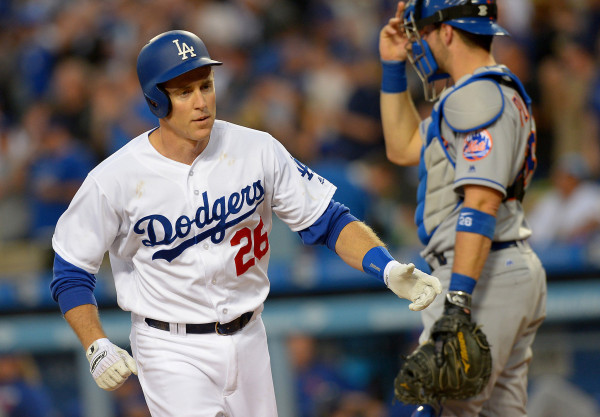
Second Base: Chase Utley
I said this would be objective but I need to preface this by saying I do not like Chase Utley. Never mind the fact that he killed the Mets on the offensive side of the ball, he’s one of the only Met killers to have also killed someone’s career, and unapologetically at that. But let’s revisit the fact that he killed the Mets on the offensive side of the ball, since that’s also important.
From 2006 to 2010, Chase Utley appeared in five straight All-Star games and spearheaded an eventual takeover of the NL East, a timeline that saw the Mets fade from World Series hopefuls to fringe playoff contenders, and then again to a borderline laughingstock in their division.
In the 81 games Utley started against the Mets during that five-year stretch, he hit .283/.379/.546 with 20 home runs and 49 RBI. Among the 20 qualified hitters (min. 45 total games played) in that time, Utley ranked second to Howard in homers and total bases (172), second to Josh Willingham in OPS (.925), and tied with Hanley Ramirez for first in runs scored (56).
All things considered, it was 2009 – possibly our most embarrassing summer in recent memory – in which Utley reaped the most benefits.
Chase slugged .772 against our Mets that year, and his 1.230 OPS remains the highest single-season mark among second basemen. He went hitless in just four of his 16 starts, but made up the margins with six multi-hit games. He put up a brutal 215 wRC+, but the splits get even worse as the games go later. In his 29 trips to the plate after the fifth inning that year, Utley slugged .963.
For his career, Utley boasted a 172 wRC+ in high-leverage spots, and he managed a .998 OPS with runners in scoring position. The terrors continued long after Jerry Manuel‘s Mets had tapped out, and relative to other second basemen, Utley’s numbers have been virtually untouched. His 39 career homers, for instance, rank ninth all-time, and the next-best finisher at the keystone, Ryne Sandberg, finishes 20 spots back. Dan Uggla places another eight spots behind Sandberg.
The only honorable mention beyond the occasional power-hitting second baseman would probably be Daniel Murphy, who single-handedly kept the Mets from gaining ground on the Nationals in 2016 by hitting .413/.444/.773 in 81 plate appearances. He’d lay another whooping down in 2017 (.354/.425/.615), but two years of torture from a former teammate doesn’t match the plague Utley unleashed on the Mets while their competitive window closed and then burned.
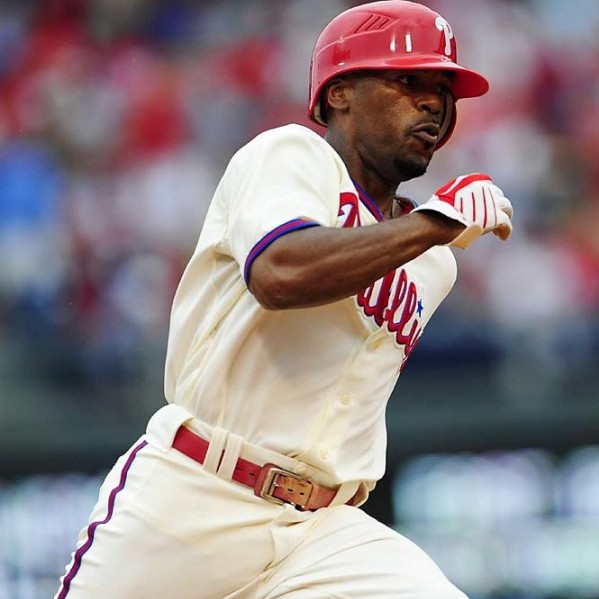
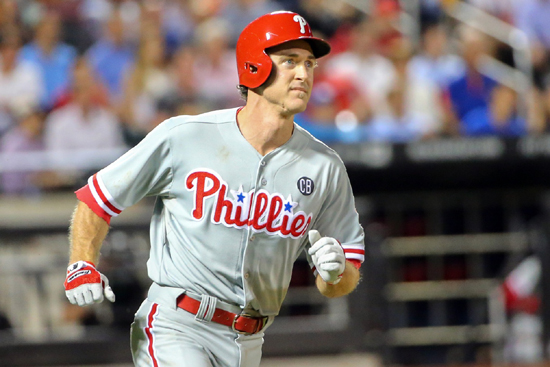
Shortstop: Jimmy Rollins
From 2004 through 2008, Jimmy Rollins was arguably the best leadoff hitter in the National League, and he remained easily the most frustrating opponent to open a game against even as his prime faded.
His impact with the Phillies involved fewer dirty slides, but between the cocky interviews and his snatching a 2007 MVP Award out of the hands of David Wright, his presence year in and year out always left me both speechless and ashamed as a young fan.
J-Roll’s 33 career home runs against the Mets rank 15th all-time and first among shortstops, as do his 64 steals and 99 walks. The .791 OPS is further away from the top of the heap, but it still sits nearly 50 points higher than his career mark, thanks in large part to the eight first-inning leadoff home runs against Met pitching.
On four separate occasions during his career, the switch-hitting Rollins put up an OPS north of 1.000 with men on base. If you look hard enough at his stats during that 2007 season – particularly as the Mets collapsed in the latter two months – you can literally hear the sound of Citizens Bank Park consuming your dreams.
There were 29 big league hitters that started in at least ten games against the Mets that year: Rollins, a leadoff man no less, led the pack in home runs (6) and total bases (54, while Ryan Howard’s 38 ranks second).
He finished second in batting average (.346) to Rafael Furcal, second in slugging (.667) to Ryan Church and second in RBI (15) to Miguel Cabrera and Jeff Francoeur. Rollins also tied Matt Diaz for the fifth-fewest strikeouts (8), but did so in nearly twice as many plate appearances (87 to 46). Only Juan Pierre (once in 46 PA) had a better rate against Met pitching that year.
I did some (more) split-digging and found that if you’d taken the New York Mets off of Philly’s schedule altogether, Rollins’ numbers would have looked something like this:
| ’07 Stats | AVG | OBP | SLG | OPS | wOBA | wRC+ |
| (NYM included) | .296 | .344 | .531 | .875 | .371 | 119 |
| (NYM removed) | .286 | .337 | .502 | .839 | .357 | 110 |
Obviously, we’re still looking at a breakout season, and perhaps still the best of Rollins’ career. But the unequivocal difference between Rollins being crowned the most valuable player in the National League and being one of a dozen or so offensive forces is decided by whether or not the New York Mets exist. This is, at least statistically, what owning a team looks like. You’d only need to remember how 2007 ended to see how this translates to killing a team.
The best competition Rollins has among shortstop Met killers is probably Derek Jeter. The .364 career average is second all time to Rico Carty among position players, his .955 OPS is 22nd, and he more or less reduced the 2000 World Series to a game between kids and adults with the offensive display he put on. But the Mets only faced him twice a year, seldom under circumstances that meant more than bragging rights.
Give Paul DeJong a few years, though, and we may revisit this one.
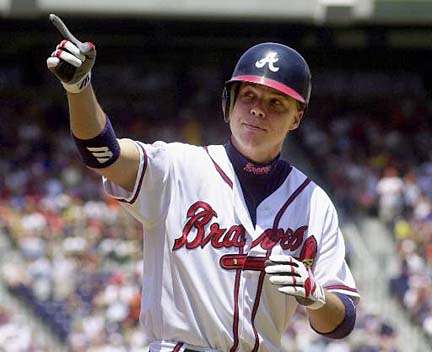
Third Base: Chipper Jones
Mets fans would jeer this man in droves every time he’d come to Flushing, often poking fun at the fact that his name was not, in fact, Chipper, but instead Larry.
The joke is an all-timer, but peeling through his stats and thinking about the history we have with both the Atlanta Braves and Chipper Jones, I couldn’t help but wonder… how do you let a man named Larry get the better of you every year for 18 years?
Only 20 players have ever notched 200 or more games against the Mets, but Larry’s Chipper’s .949 OPS ranks at the top of the class. His 49 home runs in the regular season tie for second with Mike Schmidt, but putting up a .517 OBP in a playoff series against the Mets – getting an intentional pass four times in six games, moreover – says a bit more about the power threat he posed.
1999 as a whole spelled a brutal 12 games for the Mets, a year in which Jones would crack seven of his 45 total homers and slug a clean 1.000 en route to an NL MVP title of his own. New York would win just three such contests, and only once kept him out of the hit column altogether. He had reached base seven times in a late-season series in 1998 – one that would ultimately prove the difference in locking the Mets out of the postseason altogether.
He followed suit in a three-game matchup in mid-September, homering in three straight games to sweep New York out of a half-game margin and into a dogfight for the Wild Card. Even in 2000, a season in which the Mets would claim their first pennant in 14 years, Jones would enforce a plot arc of his own, homering in a division-clincher on our own turf.
Over the course of his career, Jones faced the Mets every year for 18 years, and put up an OPS greater than .950 eight times. Already a Hall of Famer with a career .930 clip to his name, Chipper was somehow even harder to put away when he came up against the Mets.
Only three batters have been intentionally walked by Met pitching more than Chipper Jones: one is Ted Simmons, a switch-hitting catcher the Mets were also hopeless against. The other two are Barry Bonds – who was intentionally walked by everybody on more occasions than anybody – and Hank Aaron himself – one of the greatest baseball players of all time.
Particularly as fans would serenade him most passionately during the Shea Stadium years, Jones seemed to turn it around on the Mets most effectively, as he batted .313/.407/.557 in his 88 games there. Among players to never appear in a Met uniform, Jones’ 19 homers at Shea rank sixth behind Stargell, Dick Allen, Graig Nettles, Bobby Bonds, and Mike Schmidt, and he is one of just two to have done so in under 90 games (the other being Allen).
Even as injuries began to cut into Jones’ latter years, he remained a pain in the neck. From 2005 through 2012, Jones hit .265/.375/.477 with 38 extra-base hits in 101 games, batting .514 in 40 high-leverage plate appearances. All told, few third basemen in baseball have been able to remain as productive through injuries as Chipper did, and even fewer have been able to do so against the Mets.
Mike Schmidt‘s matching homer count and career .846 OPS against the Mets, despite less competitive circumstances, render him the most honorable of honorable mentions. Ron Santo (13th all-time in RBI, 18th in total bases) and perhaps also Scott Rolen (.968 career OPS in 105 games) have made a few dents over the years.
Ultimately, though, there isn’t a third baseman, perhaps not even an infielder the Mets had as hard a time at cracking as Chipper Jones.