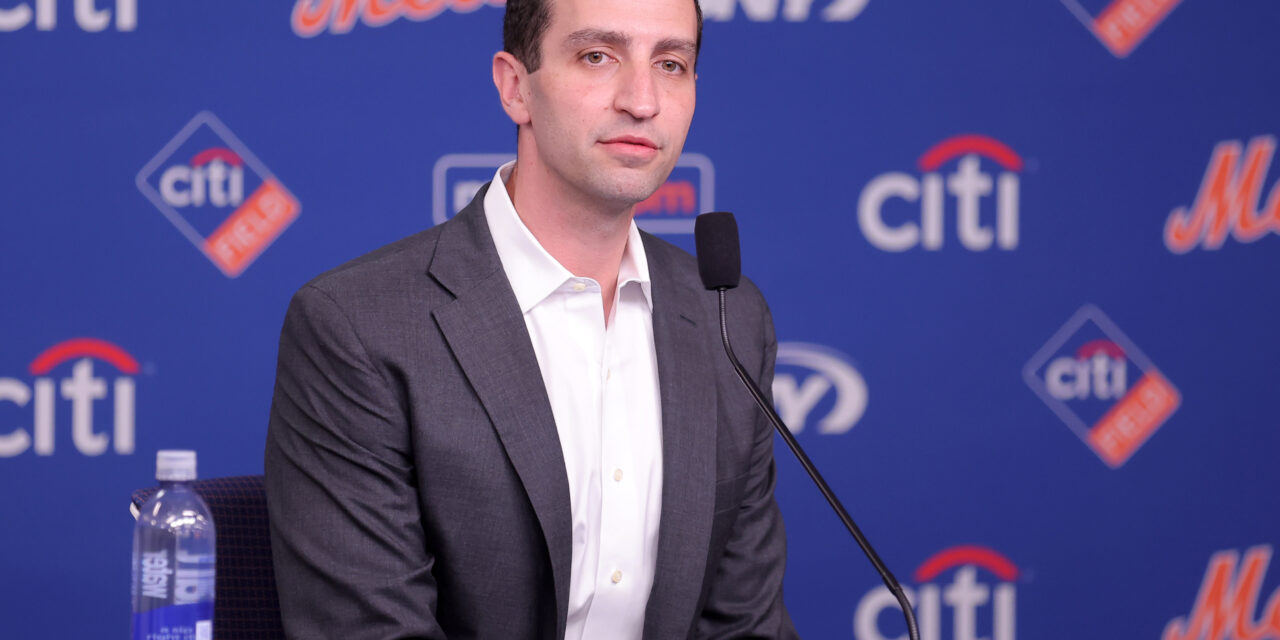
David Stearns is entering his fourth season as the Mets president of baseball operations after spending eight years in Milwaukee. Things have not gone as well in Stearns’ early tenure in Queens, though the situations are not identical either. Stearns took over a much healthier Brewers organization in 2015 compared to the Mets in 2024, who had run through multiple GMs and the gutting of whole departments over Cohen’s first few years with an eye to rebuild. Stearns also has a much larger budget to utilize while also having to work with the Mets’ poor reputation among players.
With so much success in Milwaukee, you would expect Stearns’ goal would be to follow his blueprints from Milwaukee while being able to spend big on stars when they are available. So what has he done similarly, and what has he done differently?
Similarities
Let’s start with what processes he has brought over from Milwaukee because there are many things he has done the same. He was even able to bring Eduardo Brizuela from the Brewers to Queens as an assistant general manager to help set some of these processes in place.
Overhauled International Scouting
One of Stearns’ earlier moves with the Mets was to overhaul international scouting by hiring Kris Gross as the VP of amateur scouting, James Kang as the director of international scouting, and Laiky Uribe as the Assistant Director. This was something he also did within his first year in Milwaukee when he promoted Ray Montgomery to Vice President of Scouting and realigned the Brewers scouting apparatus.
International signings have played a huge part in the Brewers’ success, including players like Jackson Chourio and Luis Lara.
Quickly Promoted Prospects Through the Minors
With the Brewers, Stearns quickly promoted prospects when they showed they were ready to move forward. Trent Grisham only played 34 games in Triple-A before his major league debut. Keston Hiura only played 57. This was the case throughout the minors, where Hiura only played 27 games in Low-A before moving up and 50 games in High-A.
With the Mets we have seen a similar strategy for players who earn promotion, like Carson Benge and A.J. Ewing, who both flew through the minors and played 24 and 12 games, respectively, in Triple-A before their debuts.
Targeted a Young Superstar to Lock Up and Build Around
This one is pretty straightforward. With the Brewers, Stearns targeted Christian Yelich, who was 26 at the time. The Brewers traded for him and then signed him to a nine-year, $215 million contract, the largest in their franchise’s history.
In his second year with the Mets, Stearns signed Juan Soto to a franchise and MLB record 15-year, $765 million contract while he was also entering his age 26 season.
Invest in Homegrown Pitching Over Long-Term Acquisitions
Outside of reportedly showing some interest in Blake Snell per Jim Bowden of The Athletic and Dylan Cease per Jon Heyman of the New York Post, the only official long-term offer the Mets made to a starting pitcher longer than three years under Stearns was to Yoshinobu Yamamoto. To be clear, this does not mean there was no degree of interest or willingness with the other starters; they would not have met with them if there wasn’t, but clearly not to the level of Yamamoto.
Instead, they have focused on developing homegrown starters including Nolan McLean, Christian Scott, Zac Thornton and Jonah Tong, as well as relievers like Nate Lavender, Dedniel Nunez and Dylan Ross. Including David Peterson‘s 68 innings, those arms combined for 495 1/3 innings, or 34% of innings thrown by Mets pitchers in 2026.
This is similar to the Brewers, who under Stearns developed a rotation of homegrown pitchers including Corbin Burnes, Brandon Woodruff and Freddy Peralta. Stearns’ pitching impact is still felt on the Brewers as he helped scout and sign Jacob Misiorowski, Logan Henderson, Aaron Ashby and Abner Uribe. He also traded for Robert Gasser.
Focus on Improving Team Defense
Over his time leading the Brewers, the team ranked fifth in fielding run value, eighth in defensive runs saved, and sixth in FanGraphs defensive run value. The Brewers have continued to perform as a plus defensive team in the years since he left the organization.
With the Mets, Stearns recently described a desire to improve the team’s defense with his infamous “run prevention” line, and the Mets did improve defensively in 2026. They went from nineteenth to sixteenth in FanGraphs defense value, eighteenth to sixteenth in fielding run value, and fifteenth to seventh in defensive runs saved. The Mets also saw their defense improve across the 2026 season as players came off the injured list.
Differences
While there have been many similarities, there have also been many differences. It makes sense that Stearns cannot do everything exactly the same. He has a different owner with different priorities. He was not able to bring over all of his staff and models with him to Queens. So what are some of those differences?
Playing in the Mid-Tier Free Agent Market
With the Brewers, Stearns largely used free agency to fill out the fringes of the roster, relying on a homegrown core to make up the bulk of the roster. There were times he made a swing for a free agent, like when he signed Lorenzo Cain to a five-year contract, but these were few and far between.
With the Mets, he has made many such moves, like Sean Manaea‘s second contract, the Jorge Polanco contract, Frankie Montas, Devin Williams, Harrison Bader, A.J. Minter, and Luke Weaver. While some of these have worked out, many have not. And those that did work out were largely worth exactly the contract, with very little surplus. His bigger wins have been contracts like buying low on Luis Severino, Griffin Canning, the first Manaea contract, and the Clay Holmes conversion.
Part of this could be working within the owner’s goal to compete while rebuilding the farm, pushing the team into these bridge signings. Whatever the reason, this was not a big part of what he did with the Brewers.
Quick vs Slow Front Office Overhaul
When Stearns took over the Brewers, he quickly made sweeping organizational changes. These included realigning the scouting departments, hiring Matt Arnold as the sole assistant general manager, overhauling their development structure under new farm director, and reassigning assistant general manager Gord Ash. Sports Illustrated at the time wrote that Stearns’ time at the Astros influenced many of his changes, quoting him saying, “What Jeff Luhnow set out in Houston with the way he created my position … is certainly something that I thought a lot about in terms of how I want things to function here.”
With the Mets, this has been a much slower process. There were departments that were gutted by Cohen and Eppler that needed to be rebuilt, as well as areas that Stearns overhauled, like amateur and international scouting. But as MMO wrote in our article “How Has The Mets’ Front Office Grown Under David Stearns?,” there are still many holdovers from prior administrations. With the recent job postings and hirings, it would seem that, just now, over three years in, they are just starting to make significant player personnel and pro scouting changes.
Extended Young Talent
This could change with the recent crop of prospects, and there were some rumors of a potential Francisco Alvarez extension in the past, but at the time of writing this article in November of 2026, Stearns has not locked up any of the Mets’ young talent under an extension.
With the Brewers, he extended Freddy Peralta to what ended up being a seven-year extension after his club options were exercised. While working alongside Matt Arnold in 2022, the Brewers extended Aaron Ashby and they tried to extend Josh Hader before eventually trading him. Chase Anderson was older and a trade acquisition, but he also signed an arbitration extension.
Stearns with the Brewers was never as liberal with his extensions as Matt Arnold has been in recent years, but he seemed to make it more of a priority than he has with the Mets. That could have been to combat payroll restrictions, or with the Mets, he just may not have found the right players yet.
Centralized Duties Under One General Manager
Similar to how Stearns made Matt Arnold the sole assistant general manager early into his Brewers tenure, he eventually centralized the workflow of the organization under a single general manager when he promoted Matt Arnold to the role in 2020.
The Mets have yet to centralize their AGMs under one general manager, with Eduardo Brizuela, Kris Gross, Jonathan Strangio and Ben Zauzmer all serving as assistant general managers. Teams typically will keep higher front office positions vacant so they can either promote their own staff to avoid having them poached, or have room to poach from other organizations by promoting their staff, but at this point the Mets do not have a general manager. They are not far off from the point in his Brewers tenure when he promoted Matt Arnold into the position.
Avoided Big Name Relievers
While running the Brewers, Stearns never had a reliever who made more than $9 million, which was Joakim Soria in 2018. He focused more on flexible bullpens full of homegrown talent and under-the-radar signings and waiver claims.
With the Mets Devin Williams, Luke Weaver and A.J. Minter all eclipsed that amount, while Adam Ottavino signed just shy of that dollar amount. He offered Edwin Diaz an expensive contract, which he turned down for the Dodgers and traded for Ryan Helsley, who was making over $8 million. He also showed no issue moving Kodai Senga to the bullpen with his $15 million a year contract and even used Sean Manaea in relief despite being on a $75 million contract.
Moving on From Established Players
With the Brewers, Stearns was not against moving on from an established player that may have value before their contract ran out. With the Mets, he has let players like Pete Alonso leave in free agency, or traded players like Brandon Nimmo and Jeff McNeil after their value had decreased. But none of that is similar to trading Josh Hader at the top of his value which landed them Robert Gasser and Esteury Ruiz, who they later flipped for William Contreras. Stearns also traded Zach Davies and Trent Grisham to the Padres for Luis Urias and Eric Lauer, who both had multiple productive years for the club.
With the Mets, he went into 2026 with all of David Peterson, Kodai Senga and Sean Manaea. He held Mark Vientos and Ronny Mauricio, who may get non-tendered this offseason, as well as Brett Baty, who at least looks like he could be a productive player in 2027. With the Mets, Stearns has not seemed to have the same appetite to move players who could be productive for the major league roster. Maybe the feeling is the club does not yet have the farm to make up for their production, but this is an area he was successful in Milwaukee and has not utilized in Queens.
Takeaways
There are many reasons some philosophies are different and could range from access to a larger payroll, to growth league-wide in baseball, to specific owner priorities. David Stearns has also shown through his career a willingness to adjust and adapt, but it is interesting to look at some of the similarities and differences between how he ran the Brewers and how he has run the Mets so far.