
When the Mets signed Clay Holmes to a three-year, $38 million deal in the 2024-25 offseason, the initial reaction was subdued.
Fans shrugged their shoulders and acknowledged that, on paper, the deal made perfect sense. Good relievers are finite and, in his four seasons with the Yankees, Holmes established himself as one of the major’s best.
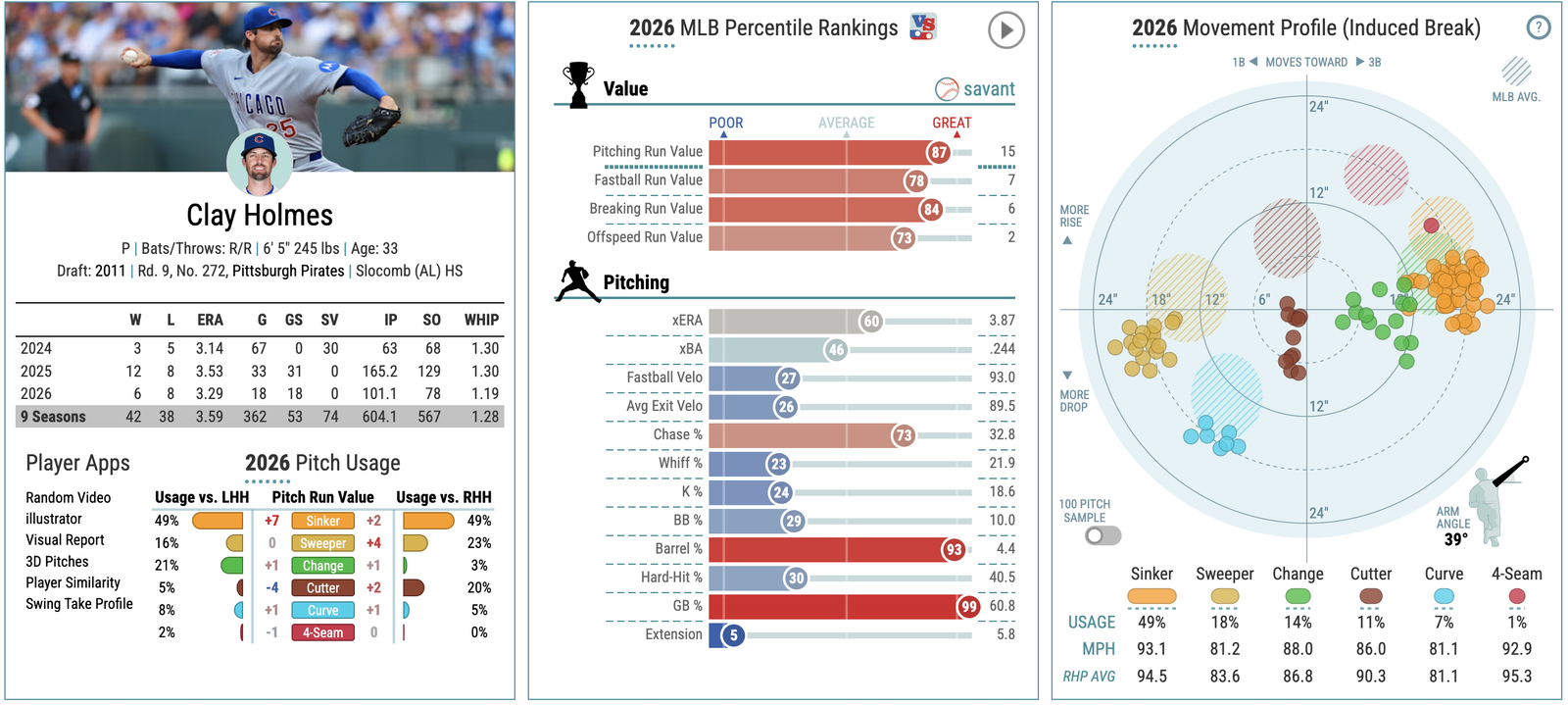
And then, just like Holmes would 111 times over the next season-plus, the Mets threw their fans a curveball: Holmes would migrate back to the rotation.
In the end, the deal worked out for both parties. The Mets taught Holmes a kick change and, in return, Holmes fronted their starting staff for a season and a half, and on his way out, delivered top prospect Jefferson Rojas.
Holmes was one of the many to take part in the reliever-to-starter movement. Previously, teams had three ways to acquire starting pitchers: drafting, trading, or signing. Now that a fourth avenue opened – conversion – teams rushed to identify candidates worthy of a spot in their staff.
The results of the experiment have been mixed.
Griffin Jax and Michael King represented clear success stories, utilizing their expanded arsenal to attack both lefties and righties effectively. On the other side of the spectrum, dreams of Jordan Hicks securing a long-term spot in the Giants’ rotation fizzled out after just 20 starts.
This winter, teams are, once more, seeking out starter traits in free agent relievers, scouring the market like a portfolio manager in search of alpha. Baseball Prospectus writer Jarrett Seidler recently listed Adrian Morejon as a reliever who could be moved to the rotation in 2027.
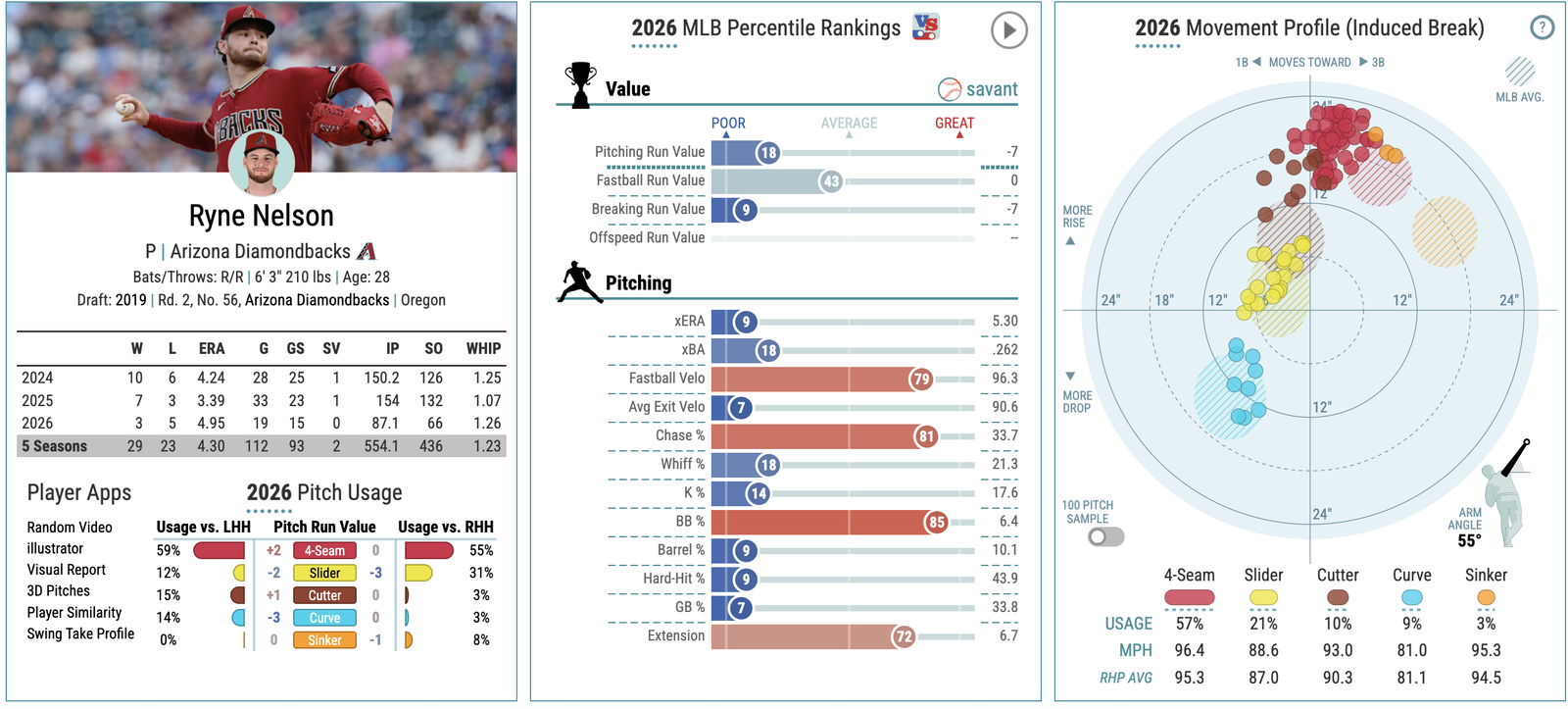
Current Diamondback reliever Ryne Nelson is another candidate. In 2026, his ERA neared five, and he was relegated to the bullpen.
And yet, Nelson, hiding in plain sight, is a prime candidate to return to the rotation and dominate in 2027, should he follow the Clay Holmes blueprint.
Let’s build a great, modern starting pitcher. That pitcher needs a few qualities:
- An elite fastball trait (velocity, movement, spin rate, etc)
- A plan against righties
- A plan against lefties
- A modicum of command.
One of the major’s best fastballs is hiding like an oasis in the desert of Arizona.
Nelson, despite not receiving the same fanfare as young aces Trey Yesavage and Sean Burke, slotted in between the pair in the vertical movement (IVB) leaderboard, 750-pitch minimum, in 2026.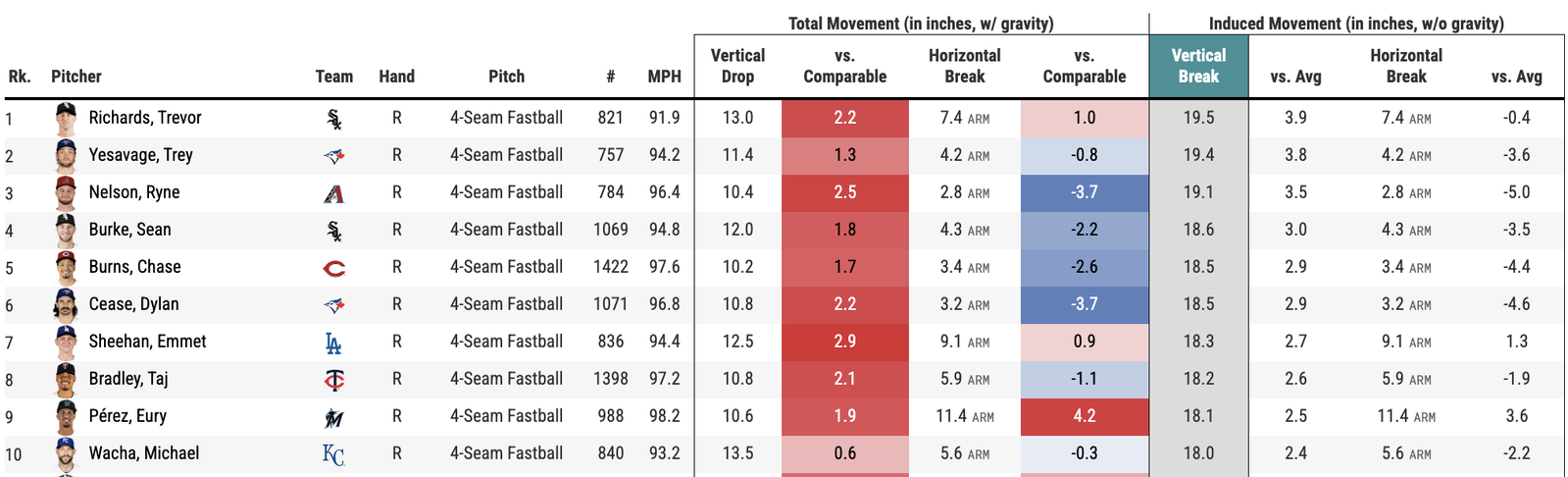
His heater, if utilized properly, is an elite weapon thrown from one of the Majors’ northernmost slots. Unsurprisingly, it’s a good thing when a pitcher’s fastball breeds compassion to Chase Burns‘s.
There’s precedent for Nelson’s fastball success. In 2025, with an identical movement profile, his fastball produced +24 Runs, tops in the majors, though the success didn’t carry through to 2026. Changing location frequency to the top rail in 2026 resulted in a decreased Location+ score, and batters teed off of it as if they were Messí at a community kickball game.
Good Fastball Traits: Yes
In 2026, against righties, Nelson had a plan: grip four-seamers and rip four-seamers 50% of the time. There have been seasons where that approach worked really well, and others, well, not so well. He tended to complement his heater with a slider thrown with plenty of gyro spin, an offering that harkened back to the days of the “Warthen Slider.”
Last year, his fastball and slider aggregated to -3 Run Value and .808 OPS, two numbers that fare poorly at face value. But a peek behind the curtain revealed a more promising pitcher against same-sided batters; both his 1.73 HR/9 and 57.7 LOB% marks portend better results in the future.
As 2025 proved, Nelson can dominate righties (+8 Run Value) by leading with just his fastball and slider. Simply by the law of averages, the page may turn on his issues against righties in 2027.
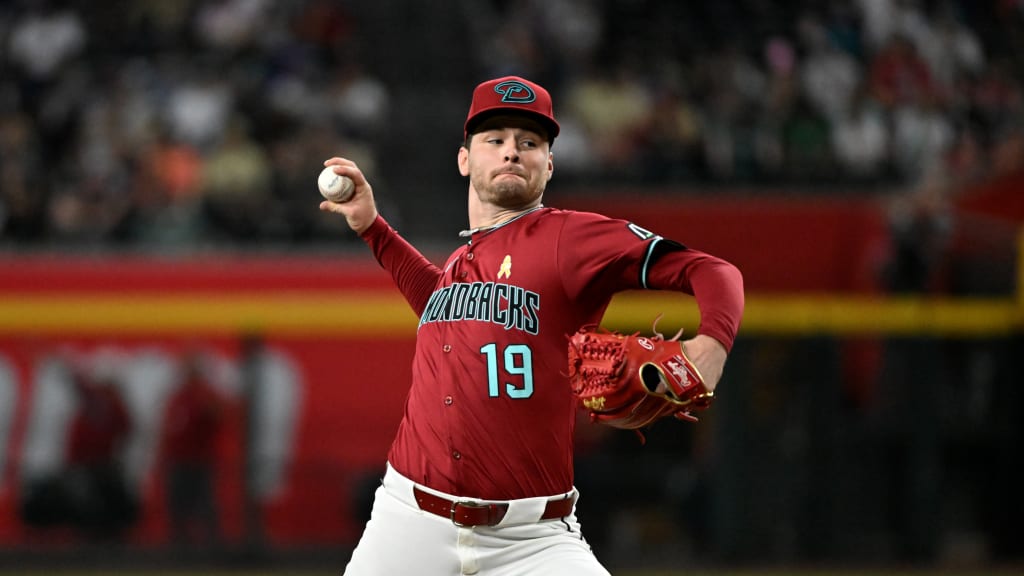
Photo via MLB.com
Solid Plan Against Righties: Yes
Against lefties, there’s a tentative plan, or at least a concept of a plan. Unsurprisingly, in 2026, Nelson poured in his fastball. Cutters, sliders, and curveballs thrown at a greater than a 10% clip comprised the rest of the strategy.
Two years ago, the Mets acquired a pitcher with no offerings located on the inner semicircle on the right side of the pitch movement plot. After they equipped Clay Holmes with a kick change, Holmes stymied lefties to the tune of a .661 OPS and .294 wOBA in his first season as a starter.
Nelson is in the same boat.
Any team acquiring Nelson should reach into their “Clay Holmes Improvements Ideas” bag and yank out a kick change. Of course, every pitcher is different and what worked for “Pitcher A” is no guarantee to work for “Pitcher B,” but any risk is mitigated by trying a fix on one of the major’s worst pitchers, results-wise, in 2026.
Armed with a top-tier pitching development apparatus, the Mets are well-suited to take a few shots at the developmental dartboard.
Clay Holmes looms as a success story. If armed with a kick change, Nelson is just an afternoon drizzle away from blooming in Queens.
Tentative Plan Against Righties: Yes
Modern starting pitchers are built like perfect lab specimens fresh off an assembly line. The “Modern Pitcher” is a big, hulking being, holding both a quiver of high-velocity fastballs and a series of physics-defying secondaries, but lacking the command module.
Nelson must have rolled through the line when the settings were flipped. In 2025, his fastball sat only a mile-per-hour better than league average, but was located exquisitely to the tune of a league-best +24 Runs.
Last year, he peppered the zone with the rest of his arsenal. Only the likely suspect – his curveball – sat below a 39% zone rate. At the end of the day, Nelson permitted a free pass at a 6.4% rate, a mark good enough for the 85th percentile in the majors.
Command: Yes
The Fit?
In 2025, Jonah Tong made his debut, reaching the skies with his 64 degree arm angle. A year later, Tobias Myers entered 32 games and matched Tong’s extreme arm slot. Recently, the Mets acquired fellow righty Jack Anderson off waivers from the Twins. Anderson releases from a, you guessed it, 64 degree arm angle.
Either the Mets’ model prioritizes high-slot righties, or the Mets really like paying homage to Elmer Dessens. One would tend to think it’s the former.
Nelson’s high release point fits the model’s recent recommendations. Among all starters, his 55 degree arm angle ranked fifth in the majors.

Brad Penner-Imagn Images
In both the 2025 and 2026 seasons, a lack of quality rotation depth handcuffed the club, causing the unaddressed leak to sink the battleship, or, as president of baseball operations David Stearns put it, “resulted in an uncapped downside scenario.”
Nelson is a perfect candidate to quell the leak. He has starting pitching experience, is controllable through 2029, and is optionable.
The Mets don’t need a grizzled, tobacco-spittin’ vet capable of 30 starts to anchor their rotation. They just need quality innings.
The Diamondbacks’ decision to cut payroll this winter could result in Nelson falling right into the Mets’ lap, just as he enters his second year in arbitration. That, coupled with his on-the-field results, should preclude the Mets from tapping into the upper echelon of their farm system in a potential deal.
Further, there’s a case to be made that Nelson has not been exposed to an exemplary pitching development program yet. Arizona is not known as a pitching development mecca, to say nothing of recent job turnover among their pitching staff.
The Mets did well with the Clay Holmes Experiment. It’s time to turn their microscope to Ryne Nelson.