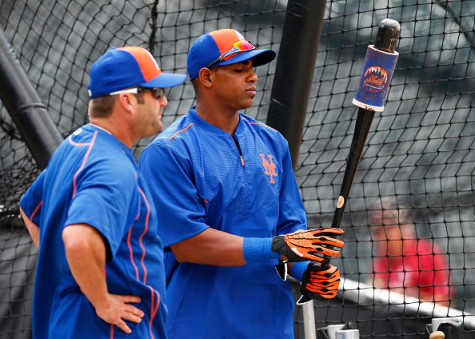
The Phillies fired their hitting coach Kevin Long, who had been with the club since 2022. After leaving the Mets following the 2017 season, he spent four seasons with the Nationals. Both the Nationals and Phillies regularly ranked as a top-ten offense with him at the helm, and the Nationals won the World Series in 2019 with him as their hitting coach.
Could he return to the Mets? Matt Gelb of The Athletic thinks it could be a possibility, writing, “It’s possible Long returns to the Mets, where he was the hitting coach from 2015-17; he remains close with New York star outfielder Juan Soto, whom he coached as a young player in Washington.”
Would Kevin Long Fit the Current Mets?
After parting ways with Jeff Albert, the Mets currently have one hitting coach in Troy Snitker as well as an assistant hitting coach in Rafael Fernandez. It is common for most teams to have multiple hitting coaches in the modern game. The Dodgers have Aaron Bates and Robert Van Scoyoc, the Rays have Chad Mottola, Will Bradley, and Ozzie Timmons, the Guardians have Grant Fink and Junior Betances, and the Brewers have Guillermo Martinez and Daniel Vogelbach (yes, that Daniel Vogelbach). The important part is to have the coaches on the same page, which was not the case when Eric Chavez and Jeremy Barnes were the hitting coaches. They came from very different backgrounds with very different philosophies that at times seemed to run counter to each other.
In 2023, Long did an interview with Paul Casella of MLB.com where he outlined his philosophy as a hitting coach. He bases the core of his philosophy on analyzing film, stating he watches “2,000-3,000 swings on a guy before I even met them.” He utilizes data to understand why specific things are happening, but believes it is important to view not just the current version of a swing, but how it has evolved over the years and how the changes with data line up with the changes in the swing itself.
Long is more old-school in his approach than Snitker and Albert, both of whom have strong biomechanics backgrounds. Where Snitker and Long do line up is how they are both known as hitting coaches that get in the cage with the players and provide hands-on experience. Chandler Rome of the Houston Chronicle wrote about Snitker’s hands-on approach with players like Kyle Tucker. They both focus heavily on the mechanics of what goes into a swing, even if they get there by different means with Snitker focusing more on analyzing the data behind the kinetic chain and Long focusing on analyzing the visual components of the swing through film.
Other similarities between Snitker and Long come from their views on swing and miss. When he first came to the Phillies, Long worked with players to cut down on their chase rate. With the Astros, Snitker pushed players to improve on their overall selectivity both in and out of the zone. Long has specified that hitters need to balance their aggression with intent and not become passive by trying to limit chase rate. It should be noted that while the Phillies’ chase rate decreased across the early part of Long’s tenure, it did jump up in 2025 and 2026, though they did run an above-average whiff rate overall. This was also the case with the Astros at the end of Snitker’s tenure.
From interviews the coaches have done over the years, it seems like their overall view of what hitting should look like is similar. No one approach fits every player, but it is better to lift the ball in the air than hit it on the ground. Hitters should be selective and not passive and should find the right balance between aggression and patience. Hitting the ball hard is a key component to success, and both coaches are happy to get in the cage with any player as needed.
Where they seem to differ is how they help players get there. Maybe two coaches with different backgrounds working to the same goals could benefit the team.
What Does Long Bring That the Mets Need?
Long’s biggest strength is communicating with players, especially veterans. This was reported by Mike Puma of the New York Post as something that Jeff Albert struggled with, especially connecting with veterans. Players including Kyle Schwarber and Juan Soto have raved over the years about Long’s ability to connect with players. This is something the Mets could use to help relay complex hitting changes to the players. It should be noted that this is a skill Troy Snitker has been reported to have, but having multiple hitting coaches who can communicate well is not a bad thing.
Long is best known for prioritizing lifting the ball in the air over chasing ground ball hits. In 2026, the Mets struggled to lift the ball consistently, ranking 20th overall in launch angle and 10th highest in ground ball rate. There were successful groundball teams like the Brewers, but Jake Bauers, William Contreras and Jackson Chourio made up a bulk of their offense, and all ran below-average ground ball rates. The Mets were top three in hard-hit rate in 2026 and ninth in home runs, but it’s not hard to see how lifting the ball in the air more could have helped their offense. While the Mets preached lifting the ball more in 2026 and did improve as the season went on, even in the second half they were below average.
Long could also benefit the Mets by bringing in-depth knowledge about the Phillies hitters, having been their coach for years to assist with game planning. Much of that team’s core is locked up under long-term contracts, meaning the Mets likely have many more games against them.
Verdict
For the Mets, it would come down to how they feel Long’s different approach, with the goal of a similar overall offensive look, would fit in the organization. The last thing you want is for the players coming up through the farm system to reach the majors and feel like they are being told to unlearn everything by the major league hitting coaches. It also depends on how the organization feels Snitker and Long would work together, as they would either be co-hitting coaches, or one would report to the other.
All said, there are ways to see how Long could fill gaps the Mets have in their hitting apparatus and could potentially help be a bridge between the biomechanics side of hitting and how it is implemented. There is no one-size-fits-all in hitting, and hitting philosophies are always evolving, so finding that balance is key.