Brett Baty, UTIL
Player Data: Age: 26 (11/13/1999) B/T: L/R
Primary Stats: 143 G, 473 PA, .236/.309/.371/.681, 99 H, 22 2B, 11 HR, 56 RBI, 53 R, 5 SB, 44 BB, 125 SO
Advanced Stats: 91 OPS+, 91 wRC+, 26.4% K%, 9.3% BB%, .304 BABIP, .321 xwOBA, 1.0 fWAR, 0.6 bWAR
2026 Salary: Pre-Arbitration
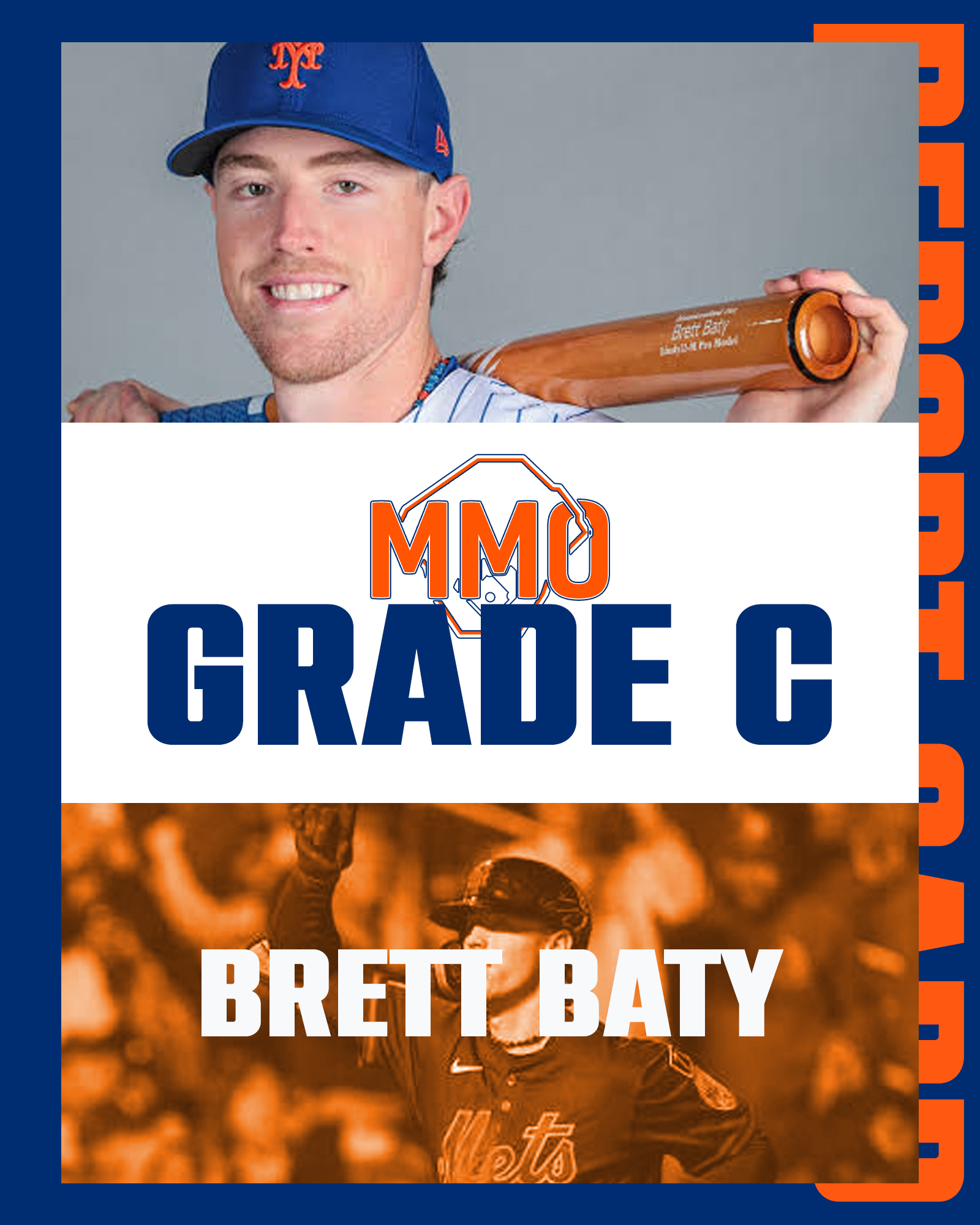
Grade: C
2026 Review
Each of the last few seasons, it seems that Brett Baty shows up to camp trying to hit for contact instead of power, struggles for a few weeks to a few months, and then trades contact for power and has a great second half. However, if the Mets tender Baty a contract for 2027, and all signs as of now point to that being the case, he must stay deep in the box, look to drive the ball and swing hard, which brought him the most success in 2026.
Through the end of June (82 games), Baty slashed .210/.294/.294/.589, which was good for a 69 wRC+. However, in May, he posted a 116 wRC+, hitting .265/.365/.386. From the start of July through the end of the season, Baty slashed .273/.332/.483/.814, with a 124 wRC+.
Looking deeper month by month, clear trends point to why Baty struggled.
In those first three months, Baty looked completely different than he did from July onward. From March through June, he put up:
- Bat Speed: 72.1 miles per hour
- 90% EV: 105.4 miles per hour
- Max EV: 111.4 miles per hour
- Hard-Hit rate: 37.9%
- Zone-Contact: 81.6%
- Pull Fly Ball Rate: 10.3%
From July onwards:
- Bat Speed: 73.9 miles per hour
- 90% EV: 107.7 miles per hour
- Max EV: 114 miles per hour
- Hard-Hit rate: 47.6%
- Zone-Contact: 79.6%
- Pull Fly Ball Rate: 18.3%
Now, compare that to May 2025 through the end of the season when Baty slashed .263/.324/.448/.772:
- Bat Speed: 74.8 miles per hour
- 90% EV: 106.8 miles per hour
- Max EV: 115.6 miles per hour
- Hard-Hit rate: 47.2%
- Zone-Contact: 80.5%
- Pull Fly Ball Rate: 11.8%
When Baty prioritizes power and driving the ball over contact, he is at his best. Baty can hit the ball very hard. His hardest hit ball this year was roughly the same as Pete Alonso’s. He has better bat speed than Alonso, pulls the ball more, and their 90% EV are within 1% of each other. So why isn’t Baty hitting 30-40 home runs?
Baty’s issue is his pitch recognition. He takes almost one-third of hittable pitches. His selectivity and SEAGER both rate as below average. While he puts up plus damage rates overall, his ability to spot which pitches he can do damage on by every metric is poor. That makes it even more imperative that he prioritizes driving the ball when he does make contact. This was not something he did early in the season, and his success came when he made that switch, similar to when he made the same switch in 2025.
Defensively, he looked good across the infield and outfield. He spent most of his time at second base and first base, but saw time at third base and the outfield occasionally, even spending time at shortstop for a game. While he’s not a plus-plus defender, Baty posted a +1 OAA in 2026.
2027 Outlook
The Mets should not construct their roster in any way that revolves around Baty as an everyday player in 2027. Injuries and his performance could help him force his way into that role.
However, the best use for him would be as a bench utility player. He should have the opportunity to come to camp and compete to be a bridge to the young guys at second base, but even there the Mets should bring some non-roster invitees to compete alongside him to take that role from Marcus Semien.
Across the last two seasons, Baty has a .245/.311/.402/.713 slash line, which is good for an exactly league-average 100 wRC+. He has 29 HRs in 273 games (17/162 pace) and put up 3.3 WAR (2 WAR/162). If he can average that in 2027, he’s a useful player off the bench (until he can prove himself otherwise). If he struggles again to start the season and the Mets are competitive, he also has an option. The Twins optioned Matt Wallner this year, who had far more tenure, so there is precedent.
In terms of depth, looking at some of the playoff contenders for 2026, the Dodgers dedicated 1,194 PA to players with a sub-100 wRC+, the Phillies gave 3,865 PA, the Brewers 1,968 PA, the Yankees 3,462 PA, etc. Even contending teams typically utilize 20-25 or more position players across a major league season. If Brett Baty is able to give 300-450 PA of roughly league-average offense, with the ability to move around the diamond and be optioned if he struggles, there is a lot of value. Another team may even view him as an everyday player and look to trade for him this offseason.