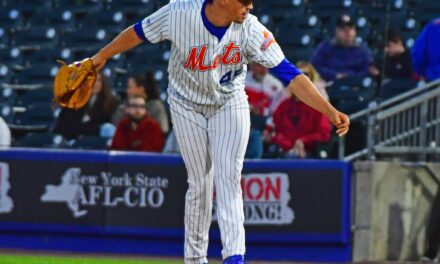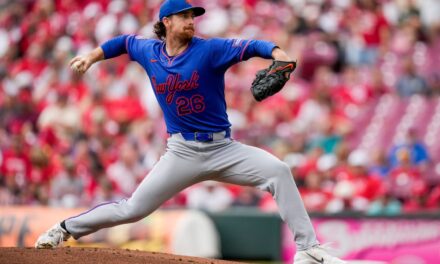

The Mets welcome change. Especially to hitting mechanics.
The evidence is scattered throughout their farm system.
Across the organization, swing tweaks pop up seemingly weekly, tinkering is encouraged, and bat path adjustments are as common as a Jefry Yan strikeout celly.
It’s all part of the process to develop the Mets’ next crop of young offensive stars, one of whom is already starring in the Majors thanks to a swing change of his own.
Carson Benge struggled to find his swing out of the gate, posting just a .525 OPS in April, but after making intentional swing changes, he has emerged as a legitimate Rookie of the Year candidate.
Throughout the season, Benge made several mechanical adjustments that have borne fruit.
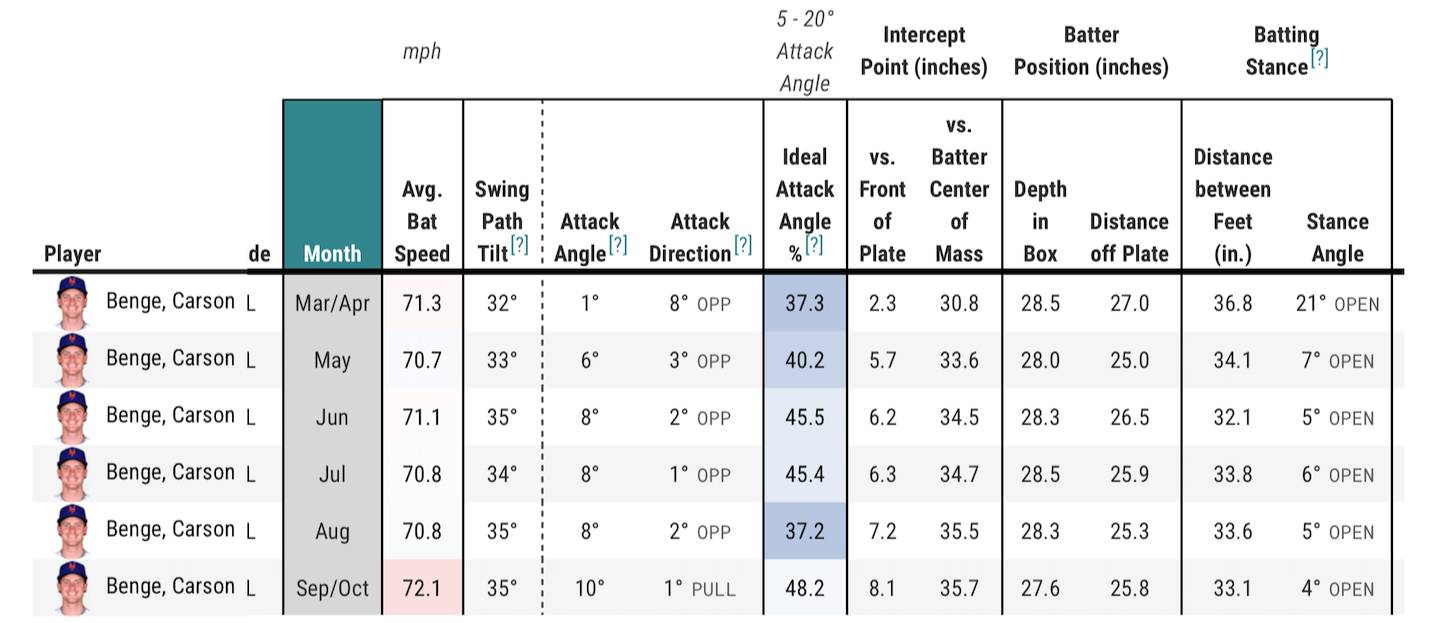
His intercept point, compared to his center of mass, has crept from 30 inches at the beginning of the year to a maximum of 35 inches. This change paid dividends to his pop; Mike Pietrello of MLB.com found that home runs originate from swings with an intercept point in the mid-30s.
Along with making contact further out in front, Benge steepened and sped up his swing, shifted his attack angle, and closed his stance by 17˚. These drastic changes have led to a .284/.346/.443 triple-slash since June 1.
Just remember: the rookie is not a “Psychopath” for making all these changes in such a short amount of time. He’s rightly earned that moniker for other reasons.
Their 2024 first-rounder is just the tip of the iceberg.
To develop their hitting equivalent of Generation K (Generation HR, anyone?), the club guides players to visit their state-of-the-art hitting lab.
There, unfinished hitting prospects are molded into major-league weapons.
At the lab, small nodes are placed on various body parts for dual purposes: tracking a swing’s efficiency and locating misdirected force. When leaks are identified, swings are refined through a variety of drills. It’s all part of the club’s goal to produce more impactful batted balls.
When the lab was unveiled, Will Sammon of The Athletic spoke to the club’s former’s co-coach of hitting, Jeremy Barnes, who touted the lab’s benefits for younger players:
You can identify areas of change quicker and start to get on it,” Barnes said. “Maybe we could have addressed something with (Brett) Baty a year or two earlier. Maybe we could have figured something out with (Mark) Vientos or (Ronny) Mauricio a year or two earlier. It’s those little things. Speeding up the development process is what we’re going for.”
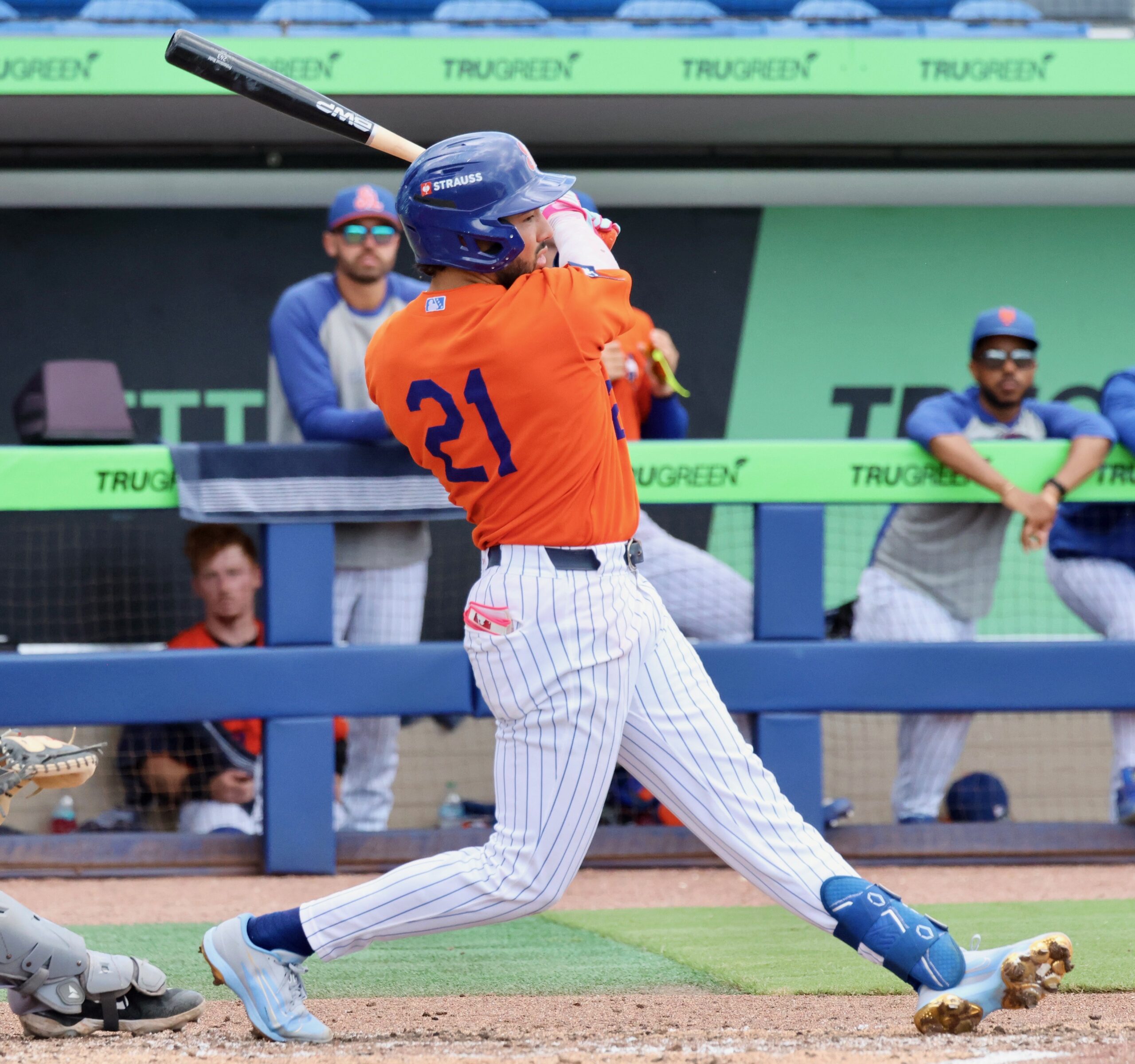
Antonio Jimenez by Ed Delany / MMO
Mets’ 2025 second-rounder Antonio Jimenez exemplifies one of the younger players Barnes indirectly referenced. During visits at the lab, Jimenez completely revamped his swing.
Oh, my goodness. I love the Mets’ hitting facility. They have a lab [in Port St.Lucie], and I remember we got marked up [with nodes that track biomechanics], and it just changed my whole perspective on how my body actually moves. They helped me understand where my bat is starting in the zone.
Someone call The Monkees—Jimenez is a believer.
After a trying start to 2026 with the Brooklyn Cyclones, Jimenez revamped his swing to chase more power. Previously, work at the lab resulted in simplified lower-half mechanics. As a result, Jimenez posted an OPS 300 points higher in his second go-around with Brooklyn.
It’s not just the Mets’ draftees making swing adjustments. The newest Mets have recently made swing changes, or are undergoing swing adjustments under the Mets’ tutelage.
At points last season with the Rays, Aidan Smith‘s production propelled conversation that he may belong within the top 100 prospects in the minor leagues. And then, well, his swing unraveled, and his performance waned.
Now, the Mets think they have him on the right track.
From Brooklyn Cyclones’ hitting coach Devin DeYoung:
“He’s trying to get back to his old bat path. It aligns with some of our philosophies”
With the Cyclones, different mechanisms of Smith’s swing have changed. While bat-tracking data is not publicly disclosed, to the naked eye, his bat path now looks flatter, not like the grooved jab Smith used during his time with the Rays.
While the jury is still out on the long-term impact, the short-term looks promising. With the Mets, Smith’s OPS sits 360 points higher.
Smith is far from the only Mets farmhand making adjustments at the dish.
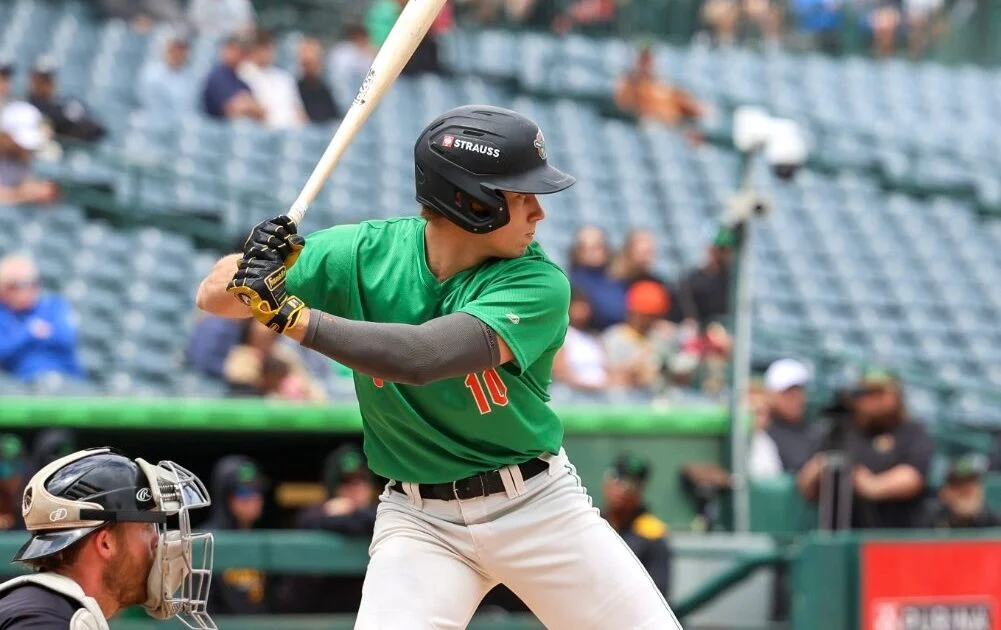
Sammy Stafura. Photo by Greensboro Grasshoppers
At the deadline, New York landed Sammy Stafura, fresh off a heater of 14 home runs in 18 games, in exchange for Luke Weaver. You may have heard: Stafura’s a Mets fan.
Now, while it’s foolhardy to expect that level of offense to be sustained over a full season, a recent swing adjustment unlocked additional exit velocity and increased bat speed. His change didn’t sneak past the opportunistic Mets.
“We’ve seen some bat speed upticks. We’ve seen some exit velocity upticks…. This is a player who has real power” – David Stearns
Even several of the farm’s less heralded minor leaguers have gotten into the swing change mania. Jorge Eckhardt, a contributor to MMO, recently for Rockwave profiled Cyclones’ backstop Davierson Gutierrez, who fiddled around with his swing throughout the 2026 campaign.
At the outset of the season, during his set-up at the dish, Gutierrez placed his legs parallel, as if tied down to the same railroad tie.
After the first two months produced a .500 OPS, Gutierrez thrust his lead left leg back, as if to push back the bad karma that had defined his 2026 campaign up to that point. Since the change, Guittierez posted an OPS 200 points higher.
Benge, Smith, Stafura, and Corey Collins are among the legion of young Mets with recent swing tweaks.
It’s all part of the new technical paradigm in the minors.
The Mets didn’t select Mitch Voit in the first round of their 2025 draft on the back of his Big 10 production. His force plate data during the MLB Draft Combine was simply too good to pass up. While no concrete data has emerged, it would be no surprise to learn Voit no longer swings the lumber the same.
Force plates, hitting labs, and bat sensors. They’re all remnants of the pro-technology faction swallowing hitting development systems across professional baseball.
The game is changing, and the Mets’ swings are changing along with it.