
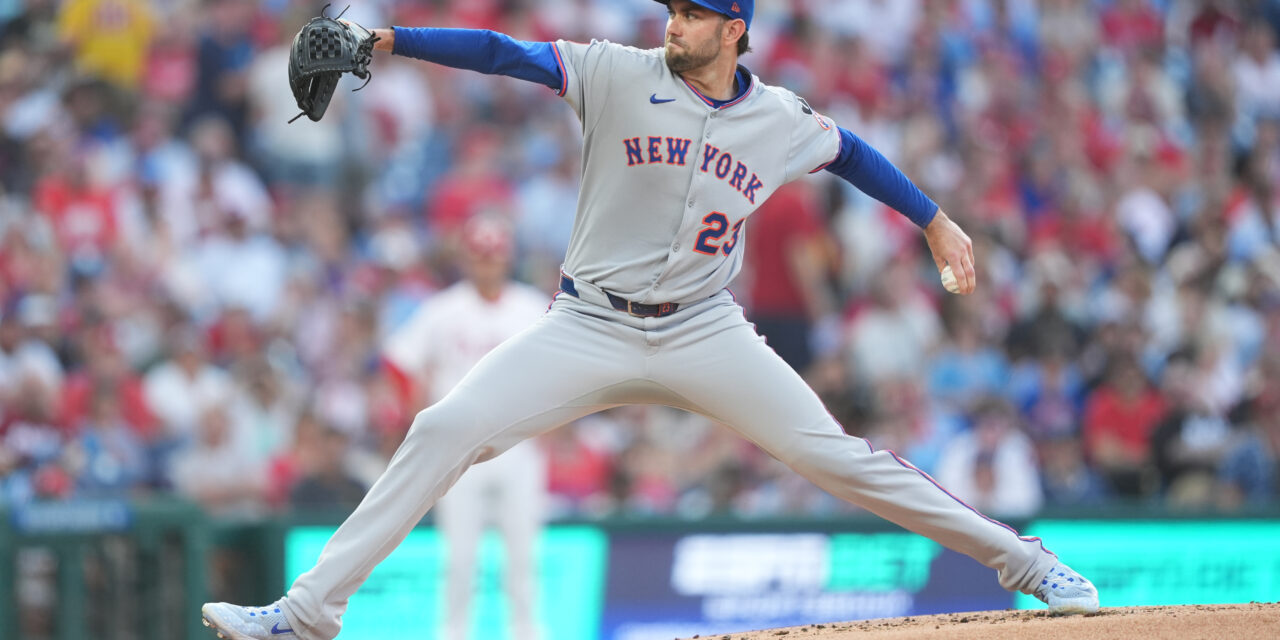
With all the ruckus surrounding the Mets lately — the injuries, the regression, the numerous transactions — a soothing constant, until recently, had been left-handed starter David Peterson.
But recently, in abrupt and seemingly unprecedented fashion, even Peterson has become less reliable.
Before this week, Peterson had allowed three earned runs or fewer in 15 consecutive starts, dating back to last year. It had been a remarkable run of consistency for the former first-round pick, who’d really found his form after waves of success and failure. Now, in each of his last two starts, he’s surrendered five earned runs. He failed to make it through five complete innings in either outing.
“It’s one of those stretches where, back-to-back outings — we’ve gotta go back and watch films and make some adjustments,” Mets manager Carlos Mendoza told reporters after Friday’s 9-1 loss.

David Peterson (23) Credit: Kyle Ross-Imagn Images
The latest outing came against a lowly Pirates team, one that owns the worst OPS in the National League. Four of the five runs scored in the second inning, but Peterson still labored through his outing and was pulled with one out in the fifth, having thrown 91 pitches (56 strikes).
In that fateful second inning, Peterson allowed four hits in a row and five in a six-batter span. One could point to Juan Soto‘s misplay on Alexander Canario‘s double in Peterson’s defense, but the ball was still scorched at 107.9 mph. In fact, all four of the consecutive hits were 103.5 mph off the bat or higher. All five hits in the inning were 101.7 mph or higher.
Even in a successful season, Peterson has only been in the 28th percentile for average exit velocity (90.3 mph). In Friday’s outing, the average exit velocity against him was a blistering 98.2 mph. Naturally, his whiff rate was also lower than his average, and the amount of contact on pitches both in and out of the zone was higher.
He didn’t have any significant changes in his pitch mix — he was just getting hit harder and more often.
“The fastball, he’s having a hard time locating it glove-side. There’s a lot of arm-side misses,” Mendoza said. “The changeup is kind of just floating in the strike zone. He’s having a hard time seeing that fade. And then same thing with the slider — the sharpness, getting backdoor to the right-handed hitters.”
Mendoza emphasized that Peterson is perfectly healthy; it’s his mechanics that need tweaking.
His command, in general, wasn’t in sync on Friday. Despite mostly settling down after the four-second, he still had to navigate a pair of walks in the fourth inning. Peterson told reporters after the game that it was actually the walks—three in total—that bothered him more than the hard-hit balls. In both cases, though, it stemmed from Peterson not locating his pitches the way he wanted to, whether it was missing for a ball or up in the zone.
“It needs to get better,” Peterson said.
Before these two starts, Peterson had been performing like one of the best pitchers in baseball over a stretch of 30-plus starts. In that context, a stretch like this can seem a bit head-scratching. It’s worth pointing out that he ended last season with a somewhat similar stretch; he allowed five runs (four earned) two times in a three-start span to end the year. He still posted a 2.90 ERA in 21 starts overall.
Peterson’s 2025 ERA sits at a very good 3.30. He’s finally hit a bit of a slump, but it’s only emphasized just how good he’d been before that. The question now is if he can find his location again and settle back into the reliable southpaw he’d become, or if the Mets will have yet another question mark on their hands going forward.