
Troy Taormina-Imagn Images
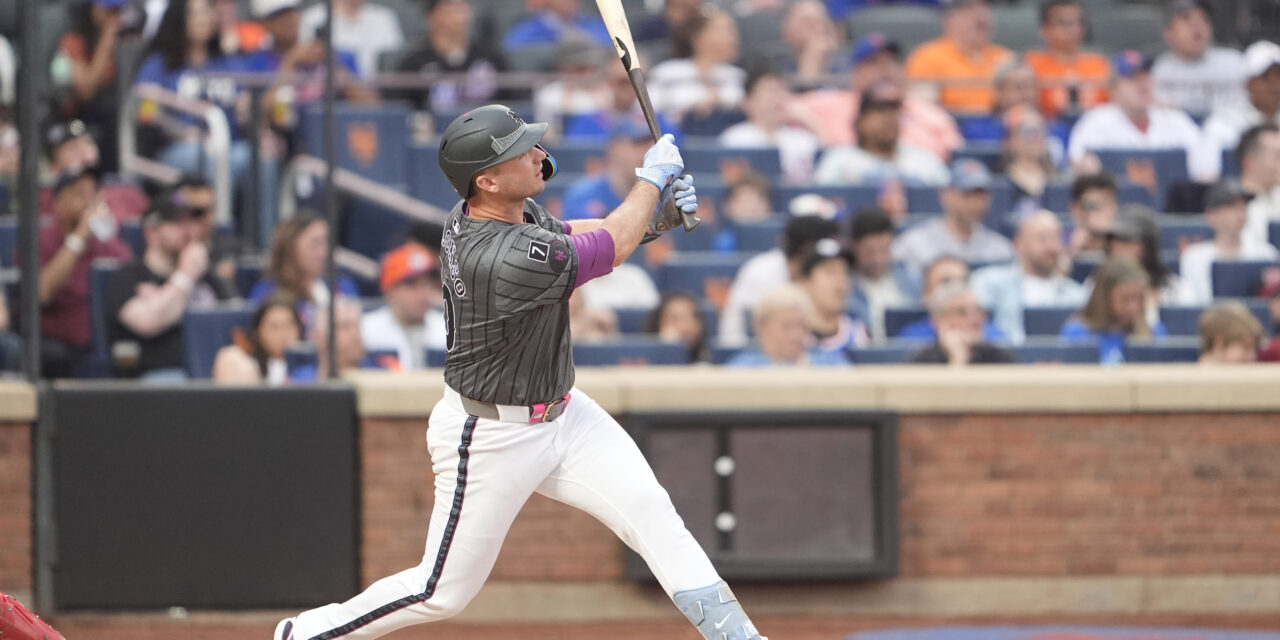
Pete Alonso is slugging his way to a lucrative new contract.
His furious start has him primed as a contender for the franchise’s first MVP award. On the heels of a disappointing 2024 campaign, where the first baseman hit for a paltry. 343 wOBA and career-low .219 ISO, Alonso’s since posted a .310/.419/.589 clip in 2025, equivalent to a full-season total of 36 home runs.
His 2025 success can be attributed to batting stance adjustments that hitting coach Eric Chavez hinted at during a recent radio interview with Mets’ broadcaster Pat McCarthy. Chavez said:
“[Alonso’s] totally revamped his swing…. He’s able to hold his positions a lot longer, stay behind the baseball and rotate behind the baseball.”
Baseball Savant’s new tooling visualizes how Alonso’s career year is a byproduct of his upgraded mechanics.
Savant’s litany of tools has defined baseball’s last half-decade. Their most notable disclosures revolved around the art of pitching, leading to terms like spin rate, seam orientation, and spin axis entering the public vernacular. Last season, it released arm angle data, its first such disclosure of pitching biomechanics.
Recently-released bat tracking and batting stance tools push the onus onto the fan to understand hitting biomechanics – similar to the explosion that has culminated in a pitching revolution.
Using Savant as a lens to delve into the art of hitting, we’re able to quantify Alonso’s adjustments that have led to his outstanding campaign.
In 2025, Pete Alonso’s average bat speed crept up to 76.3 mph. When he’s hitting hard-hit balls (as defined by Savant), his bat speed is nearly two miles an hour harder, compared to 2024. While this bat speed delta doesn’t sound like a lot off the bat (pun intended), batters, on average in 2025, have posted 50 points higher of wOBA on swings in the 77 mph bucket, compared to the 76 mph bucket. 
His fast-swing rate (percentage of swings >75 mph) increased by 12%, compared to 2024. And when he’s swinging hard, the results follow, as evident by his career-best bat speed on hard-hit balls.
While bat speed is certainly a useful tool, it doesn’t tell the entire story – merely a single chapter. Bat speed isn’t a proxy for in-game hitting performance. It’s as if a pitcher added a change-up to his repertoire? Could it help? Absolutely. Is it a given? Not at all. Some of the best hitters in the league (Luis Arraez, Steven Kwan, etc) bring up off the bottom of the bat speed leaderboard.
Alonso’s power surge has been complemented by a drastic change in his batting stance at the plate. Thanks to Savant’s nifty features, we’re able to track player movement and biomechanics in and around the batter’s box.

His stance has closed off by seven degrees since Opening Day 2024; he’s standing shallower in the box, and he’s shortened his stance by half a foot. His intercept point (the x,y coordinates where his bat makes contact with the ball) shows that Alonso makes contact four inches in front of the plate, compared to the average Major League hitter.
While public bat tracking data is not available prior to the 2023 season, we can assume that these are the swing changes Chavez hinted at.
This isn’t your usual hot-start typically followed by a mid-season swoon; Alonso’s expected statistics support this level of production. While his BABIP is higher than career norms, his expected wOBA, average exit velocity, and hard-hit percentage all sit in the 98th percentile or higher. Brian Murphy of MLB.com recently investigated Alonso’s resurgence, noting that his plate discipline and two-strike approach have turned a corner, in addition to his swing alterations.
Overall, this new frontier of public hitting data is certain to produce additional insights. Major League Baseball – and quite a few of its fans – have pivoted to following the game through a data-driven approach. With additional data releases scheduled for later this year, it’s a wonderful time to be a baseball fan.