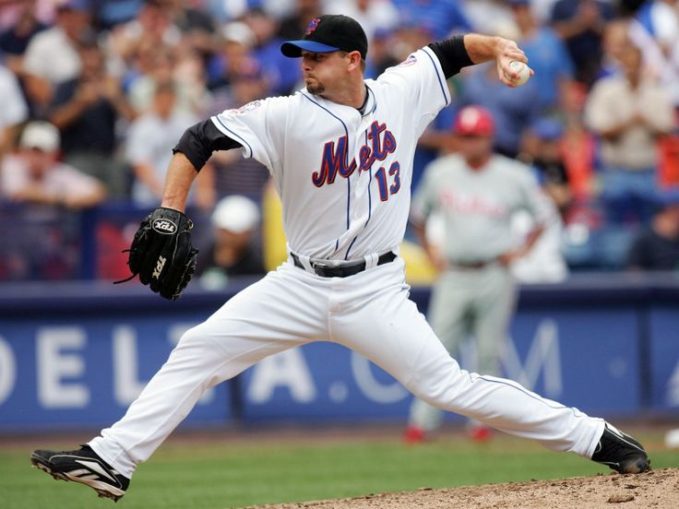
Another member of the 2006 New York Mets has earned a place in Cooperstown, fittingly closing his Hall of Fame journey much like he closed games for multiple teams during his storied career.
On Tuesday, it was announced that Billy Wagner will join Ichiro Suzuki, Dave Parker, Dick Allen, and C.C. Sabathia as part of the Baseball Hall of Fame Class of 2025. Wagner was elected in his 10th and final year of eligibility, earning 82.5% of the vote. He becomes the third member of the 2006 Mets to reach the Hall, alongside Pedro Martinez and Tom Glavine.
Wagner’s Hall of Fame candidacy steadily gained momentum since his debut on the ballot in 2016, when he garnered 10.5% of the vote. Though he experienced a slight dip in support the following year, his numbers consistently climbed in the years that followed. By 2022, Wagner had reached 31.7% and surpassed the halfway mark with 51% that same year. In 2023, he fell just five votes shy of induction, receiving 284 of the 289 needed for enshrinement.
That moment Billy found out he was going to the Hall 🥹 pic.twitter.com/7kuoYjdH0t
— New York Mets (@Mets) January 21, 2025
Wagner holds several records among pitchers with at least 900 innings pitched, leading in opponents’ batting average (.187), strikeouts per nine innings (11.92), and hits allowed per nine innings (5.99). He also ranks second in WHIP (0.997) and opponents’ OPS (.558). Wagner becomes just the ninth reliever inducted into the Hall of Fame, joining legends like Mariano Rivera, Dennis Eckersley, Hoyt Wilhelm, Goose Gossage, Trevor Hoffman, Lee Smith, Rollie Fingers, and Bruce Sutter.
“Everything I do has been a blessing,” Wagner said. “To look back and see that I’m the first left-handed reliever, the first Division III [college player], the first guy from the state of Virginia in the Hall of Fame as a baseball player, those things that are meaningful.”
Known for his blazing 100-mph fastball, Wagner defied expectations with his small frame, becoming one of baseball’s most dominant closers. Remarkably, his path to becoming a hard-throwing left-hander began after adversity. Naturally right-handed, Wagner broke his right arm twice at the age of seven and taught himself to throw left-handed by hurling a ball against a barn in rural Virginia.
Wagner’s talent blossomed at Ferrum College, where he set NCAA Division III single-season records in 1992 for strikeouts per nine innings (19.3) and fewest hits allowed per nine innings (1.88). That summer, he played in the Cape Cod Baseball League, earning recognition as its outstanding pro prospect. Selected in the first round of the 1993 MLB Draft by the Houston Astros, Wagner initially worked as a starter in the minors before transitioning to a relief role after being called up in 1995. He made his MLB debut on September 12, pitching just once that season.
In 1996, Wagner permanently shifted to the bullpen, making an immediate impact. He posted a 3.28 ERA with nine saves and struck out 11.7 batters per nine innings. By 1997, Wagner had emerged as one of the league’s premier closers, setting a then-record 14.4 strikeouts per nine innings while earning 23 saves. His 106 strikeouts in relief that season set a franchise record for the Astros.
The following years solidified Wagner’s dominance. In 1998, despite missing time after a line drive struck him in the head, he recorded 30 saves and helped the Astros win the NL Central. In 1999, he earned the NL Relief Man of the Year Award, posting 39 saves, a 1.57 ERA, and 124 strikeouts in 74 innings, holding opponents to a .135 batting average.
Wagner’s 2000 season was cut short by a torn flexor tendon, but he rebounded in 2001 with 39 saves and a 2.73 ERA. He continued his dominance over the next two seasons, recording a career-high 44 saves in 2003 and leading the league in 100-mph pitches, throwing an astounding 159. That year, he also closed out a historic six-pitcher no-hitter against the Yankees. After criticizing Astros management for not assembling a playoff-caliber roster, Wagner was traded to the Phillies in November 2003.
During his time with Philadelphia, Wagner saved 59 games over two seasons, including an All-Star campaign in 2005. He then signed a four-year, $43 million deal with the New York Mets, where he recorded 101 saves over three seasons, including a milestone 300th save in 2006. His stellar performance helped the Mets win the NL East for the first time in 18 years.
“I joined the Mets because going to New York would be one way to try to get to the Hall of Fame, and it wasn’t going to be easy when you have the greatest closer across town [Rivera],” Wagner said. “I also knew coming from a small town, the environment was going to be difficult.”
Wagner’s performance declined in the second half of 2007, converting just 13 of 17 save opportunities with a 3.90 ERA. August was particularly rough, with a 6.23 ERA and back spasms in September further impacted his effectiveness during the Mets’ infamous late-season collapse.
In 2008, Wagner logged 27 saves in 34 games before tearing his ulnar collateral ligament and flexor pronator tendon, requiring Tommy John surgery and sidelining him for a year. He returned briefly in 2009, pitching a scoreless inning with two strikeouts on August 20 before being claimed off waivers by the Red Sox.
In 2010, Wagner signed with the Atlanta Braves and delivered a remarkable final season. He recorded 37 saves, posted a 1.43 ERA, and struck out 104 batters over 69 1/3 innings. His efforts earned him his final All-Star selection and saw him surpass the 400-save milestone. Wagner retired at the end of the 2010 season to focus on spending more time with his family.
Over his 16-year career, Wagner earned seven All-Star nods and accumulated 422 saves, the eighth-most in MLB history and the second-most by a left-hander, trailing only another Met, John Franco. Wagner’s dominance in the game as a closer has firmly secured his place among baseball’s all-time greats.
“Congratulations to Billy Wagner on baseball’s highest honor,” Mets owners Steve and Alex Cohen said in a statement. “He was a two-time All-Star during his four seasons in Queens and earned his 300th career save in a Mets uniform. Billy was one of the game’s [most dominant] closers and will now be forever enshrined in the Hall of Fame.”