Andy Marlin-USA TODAY Sports
MLB’s lockout of the players is ruining a bunch of things. Not only has this winter been incredibly boring and long, but it could also get more boring and longer because spring training might be delayed, regardless of what Rob Manfred said on Thursday.
This should be a time when we’re all excited about the year ahead as pitchers and catchers prepare to report to Port St. Lucie. Obviously, that’s not happening right now, and we’re left grasping for straws on what to even talk about for the upcoming season. And that’s mostly because we have no idea when it’s going to start and how close to a “normal” schedule we’ll watch the New York Mets and the rest of the league eventually complete.
While there are still many free agents who need a new home once the lockout ends, the only kind of offseason normalcy we’ve experienced since the start of December has been the release of season-long projections for teams and players. Last week was wonderful because the ZiPS standings projections were released, allowing us to just think about baseball instead of the CBA “negotiations” for a minute.
But when diving back into the individual projections for the Mets, I noticed something on the position-player portion of the roster that I had to learn more about.
Lots of Production From Lots of Dudes
As I sat there, staring at these projections and hoping for something to jump out at me, it actually happened. From top-to-bottom, here are the seven players with the highest projected fWAR:
- Francisco Lindor: 4.7 fWAR
- Pete Alonso: 4.0
- Eduardo Escobar: 2.9
- Brandon Nimmo: 2.8
- Jeff McNeil: 2.8
- Starling Marte: 2.8
- Mark Canha: 2.0
Obviously, all these projections could eventually mean nothing if the lockout impacts the 162-game regular-season schedule. But for the time being, there’s a “normal” season of baseball on tap, so we’ll just go with it. With that in mind, my first thought was, “Jeez, that seems like a lot of guys with at least 2.0 fWAR for the season.”
Pairing this observation with ZiPS’ record projection of 88-74 for the Mets, I began wondering how many position players posted at least 2.0 fWAR in a season when New York had a winning record.
Every playoff-caliber team has one or two standout performers that seem to shoulder a majority of the production, but they can’t do it on their own. Just ask Mike Trout — if there’s anyone good enough to get their team to October all by himself, it’d be him, and he hasn’t come close. So, a team with postseason aspirations will need a couple of standout performances, but they’ll also need contributions from many other areas.
However, I was skeptical as to how often the Mets had *seven* different players register 2.0 fWAR in a season. It turns out that this occurrence barely happened at all over the past 25 years.
Comparing This to Past Winning Seasons
Since 1997, the Mets have produced 12 different winning seasons. While it hasn’t happened all that often, they’ve at least made it count when it does. Outside of 2001 (82-80) and 2005 (83-79), the Mets have registered at least 86 wins the other 10 times, which includes eight seasons of 88-plus victories.
Going back through the individual position-player production for each of these squads, I tallied up the number of players with 300-plus plate appearances who accumulated at least 2.0 fWAR that year. I then took it a step further to see how many of those performances resulted in at least 3.0 fWAR. Here are the results.
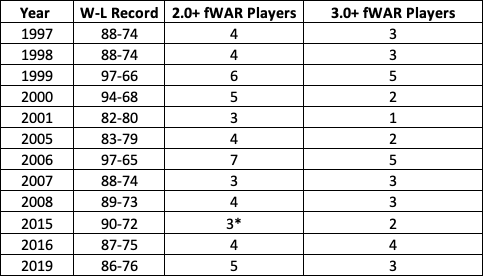
As you can see, 2015 gets an asterisk. Although he only stepped to the plate 249 times with the Mets, Yoenis Céspedes still produced 2.6 fWAR and he was obviously an integral part of that club reaching the heights it did.
A couple more notes before we move on: 1999, 2007, and 2008 each had three players with at least 5.0 fWAR. John Olerud, Robin Ventura, and Edgardo Alfonzo did it in ’99, while Carlos Beltrán, David Wright, and Jose Reyes did it in both ’07 and ’08.
The Mets have watched some impressive individual performances propel them to winning campaigns. However, only the 2006 club reached that magical number of seven 2.0-plus fWAR seasons, with 1999 coming in a close second. Using win-loss record as the benchmark, those two clubs were the most successful in the regular season, and they both share a similarity in that the majority of those 2.0-plus fWAR seasons were much higher than that.
Looking Ahead to 2022
Are the Mets a 97-win ballclub right now? I suppose anything can happen, but it certainly doesn’t seem that way. Their current projection of 88 wins feels about right if things go their way, which we know is a big if because #Mets.
Those individual ZiPS projections are based on most players staying reasonably healthy. Out of this group, only Nimmo (413 plate appearances) is projected to accrue fewer than 500 plate appearances. And, this should go without saying, but a team’s ultimate success or failure doesn’t depend solely on how the position players perform. There also needs to be a hearty amount of production from the starting rotation and bullpen, which we’ll investigate in more detail another day.
It wouldn’t be a good idea to expect seven different Mets position players to post at least 2.0 fWAR, especially if they end up in the neighborhood of 88-90 victories. At least from what we can see from past years where New York has won a similar number of games, that doesn’t necessarily have to happen. They may only need about half of them to. But if that’s the case, the ones that do get over this arbitrary benchmark will probably have to keep going beyond 3.0 fWAR.
What I’m trying to say here is baseball needs to come back pronto because I’d love to actually find out if the Mets can do this or not in real life. I’m tired of just imagining it, just like everyone else is. Let’s hope we can manifest a mostly normal season sooner rather than later.