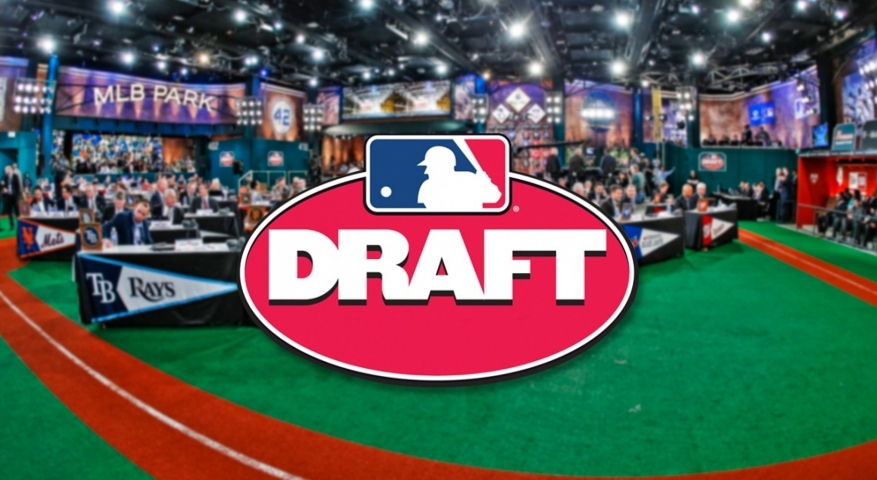
In part four of our series on the negotiations toward a new current Collective Bargaining Agreement (CBA) between MLB and the MLBPA, we’ll take a look at the draft. How the draft works is currently a topic of discussion between the owners and the players.
The First-Year Player Draft, also known as the Rule Four Draft, is Major League Baseball’s primary method for assigning amateur baseball players (typically from high schools and colleges) to teams. The draft order is determined based on the records of teams in the previous season, without regard to league, with the team having the worst record receiving the first pick in the draft order. In addition, teams that lost free agents in the previous off-season may be awarded “compensatory” picks.
The reverse-order of the draft is the primary point of debate. The MLBPA views this structure as encouraging “tanking”, teams not attempting to compete to secure favorable positioning in the following season’s draft. Altering the way the draft works is one desire of the union to address the larger issue of league-wide competition. Another is how much teams spend on their major league payrolls, particularly those that receive money from revenue sharing. On the latter point, the MLBPA has a case. In 2021, the Pirates’ payroll was just over $35 million, and the Orioles’ spent about $46 million on payroll. For context, Mike Trout will make $37 million in 2022, and Francisco Lindor will earn $34 million next season.
The MLB Draft, using record order from worst-to-best, has a traditional format. The NFL uses the same format, though picks can be traded, so the team with the worst record does not always draft first.
In the NHL, the teams are seeded in the draft order based on their regular season point totals. The odds of winning the lottery are weighted on a descending scale that gives the greatest chance of winning to the team with the lowest point total (18.5%), and the worst chance to the team with the highest point total (1.0%).
The NBA uses a different methodology. A machine picks four balls at a time, and every possible combination of numbers is assigned to a team. Teams with worse records get more combinations of numbers, which means they have a better chance to win. The machine picks three teams, and these teams get the first three picks in the draft.
Clearly, the NHL and NBA have instituted systems to prevent that which the MLBPA is seeking to prevent, a “reward” to teams for having a bad record. If a team has made the decision to build through the draft (think about the Astros in the mid-2010s), it would be counter-intuitive for that team to acquire costly players to win more games and move down in the draft order, as doing so would be self-defeating in terms of its overall strategy.
What are some workable solutions to take away the tanking incentive, yet maintain a fair draft system? Throughout this series, we have referenced Ken Rosenthal’s perspective on each topic from his article in The Athletic. On the draft topic, Rosenthal suggests the following:
A formula based 60 percent on win-loss record from the prior season, and 40 percent on market size (the MLBA has proposed this). Teams that receive revenue sharing also would be incentivized with compensation picks if they finished above .500 or made the postseason, as well as a provision that would restrict any team from picking in the top five in consecutive years.
One agent suggests a draft order with even more extensive incentives: First 10 picks to the lowest-revenue clubs, with the first selection going to the team with the best record; next 10 selections to the postseason teams, including extra choices for low-revenue clubs that qualify; final 10 choices to the non-playoff, non-low revenue teams, again in descending order of records.
Opinion
Drafting in the reverse order of records in the previous season works in the NFL. However, it’s time for baseball to migrate away from that format and do something more aligned to the NHL and NBA. Tanking, to varying degrees, has become all-too-apparent in MLB. It’s at the point now where on Opening Day, it’s obvious that fewer than half the league’s teams have significantly invested in their on-field product. Whether this is for draft picks or other reasons (perhaps simply not wanting to spend), is a different matter, but competition needs to be addressed.
As I was preparing for this series, I had what I thought was an interesting and workable idea about the draft. Jayson Stark had the same idea and published it in The Athletic very recently. Essentially, take the teams that did not qualify for the playoffs, and assign the top draft picks based on their record, from best to worst. This way, teams have something to play for, even if they have no shot at a playoff spot. Teams may be inclined to hold onto players at the trade deadline (something Commissioner Manfred says is a problem for smaller-market teams), and fans who have tickets for games after Memorial Day may be able to see a team that is at least playing for something.
To put a slightly different spin on the idea, I further propose this. How about taking the the teams that do not qualify for the playoffs, and creating an odds-based lottery system to determine draft order? Yes, this is similar to the NHL’s system, with different odds. There are 20 teams that do not qualify for the postseason each year. How about giving the team with the best record among them twenty chances in a lottery system, and so on down to one chance in the system for the team with the worst record?
Here is another twist. On the night the season ends, do a show on MLB Network where some retired star players lead the selection of the draft order (it could be machine-based like the NBA’s system). This may not draw the same television audience as the NFL Draft programming, but it would be interesting for die-hard fans.
Competition needs to be addressed in baseball. The draft is one way to do so. We have touched on the Competitive Balance Tax, Arbitration, and Free Agency in the other articles in this series. All of these play a role in league-wide competition.
The teams that compete best qualify for the postseason, and the structure of the playoffs will be the topic of the next, and last, article in this series.