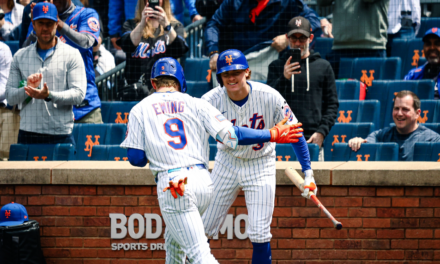
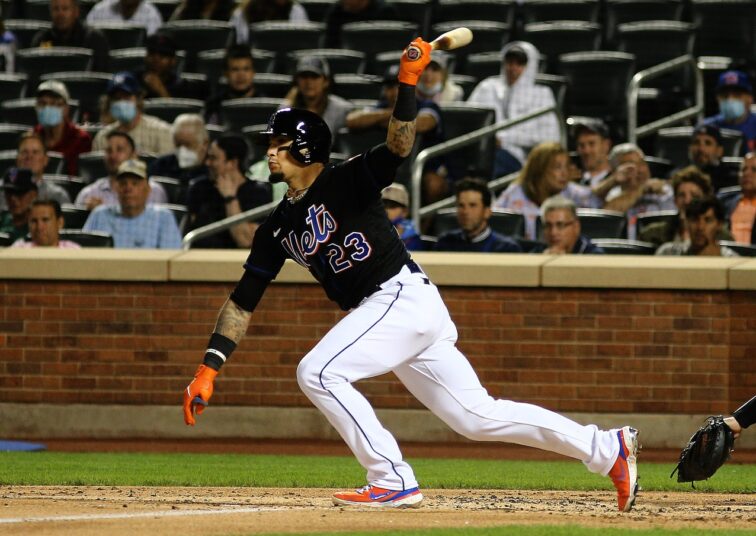
Mandatory Credit: Andy Marlin-USA TODAY Sports
With the Mets officially out of playoff contention, mental energies are shifting toward the offseason.
The Mets clearly have a litany of issues to work out once the season ends next weekend, from who is going to lead their baseball operations down to sorting out the minor-league development staff. Somewhere among all that will be addressing who will be playing for the 2022 iteration of the New York Mets.
Javier Báez, who the team acquired two months ago at the trade deadline from the Chicago Cubs, was brought in on an expiring contract to provide a jolt to a dragging offense for a couple months. He did his best, now slashing .309/.380/.544/.923 in 166 plate appearances to go along with an increased walk percentage (7.2 percent, which would be a career-high over a whole season) and decreased strikeout percentage (27.7 percent, two points below his career average).
Now the main question becomes: is the Mets version of Javier Báez worth offering a long-term deal? MMO’s Drew Rosen posed this question last week, and answering that question will be one of the top priorities for the incoming front office.
“I feel like I kind of needed this,” a trade to the Mets, “to know a little bit more of myself and work a little bit harder,” Báez told NBC Chicago‘s Gordon Wittenmyer this past weekend. That work has shown through his production since coming off the injured list in late-August between showing more patience at the plate and his power. (Báez is tied for the team lead in home runs with Pete Alonso since August 22.) He’s reached base safely in 19 straight games — a career high — with a more careful eye.
Báez also brought his same-old base-running tricks from Chicago, routinely avoiding tags with shifty hands, and his defense alongside good friend Francisco Lindor, who apparently has owner Steve Cohen’s ear, has been top-notch even as he moved to second base. Báez, who said he’d only move to second base for Lindor when he first came to the team, says the pair can be even better as a middle-infield pairing, telling Whittenmyer, “if it’s going to be a whole year, or 10 years” together, “we obviously are going to get those adjustments to click and be [in sync].”
“I think me and Lindor are closer than KB and Rizzo,” Báez said in the same article, referring to his former best-friend teammates Kris Bryant and Anthony Rizzo. “It’s a really special thing here. … I would love to stay here and play with him.”
That’s encouraging.
Because the team acquired him in the middle of the season, the Mets don’t have the ability to extend a qualifying offer to the infielder. So, they could lose him for nothing, having given up Pete Crow-Armstrong, one of their top prospects at the time, to get him and Trevor Williams.
So the question then becomes, if you think the changes Báez made at the plate once arriving to the Mets are real (Hugh Quattlebaum’s hitting philosophy presumably gets some credit here): how long are the Mets willing to sign Báez for and for how much? And will he give the Mets a break or two if it means securing playing with one of his best friends for the next half-decade?
If the offer is right, “and they make it happen,” Báez said, “I would love to stay in New York.”