With the second half of the 2021 campaign underway, the New York Mets find themselves at the top of the National League East Division and are attempting to capture their division title since 2015, but in order to accomplish that feat, they’ll need their offense to produce much more consistently.
It’s no secret the front office will be searching for an impact bat at this year’s trade deadline, although this team also needs to receive improved performances from its current group of hitters over these next couple of months. Most of the attention will likely be on shortstop Francisco Lindor, who struggled mightily at times in the first half, but he wasn’t the only inconsistent batter on the roster as Dominic Smith is still looking to turn his season around.
Following a breakout performance in 2020, where he produced career highs in extra-base hits (32), RBIs (42), SLG (.616), ISO (.299), BABIP (.368), wRC+ (164) and fWAR (1.8) through 50 games, Smith entered this season with extremely high expectations and hasn’t been able to match them just yet.
Sure, the 26-year-old kicked off the regular season on a high note by hitting two home runs and five RBIs over the first six games, but his lack of consistency is a major issue that remains unsolved. Unlike last season, the left-handed slugger hasn’t replicated his impressive power and contact metrics up to this point, causing him to serve as an average run producer throughout the first half of the schedule.
Looking like a completely different version of himself in 2021, Smith has earned 311 plate appearances through 84 games, producing just eleven doubles, nine home runs, 37 RBIs, a .137 ISO, a .308 BABIP, a 99 wRC+ score, a 0.4 fWAR rating and a measly slashing line of .252/.322/.388/.710.
What’s even more worrisome is that the versatile first baseman hasn’t been generating nearly as much hard contact as he was in 2020, where he created a career-high 46.7% hard-hit rate and a 13.3% barrel rate. Failing to apply that same success to this season, his hard-hit rate has dropped to 39.1% and his barrel rate has decreased to just 6.3%.

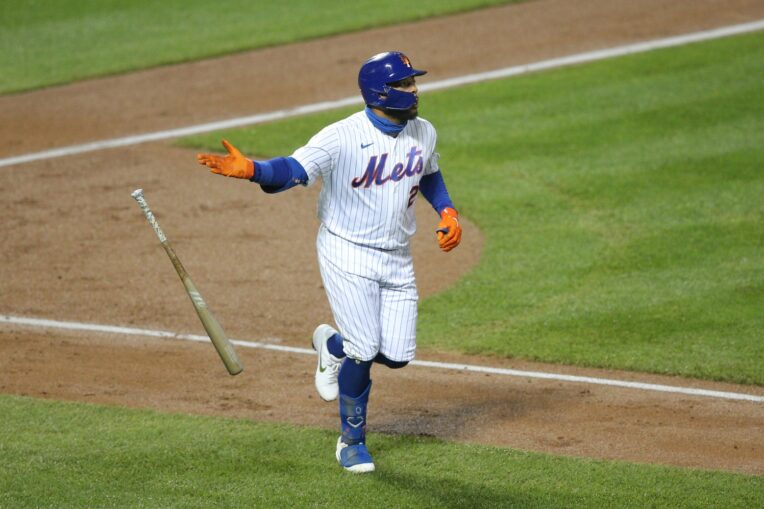
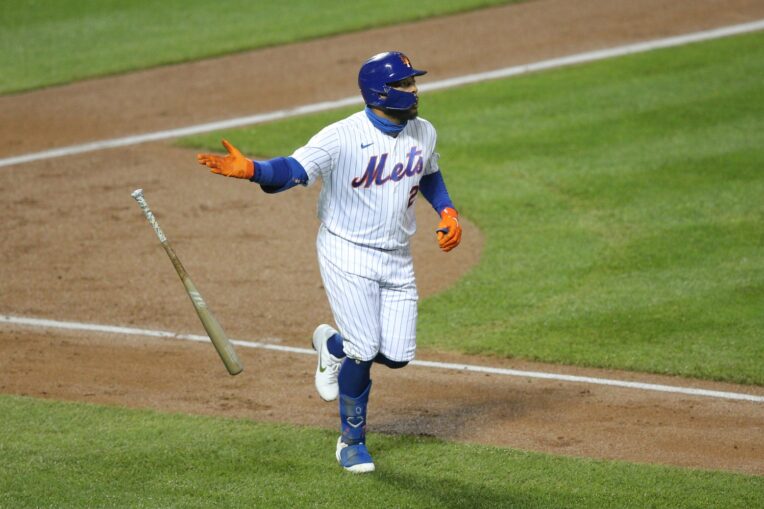
Credit: Brad Penner-USA TODAY Sports
There’s no question the first half didn’t go as planned, however, it’s certainly not too late for Smith to bounce back during the most crucial time of the schedule. Along with being handed a clean slate, the former first-round pick also entered the all-star break on a fairly encouraging hot streak, which began once the calendar turned to July.
Seemingly breaking out of his season-long slump, the California native caught fire against the Atlanta Braves on Jul. 1, where he went 2-for-4 with a pair of solo home runs, and built off that success over the next 10 games leading into the Midsummer Classic. Though his hot streak only spanned across an 11-game span, this small sample size shouldn’t be overlooked as it’s the best he’s performed at the plate since last season.
Making up for his previous hitting woes, Smith helped carry the Mets’ offense into the mid-season break, as he recorded two doubles, three home runs, eight RBIs, a .297 ISO, a .333 BABIP, a .398 wOBA, a 44.4% hard-hit rate, a 90.7 mph average exit velocity, a 156 wRC+ score and a slashing line of .297/.357/.595/.952 over his last 42 plate appearances.
Putting this recent success into perspective, the former top prospect created just nine doubles, six home runs, 29 RBIs, a .112 ISO, a .305 BABIP, a .296 wOBA, a 38.3% hard-hit rate, an 87.9 mph average exit velocity, a 90 wRC+ score and a mediocre slashing line of .245/.316/.357/.673 over 269 plate appearances from April to June.
So what’s sparked Smith’s resurgence at the dish? Well, his improved results against left-handed pitchers were a major factor in his offensive explosion before the break. While only 16 of those 42 plate appearances came against lefties, he made every single one count and created plenty of damage during those situations, which is something he couldn’t achieve earlier in the season.
Since the start of July, the Junipero Serra HS standout’s reverse splits have been spectacular, resulting in two doubles, one home run, four RBIs, a .333 ISO, a .500 BABIP, a .549 wOBA, a 46.2% hard-hit rate, a 255 wRC+ score and a slashing line of .467/.500/.800/1.300.
In comparison, the emerging star produced just two doubles, one home run, 11 RBIs, a .091 ISO, a .366 BABIP, a .320 wOBA, a 26.2% hard-hit rate, a 106 wRC+ score and a slashing line of .291/.349/.382/.731 over 63 plate appearances through the first three months of the season.
Given Smith’s small sample size in July, chances are his remarkable metrics against left-handers will somewhat regress in the second half. Having said that, he still might be able to perform effectively during those left-on-left situations through the remainder of the campaign, especially since he’s started to turn a corner against breaking balls.
Prior to this recent stretch, sliders and curveballs were two pitches the Mets’ left fielder struggled mightily against from April to June, and while righties have still been able to frustrate him with those offerings in July, lefties haven’t enjoyed that same level of success.
Here’s how Smith has performed by month against breaking balls from left-handers this season (months are positioned in ascending order from bottom-to-top):

Source: BaseballSavant.com
Again, Smith hasn’t compiled a large sample size against lefties in 2021, but there are some signs that could suggest his production might be sustainable, at least to a certain point. Starting with the type of contact he’s generated against breaking balls, his hard-hit rate has climbed to 40.0% and his LD rate has increased to a season-high 60.0% in July.
Adding to his case of creating more hard-contact and line drives, the lefty slugger also improved his plate discipline just before the all-star break, as his chase rate has dropped to a season-best 28.6% in July. Additionally, his whiff rate against sliders and curveballs has also gradually reduced as the season has progressed, improving to 18.2% this month.
Based on these adjustments, it’ll be extremely important for Smith to continue to focus on staying patient at the plate throughout the second half, particularly against breaking balls. If he can maintain these current results against lefties and start applying them against righties, perhaps this type of approach could help him stay red-hot over these final two and a half months.
Considering the Atlanta Braves and Philadelphia Phillies don’t appear to be serious threats for the division title, the Mets could potentially start building a solid gap between themselves and the rest of the competition if they start strong out of the gate. But in all likelihood, this club probably won’t be able to run away with the division unless they receive consistent offensive production.
Even though that responsibility can’t be placed on just one player, witnessing continued success from Smith could help ignite this lineup and allow them to start playing up to their high expectations moving forward.