
Mandatory Credit: Kamil Krzaczynski-USA TODAY Sports
If there was one thing we were not expecting in the New York Mets’ 3-1 loss to the Chicago Cubs on Tuesday night, it was to see the usually even-keeled Luis Rojas get ejected from the game for the first time in his managerial career.
It all started in the fourth inning when pitcher Taijuan Walker‘s outing began to go south. Walker had a couple close calls go against him — which led to two runs and a prolonged fourth inning.
Walker struggled with his command, matching a career-high with six walks. As a result, he did not make it out of the fourth after walking in a run with the bases loaded and two outs.
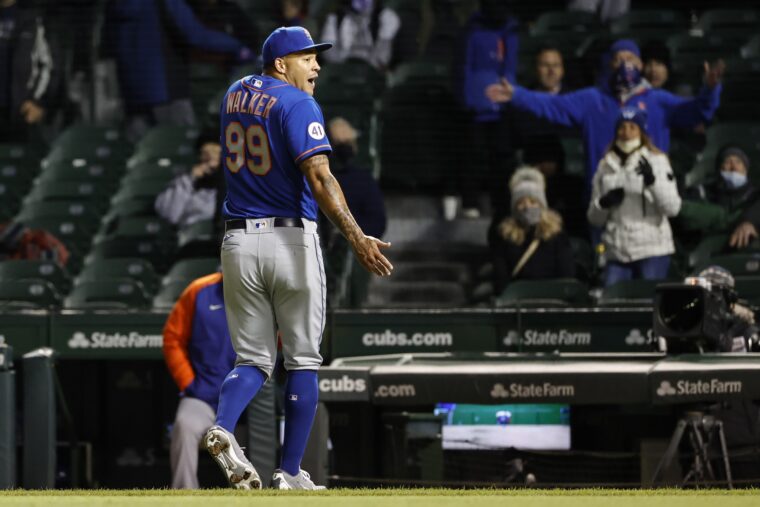
But after exiting the game, Walker did not go back to the dugout quietly. Walker voiced his frustrations by barking at home plate umpire, John Libka, on his way off the mound. This caused Walker to get ejected from the game, despite his night being over regardless.
Even with Walker gone, that didn’t stop Rojas’ own frustrations from boiling over two innings later. In the sixth inning, Rojas was ejected for arguing balls and strikes as he was clearly still unhappy with the strike zone Libka established.
And to no surprise, Rojas did not hold back regarding his displeasure with the umpire after the game.
“Personally, I felt Taijuan got squeezed a little bit by the home plate umpire,” said Rojas. “It’s tough when you are not getting some calls.”
While it was fair to question whether Walker became fatigued in his final inning, Rojas did not think that was the case, citing the calls that went against him.
As for Walker, the pitcher would not take the same route as his manager in criticizing the umpire. Instead, Walker put the blame on his own command of the zone — or lack thereof.
“Honestly I think I was just frustrated with myself. Six walks is never good. After the third inning, I kind of just lost control of the strike zone,” said Walker. “My fastball command wasn’t there and I just wasn’t getting ahead.”
To Walker’s defense, it’s not an easy task to pitch in the conditions he dealt with on a frigid night at Wrigley Field, which saw a game time temperature of 36 degrees.
However, Walker refused to blame the cold weather on his performance.
“It was definitely cold. You always try to block that out, it was a cold night. But as a pro athlete I need to learn how to block it out and go out there and do my job,” added Walker.
Walker gave up three total runs, with only two of them being earned due to a J.D. Davis throwing error, which led the to the Cubs’ first run. Walker lasted just 3 2/3 innings as walks killed him and jacked up his pitch count on the night.
Despite an early exit from their starter and manager, the Mets had plenty of chances to come back in this contest, but once again, the offense failed to come through with runners in scoring position going 1-for-6, while leaving 10 runners on base.
The Mets loaded the bases with one out against Cubs closer Craig Kimbrel in the top of the ninth, but Brandon Nimmo struck out and Francisco Lindor grounded out on the first pitch he saw to strand the tying and go-ahead runs on base.
While the Mets’ lineup has not lived up to expectations thus far, according to Davis, they are not beating themselves up over it because there is still a lot of season left to be played.
“No one’s frustrated. If it was a 60-game season (sure), but it’s a 162-game season. It is what it is and at the end of the day, it’s just one of 162,” said Davis.
“It’s back to the timing part. It’s making us be late on pitches we should hit. It’s going to come around, you feel it, you know these guys and know how they work. We created a couple chances with runners in scoring position we just couldn’t come through,” added Rojas.
The Mets will be back at it in Game 2 against the Cubs on Wednesday night at 7:40 pm ET with David Peterson on the mound. Peterson is coming off a gem versus the Phillies last week, where he matched a career-high with 10 strikeouts and is hoping for a similar outing in his first career start outside of the eastern time zone.