
Credit: Bill Streicher-USA TODAY Sports
The Mets dropped two of three to the Philadelphia Phillies in their first series of the year.
Please take everything you’re about to read with red SMALL SAMPLE SIZE plastered to your screen like you’re reading a classified document. In the name of Space Jam, I need Daffy Duck to stamp SMALL SAMPLE SIZE on the forehead of anyone who makes too big a deal out of anything that happened during these three games alá Michael Jordan when he was branded A-OK by a cartoon.
Michael Conforto knows he and the team struggled, but they’re not going to overreact. “I don’t think any of us are very worried over what happened,” he said (via Tim Britton) following the series. “But we’re well-aware we didn’t play very well, top to bottom.”
If the trends we’re seeing today are still there a couple weeks from now, then we can get excited (or disappointed, whichever you choose to be today).

Mandatory Credit: Bill Streicher-USA TODAY Sports
3 Up
Pete Alonso Kicks off MVP campaign
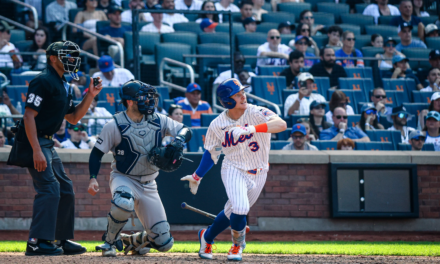
Pete Alonso’s spring training gave fans something to nibble on as Opening Day rolled up. He had a 1.211 OPS with four home runs and 16 RBI in 50 at-bats during March. He showed no signs of slowing down in the first series of the year, going 4-for-13 with a home run and three RBI.
Alonso said during the spring he wanted to win a Gold Glove Award this year, too. His defense during the first series was solid with a couple flashy diving plays and double play turns, albeit with a throwing error that resulted in a run. His comments were pointed regarding his defense after the second game of the series. “I’m a man on a mission,” he said.
If his play at first can remain a non-negative and his offense returns to 2019 form, we’re talking about a sure-fire MVP candidate.
Leadoff hitter Brandon Nimmo
One of the more puzzling events of the first series was seeing Brandon Nimmo batting eighth in the lineup in the Mets’ first game of the year. Sure, Matt Moore, a lefty, was pitching, but Moore isn’t known to dominate lefties more than righties. Run production has been an issue in Jacob deGrom starts since two Cy Young Awards and a haircut ago, so it was odd to see Kevin Pillar leading the lineup card rather than one of the best run creators in the majors.
Nimmo took it in stride, as he always does, and went 1-for-3 with a walk in game one. He was placed at the top of the lineup for the final two games of the series and had four walks, three hits, two runs and a stolen base in those two games.
He’s sitting at a .333 BA and a .667 OBP through three games. The Mets should look into keeping one of the best run creators at the league at the top of the lineup, no matter the handedness of the opposing pitcher (who’s usually out after two or three at-bats anyway) rather than ahead of a pitcher.
Miguel Castro‘s changeup
There wasn’t much positive to talk about with the bullpen (as we’ll discuss in a moment), but Miguel Castro’s “stuff” looked good–particularly his changeup.
He threw 12 changeups over his first two appearances. He averaged an insane 92.4 miles per hour on the pitch with a 50 percent whiff percentage. In 2020, Castro had the second-fastest average changeup speed (92.3 mph) behind Edwin Diaz and just ahead of Jacob deGrom.
After only throwing one change in his first appearance (it resulted in an out), he boosted that number to 11 in the second appearance to wonderful success. All three outs from his second appearance came on the pitch (two swinging strikeouts and a Bryce Harper fly out).
If Castro can harness his fastball/sinker control at 99-100 mph and have a 93 mph changeup that moves down and away to contrast it, the 26-year-old can become a lynchpin of the Mets bullpen.

Mandatory Credit: Mary Holt-USA TODAY Sports
3 Down
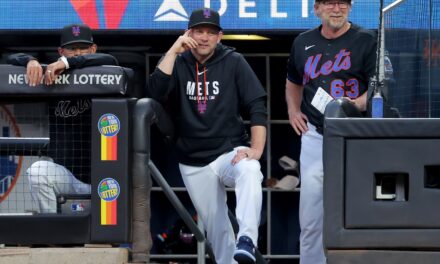
Luis Rojas‘ Managerial Decisions
It’s not great when half a dozen of a manager’s decision come into collective question in the first series of the year. Some of these include:
- Not starting Dominic Smith in game one
- Not pinch hitting Smith for Kevin Pillar when a righty reliever entered the game in game one during the fourth inning with a 2-0 lead
- Not pinch hitting Smith at all during game one, even during a 9th inning with an erratic Jose Alvarado on the mound
- Pitching Miguel Castro and Trevor May for a second day in a row when up 6-1
- Starting David Peterson against a team that beat him up for his only lackluster start in 2020 rather than a weaker Marlins offense Thursday
Sure, you can chalk up some of the initial lineup qualms to the fact front offices nowadays often have most, if not all, of the input on how the game starts. But once the game is under way and the front office is out of it, Rojas had more than his fair share of questionable decisions.
With a new regime and a contract that expires at the end of the year (if the Mets want it to), Rojas will be under a microscope during the game and certainly afterward when he explains his decisions. It’s something to keep an eye on as Rojas manages his first full year as a big-league skipper.
The Bullpen
I mean we’ve known this. It was a question going into 2020. It was a question coming into 2021. (Granted, it was something we hoped wouldn’t be a question this year, but then Seth Lugo needed surgery a week into the spring and Drew Smith started the year on the IL)
The bullpen covered a total of 10 innings this series. They gave up 10 runs, six of them earned. Take out Joey Lucchesi‘s two shutout innings at the end of an 8-2 loss, and that’s 10 runs in eight innings.
In a normal series, we may point out a single reliever who’s on a downward trend (or upward trend! We keep it positive here, too), but this series was uneasy for just about everyone involved.
Trevor May and Aaron Loup combined to blow Jacob deGrom’s first start of the year. (Researchers will analyze deGrom’s blood for what I assume is a natural numbing agent that develops when you place your fate in other peoples’ hands and are let down too many times.) May returned for game two along with Miguel Castro to pitch a tense couple innings before bad lucked arrived at the hands of Jeurys Familia with some weakly hit balls that turned into runs.
Then Jacob Barnes, who the Mets are high on to contribute to the ‘pen, gave up a three-run home run on his first pitch of the year in the final game of the year. Dellin Betances continued his stretch of uninspirational relief appearances dating back to spring training as well, allowing the final of 10 bullpen runs this series.
I might have to stamp myself with a SMALL SAMPLE SIZE on this one. Good teams and bullpens can have a bad series. Not-so-good teams see this repeat every other series.
Third Starter David Peterson
Peterson had a fine rookie year, but I think the fact he was the second best pitcher on the Mets last year may have skewed a casual fan’s expectations for Peterson for 2021.
The 25-year-old still needs time to figure out what works for him (hint: that slider) and what doesn’t, and he also needs to figure out when the good stuff is working, when to mix it up in game, how to miss bats and all the things it takes young pitchers years–not a dozen starts–to figure out. The final game of the series, though, was a reminder that he’s still working those things out.
For example, his slider was working for him most of the game, so he relied on it in innings two through four as he settled in. Overall Wednesday, he had a 48 percent whiff rate on the pitch. This is a great number. Experienced hitters like Rhys Hoskins and Bryce Harper sat on it the third time through the order, though, and connected for hits, ultimately driving Peterson from the game.
Peterson will be a fine back-end of the rotation guy as he figures these things out. Until then, he’ll probably have starts like Wednesday’s every once in a while as smart hitters get to him.