
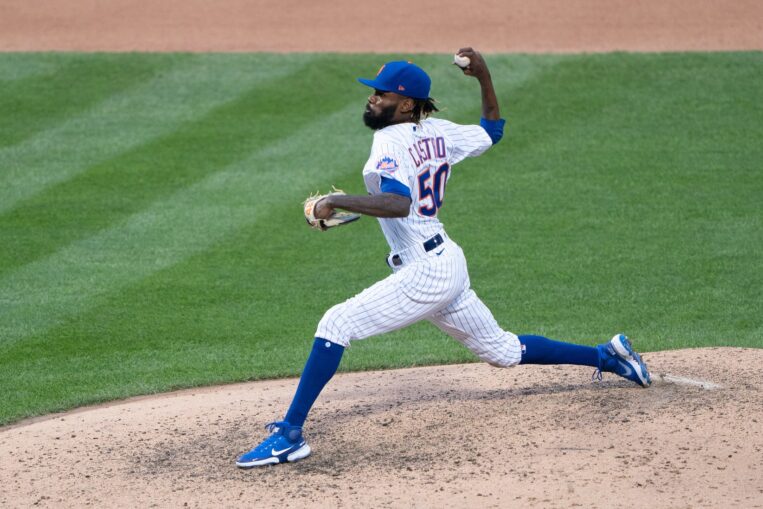
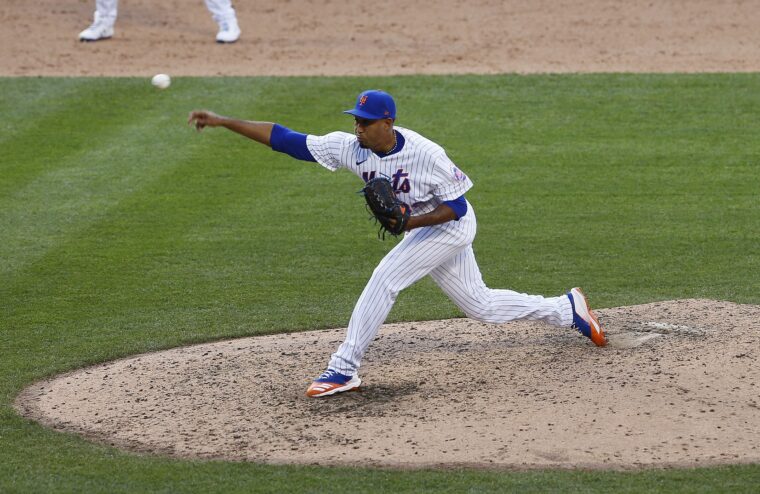
In all the hoopla of Major League Baseballs’s annual trade deadline, it’s easy for smaller scale deals to not generate tons of headlines. The New York Mets’ last-minute acquisition of Miguel Castro from the Baltimore Orioles would certainly fall into that category.
Despite that, could the 26-year-old play an important role in manager Luis Rojas’ bullpen in 2021? With a surge in strikeouts and his powerful arm pumping upper-90s fastballs with ease during the shortened 2020, that’s a possibility.
These Need To Be Better
Castro only logged nine innings with the Mets, so it’s hard to make concrete observations with such a small sample size. However, we can still point some things out that must improve with more perceived opportunity to toe the rubber this upcoming season.
With a 7.1% walk rate with the Orioles prior to getting traded, Castro was on track to post a career-best mark in that category. Until he joined the Mets, of course. This percentage will be exaggerated because of the small number of innings pitched, but regardless, it’s still eye-popping to see a 17.8% walk rate in his first action in the orange and blue. Castro somehow posted a slightly better ERA with New York (4.00) than he did with the Orioles (4.02) despite an uptick in BABIP (.378 to .455), along with a downturn in both ground-ball rate (55.0% to 43.5%) and strand rate (85.1% to 79.5%).
The above numbers get easier to maintain/improve upon when a hurler limits his walk rate. While it’s not the cure to everything, an easy way to get oneself moving in the right direction is getting more first-pitch strikes. He was doing this at a career-best rate prior to the trade (68.6%) before watching the number fall off a cliff with his new squad (48.9%). Watching Castro return to that above number with Baltimore would be cool, but simply landing closer to his career average of 55.9% would put him on a solid path moving forward.
A Good Quality to Share
What grabs the attention of most about Castro is his fastball velocity. That’ll happen when you’re tossing baseballs with an average velocity of 98.1 mph like he did last season. This isn’t where he does most of his damage against opposing hitters, though. When looking at a handful of metrics for his sinker, the results haven’t exactly looked dominant. Here’s how his walk rate, strikeout rate, and wRC+ allowed have progressed since 2017:
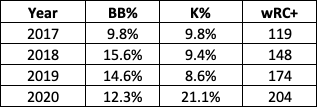
He experienced a nice jump in strikeout rate while slowly lowering that walk rate, but the overall production from opposing hitters has consistently been on the rise. That’s why the performance of his slider and changeup are crucial to his effectiveness on the mound. This is also where the similarities with Edwin Diaz come into play.
Castro posted a career-high 33.0% strikeout rate between Baltimore and New York last season, which was more than 10 percentage points higher than the year prior (22.3%). The shortened season obviously helped out here, but this is a trend the right-hander has been working on since logging 60-plus innings for the first time in 2017. That year, he posted a 13.9% strikeout rate, which he improved slightly to 15.2% the following year before registering that 22.3% mark in 2019.
This consistent rise can be attributed to the increased effectiveness of his two secondary pitches. Check out how his walk rate, strikeout rate, and wRC+ allowed has progressed since 2017 for each. First, here are the results for his slider:
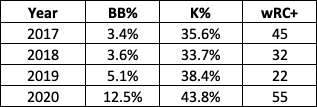
And here are the results for his changeup, which is quite the eye-popping progression:
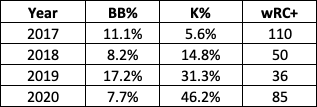
So, where exactly does Diaz come into the picture? I’m glad you asked. When looking at Castro’s pitch-by-pitch breakdown, what jumped out at me was that both his slider and changeup produced a strikeout rate north of 40.0%. That got me thinking as to whether or not any other Mets relievers did that in 2020.
I limited my search to Mets relievers currently on the active roster with at least 10 innings pitched last season. This gave me nine dudes to look at: Diaz, Castro, Trevor May, Jacob Barnes, Seth Lugo, Brad Brach, Franklyn Kilome, Jeurys Familia, and Dellin Betances. The only one of this bunch to join Castro with a strikeout rate above 40.0% for two different pitches? You guessed it: Diaz. However, May comes in a close second with a 46.3% strikeout rate on his four-seamer and a 38.9% rate on his slider. Nobody else got particularly close.
Moving Forward
Does this type of similarity hold any particular significance? Well, probably not, but it’s nice to see an under-the-radar arm like Castro accomplish something like this at the same level as Diaz, who was easily the Mets’ most valuable reliever in 2020.
Entering his first full year with the organization, which will lead to spending more time with pitching coach Jeremy Hefner and others in Port St. Lucie will hopefully help the young right-hander take a significant step forward in New York’s bullpen. Judging by his yearly fWAR numbers, he’s already trending in the right direction. Through his first four years in the big leagues (185 innings pitched), he accumulated -0.7 fWAR. Over the past two seasons (98 innings), he’s gotten himself back to zero by amassing 0.7 fWAR.
While the front office is still on the hunt for more external bullpen upgrades, they’d gladly take some kind of breakout from the 26-year-old Castro.