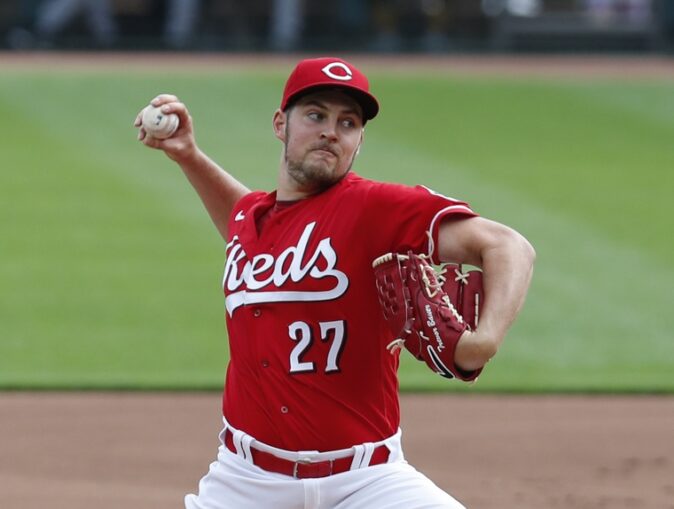
Trevor Bauer picked the perfect year to win a Cy Young award.
Even with all the weirdness that COVID brought to MLB in 2020, he leveled up his performance in a big way, seemingly setting himself up for a life-changing contract this winter. He earned every bit of it, too. In addition to being among the league leaders in fWAR (2.5) and ERA (1.73), he also ranked within the top 3% of baseball for advanced statistics like xBA, xSLG, wOBA, xwOBA, and more, according to his Statcast profile.
When looking at his 2020 performance, naysayers will mention either of the following:
— It was a short season, he’s not that good.
— Of course he was that good, he only pitched against the NL and AL Central.
Is what he did sustainable over 30 starts? Who knows, but I hate the “well the hitters he faced aren’t good” argument. There still big-league hitters, and he still had to get them out, which he did at a ridiculous rate.
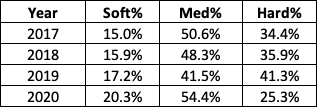
Among all the eye-popping stats he produced in what he’s likely hoping will be a career-defining year, his quality-of-contact numbers stand out to me the most. Through 73 innings of work, he produced a 20.3% soft-hit rate allowed and a 25.3% hard-hit rate allowed. Both of those ranked within the top five among qualified starters in 2020.
This would fit perfectly into what the New York Mets’ starting rotation has mostly done in recent years.
Fitting In With Mets’ Rotation
During the 2018 and 2019 season, the Mets’ starting staff — led by Jacob deGrom, duh — ranked among the best in baseball. In 2018, their collective fWAR of 18.0 was third best (best in the NL). They once again were MLB’s third-best rotation in 2019 (third best in NL) with an even better 19.7 fWAR.
The majority of the fWAR production came from the top of the rotation: deGrom, Noah Syndergaard, and Zack Wheeler. Coincidentally enough, all three of them ranked among the league’s best in both soft-hit rate and hard-hit rate allowed each year.
Here’s how the rotation’s numbers sussed out in ‘18 and ‘19, along with the league rank:

Although the percentages only shifted slightly in 2020, New York’s time at the top of the league in these categories ended, and for a number of reasons.
DeGrom was still deGrom, but Marcus Stroman opted out, Wheeler played in Philadelphia, and Syndergaard was rehabbing from Tommy John surgery. Investing in a catcher with a good defensive reputation like James McCann will certainly help, as will shoring up the defense behind the pitching staff (*cough* George Springer *cough*).
What will also be helpful, though, is bringing in a pitcher or two who has a handle on controlling contact from opposing hitters, like Bauer did this past year.

Big Improvement for Bauer
Bauer’s quality-of-contact numbers show a rather substantial improvement over the past few years. His soft-hit rate allowed hasn’t been that high since 2015 with Cleveland, and his hard-hit rate allowed hasn’t fallen below 30.0% in a single season since 2014.
Looking at these categories from 2017 to 2020, we can see that his hard-hit rate continually increased before this past season. However, his soft-hit rate kept improving after producing a career-low 15.0% mark.
While his 2020 numbers will be a little skewed because of uneven sample sizes, the rest of his batted-ball profile shows a consistent rise in infield-fly rate over the same period of time.
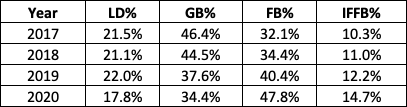
A drop in line-drive rate likely helped necessitate the substantial drop in hard-hit rate. How sustainable is it, though? Was it just some good fortune?
Helped By A Shift in Pitch Mix
Since 2017, there have been a couple of trends within Bauer’s pitch mix: a rise in sliders and cutters, along with a drop in curveballs. It’s interesting to see his changeup basically become non-existent in 2020, too.
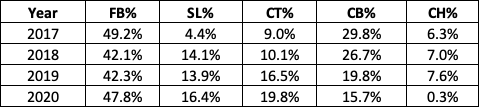
His slider especially stands out because FanGraphs gave it a 3.99 value on a per-100-pitch basis — the best among starters this past year. In seeing this type of shift, I was curious as to how the quality of contact shifted on a per-pitch basis between multiple seasons. Here’s how the breakdown looks for Bauer’s slider over the last couple years:

And here’s the breakdown for his cutter:

It’s pretty clear that these two offerings helped the right-hander take his game to another level in 2020. Bauer is also a pretty cerebral pitcher, and it appears that his wisdom and physical talent may be intersecting at the right time. Controlling opposing hitters’ quality of contact and increasing his slider/cutter usage would all blend in nicely with what the Mets’ rotation has shown us in recent years.
Adding that kind of skill set to New York could be a huge help in getting the starting staff back towards the top of baseball after failing to do so this past season.